Most SaaS content programs are quietly losing money. The blog publishes "what is X" head-term posts that pull six-figure monthly traffic, the team celebrates the dashboard, and the trial-start curve barely moves. Meanwhile a single category of pages — the kind almost no SaaS team prioritises — is converting at 5-10× the average rate, and most companies don't even own those URLs. They've been ceded to G2, Reddit, and competitors.
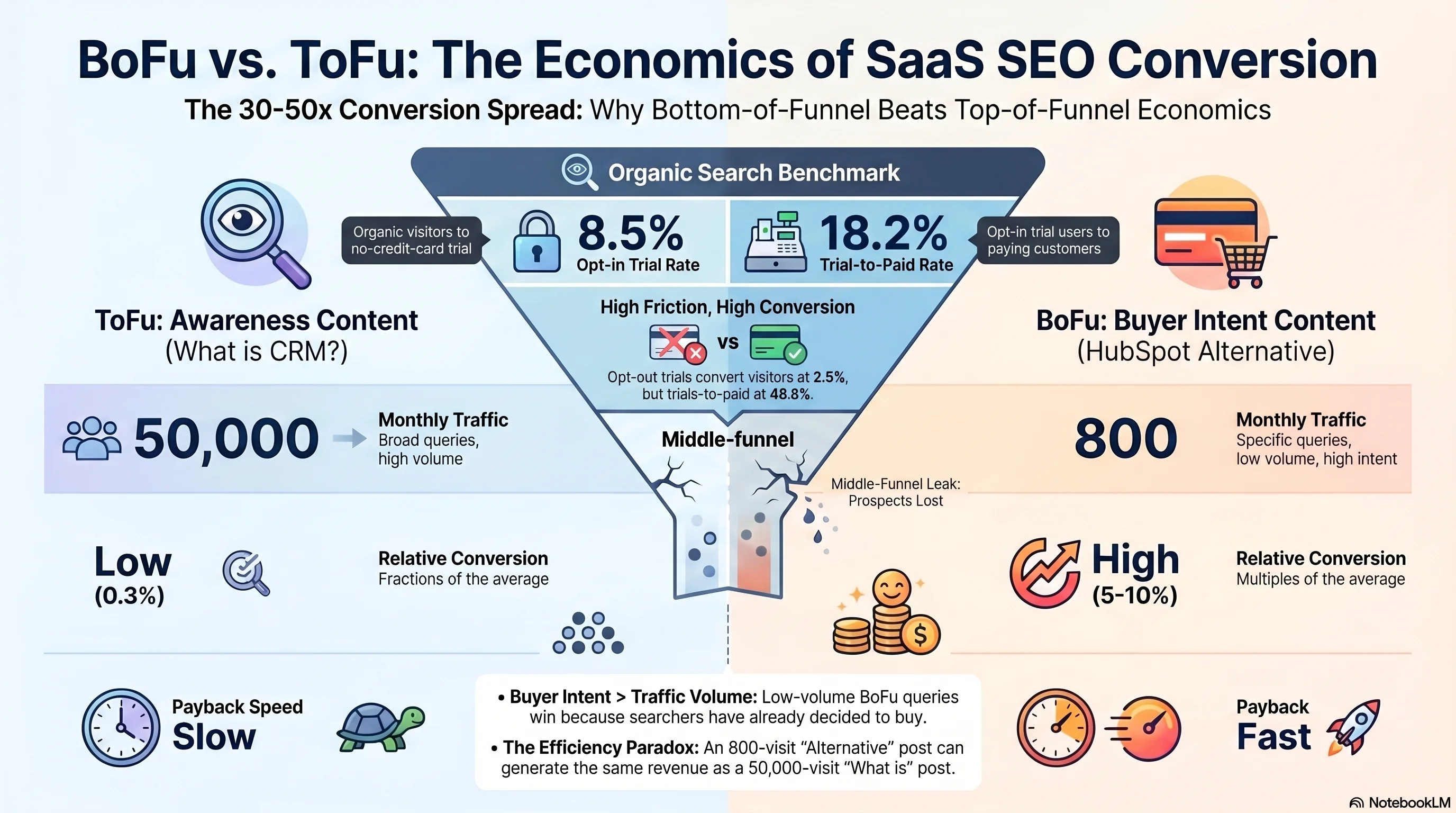
The pattern shows up cleanly in First Page Sage's SaaS Free Trial Conversion Rate Benchmarks, the most-cited dataset in B2B SaaS — 86 companies, 71% B2B / 29% B2C, tracked from Q1 2022 through Q3 2025. Their headline number is that organic search converts visitor → opt-in free trial at 8.5%, and trial → paid at 18.2%.[1] That sounds healthy until you look at what's hiding inside the average: bottom-of-funnel pages convert at multiples of that rate, and informational head-term posts convert at fractions of it. The benchmark is a blend. Most teams write only the wrong half.
This guide is the SaaS-specific SEO playbook synthesised from the operators who actually built the moats: Tim Soulo's Ahrefs (which crossed $100M+ ARR bootstrapped, with a ~10-person marketing team, in roughly seven years[8]), Zapier's programmatic /apps/ directory (25,000+ templated pages, ~15% of total organic traffic[2]), HubSpot's free-tool moat (Website Grader: 10M+ leads since 2007[3]), and the documentation-as-SEO pattern that Stripe, Vercel, and Linear quietly run as their primary acquisition channel. Every number below has a citation. Every case study has a name.
The BoFu/ToFu Economics Gap
Why most SaaS content programs are leaking sign-ups into the dashboard
The fundamental error in SaaS SEO is treating organic traffic as a single, uniform thing. It isn't. A "what is project management software" reader and a "Slack + Notion integration" reader are two completely different humans, with different intent, different time-to-purchase, and different propensities to ever swipe a credit card. First Page Sage's benchmark — visitor → trial at 8.5% from organic — is an average across both. The average hides a 30-50× spread.
The same dataset shows the conversion mechanics from a different angle: opt-in trials (no credit card required) convert visitor → trial at 8.5% but trial → paid at only 18.2%; opt-out trials (card required up front) convert visitor → trial at just 2.5% but trial → paid at 48.8%.[1] Higher friction at the top, higher conversion at the bottom. SaaS founders fight this trade-off endlessly. The point for SEO is simpler: which kind of trial each page drives matters more than total traffic.
SaaS Trial Conversion by Channel
First Page Sage, SaaS Free Trial Conversion Rate Benchmarks (86 companies, Q1 2022 – Q3 2025)[1]
Organic beats paid on both opt-in and opt-out trial conversion. The interesting part is the right-side number First Page Sage publishes alongside these: opt-in trial → paid converts at 18.2%, opt-out trial → paid at 48.8%. The opt-out trial filters for buyers; opt-in invites everyone, including the curious.
Eli Schwartz, whose book Product-Led SEO is the canonical operator reference in this space, frames the failure mode in one line: "If your main goal is driving traffic, you are leaving sales on the table."[9] The Animalz team makes the same point from the measurement side: "Measuring traffic alone will lead you to believe that bottom of the funnel content isn't useful."[6] Both authors are converging on the same conclusion from different angles — the BoFu queries are smaller in volume but enormously more valuable, and traffic-as-KPI structurally underweights them.
The fatal mistake in one sentence
The Growigami framing of this — based on an audit pattern across dozens of SaaS marketing teams — is even more direct: "They produce content for Stage 1 (blog posts) and Stage 4-5 (pricing page and demo page) and nothing in between. The middle of the funnel is empty, which means prospects who are interested but not ready to buy have nowhere to go — so they leave."[12] If you've ever wondered why your blog has traffic but your sales pipeline doesn't, this is usually the reason.
The Six BoFu Keyword Shapes That Actually Drive Sign-Ups
The durable patterns where the searcher has already decided to buy something
Bottom-of-funnel SaaS keywords aren't an art form. There are six recurring shapes, all of which assume product-category awareness — the searcher has skipped past "what is X" and is now sub-deciding among instances. The six shapes are the entire BoFu playbook. Everything else is a variation.
| Keyword shape | Example | Why it converts | Intent |
|---|---|---|---|
| [Product] + [other tool] integration | "Slack + Notion integration" | User is mid-setup and Googling the exact thing they need. Zapier's entire /apps/ moat is built on this shape. | BoFu |
| [Competitor] alternative | "Mailchimp alternative" | Captures churn-considering buyers. Kit (ex-ConvertKit) converts this query heavily; if you don't own the page, G2 does. | BoFu |
| [Us] vs [competitor] | "Linear vs Jira" | You will get compared whether you write it or not. Owning the page lets you frame the comparison honestly. | BoFu |
| [Product] pricing / [Category] pricing | "HubSpot CRM pricing" | Textbook bottom-of-funnel — the searcher already decided what to buy. Gating pricing hurts both SEO and conversion. | BoFu |
| Best [category] for [audience or use case] | "Best CRM for solopreneurs" | Long-tail commercial-investigation. Lower competition than head terms; the searcher has already self-segmented. | Mid-funnel |
| How to [verb] in [product] / how to [verb] [object] | "How to set up Stripe webhooks" | Reader has a task right now. You supply the answer using your tool — Ahrefs/Zapier specialty. | Mid-funnel |
Two things stand out about this list. First, none of these queries have impressive search volume in isolation — "Mailchimp alternative" sits in the low-thousands MSV range; specific integration queries like "Slack + Notion integration" might pull 200 MSV. Compared to "best email marketing software" (40K+ MSV), they look like a rounding error. The reason they win anyway is that the conversion rate compensates by an order of magnitude: a 5-10% trial-start rate from a 2,000-MSV BoFu page produces more sign-ups than a 0.3% rate from a 40,000-MSV ToFu page, and the BoFu trials are far more likely to convert to paid.
Second, the BoFu surface area scales with your product. Every new integration adds an integration-page slot. Every new competitor adds an alternatives-page slot. Every release with a new use-case adds a "best [category] for [use case]" slot. The BoFu library is a function of how much there is to compare, not of how clever your content team is.
Animalz on the BoFu measurement problem
Programmatic SEO at Industrial Scale
Turning one template into thousands of pages — the Zapier playbook
Zapier is the canonical case study in programmatic SEO, and the numbers explain why. The /apps/ integration directory is built from a single template stamped across every app in their catalogue (~7,000 apps) and then every plausible app-pair permutation. The result, according to figuringoutwithai.com's analysis, is approximately 25,000+ programmatic URLs delivering ~235,000 monthly organic visits — about 15% of Zapier's total organic traffic, from one templated pattern.[2] Demanzo's broader breakdown puts total Zapier organic at ~9 million monthly visits, with blog driving 67%, /apps/ driving 15%, and other surfaces (homepage, pricing, docs) covering the remaining 18%.[4]
Where Zapier's Organic Traffic Actually Comes From
Demanzo, figuringoutwithai.com (Ahrefs Site Explorer snapshots, 2025)[2][4]
The blog still does the heavy lifting — but the 15% from /apps/ represents the highest-converting subset of Zapier's organic traffic, because the user is mid-task and Googling exactly the thing they need to automate.
The mechanism is straightforward enough to repeat. Pick a structured-data axis that maps onto buyer intent (integrations, app-pairs, alternatives, locations, use-cases). Build one HTML template. Fill it with unique-per-page data — real workflows, real screenshots, real reviews — not Madlibs boilerplate. Interlink heavily. Let it compound.
The trap is exactly what makes most attempts fail: builders read "25,000 pages" and assume the play is to generate 25,000 templated pages first and worry about uniqueness later. That gets you a Helpful Content Update demotion. The figuringoutwithai.com analysis of Zapier is explicit about this — start with 50 pages, not 50,000. Pick the 50 most-searched intersections (top integrations × top use-cases × top competitor comparisons), build the template, fill each page with real content, prove the model works on those 50, then scale.
Surface: /apps/ integration directory (25K+ programmatic URLs)
Scale: 1 template × 7,000+ apps × app-pair permutations
Result: ~235K-280K monthly organic visits from /apps/ alone (≈15% of total Zapier organic)
Surface: Blog + /apps/ + workflows combined
Scale: ~9M total monthly organic visits (Ahrefs Site Explorer)
Result: Blog drives ~67% of total organic; programmatic /apps/ adds another ~15%
Surface: Website Grader (free tool, 2007)
Scale: Single page on hubspot.com/website/website-grader
Result: 10M+ leads generated since launch; #1 ranking for "website grader"
Surface: Headline Analyzer (free tool)
Scale: Single page
Result: Drives more organic traffic than the rest of CoSchedule's blog combined
Surface: Free SEO tools cluster (Backlink Checker, Keyword Generator, Website Authority Checker)
Scale: ~10 free tools at ahrefs.com/*
Result: Each ranks in the top 3 for its primary keyword; gateway to the paid Ahrefs suite
Surface: Template gallery (/templates) + help docs (/help)
Scale: Tens of thousands of templated pages
Result: One URL per use-case × industry × template; help docs rank for long-tail "how do I X in Notion"
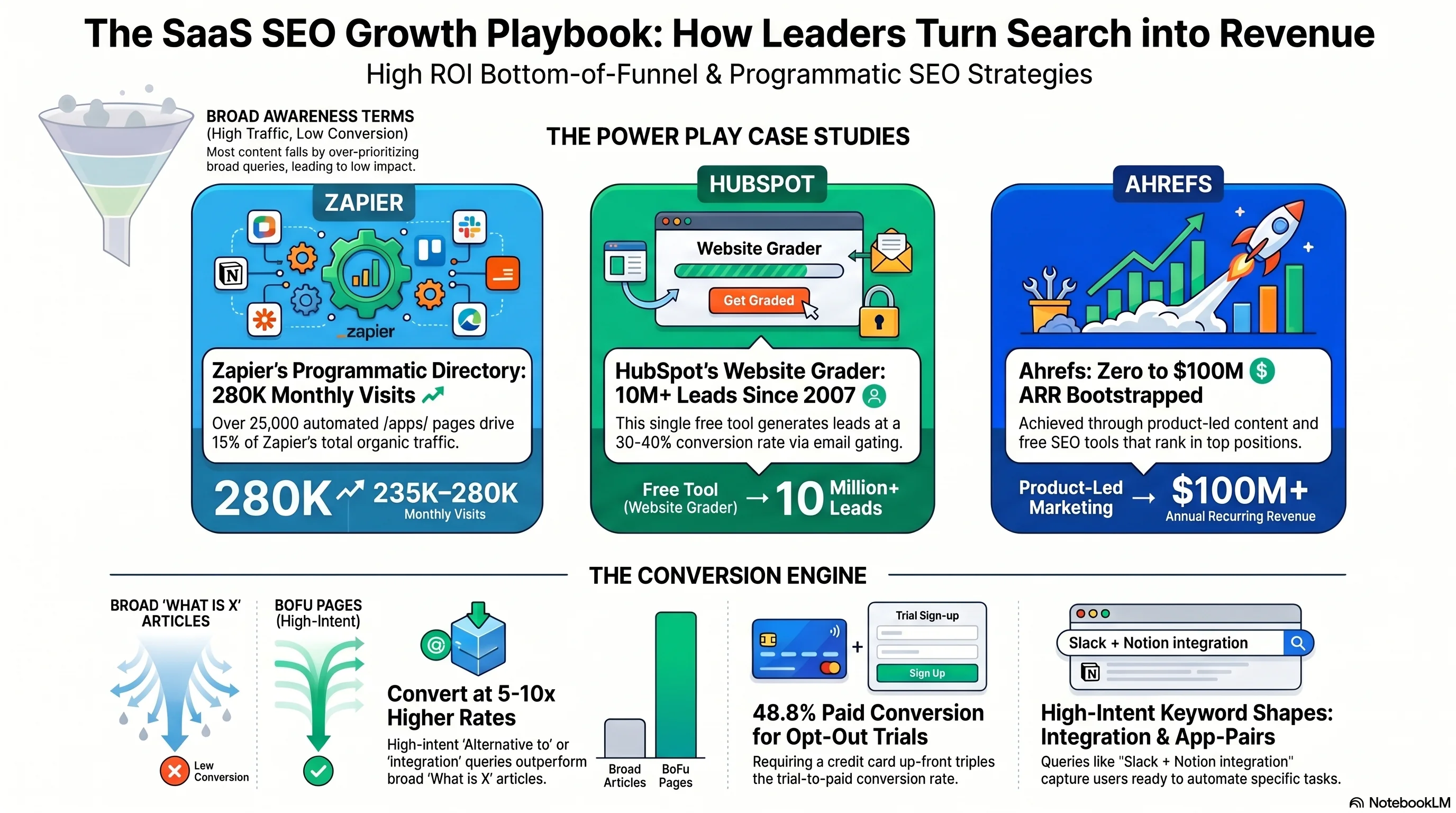
Matt Bowers, Zapier's former Head of SEO, framed why this surface area converts so efficiently in the demanzo writeup: "The expected conversion rate is high because the user is Googling exactly the thing they need to automate, and Zapier is right there with a free trial that does exactly that."[4] The integration-page query is sub-decision intent. The searcher isn't comparing categories; they're trying to wire two specific tools together. If your page is the first one Google surfaces and it actually solves their problem, the trial-start is nearly automatic.
Free Tools as Permanent SEO Assets
The pattern that produces compounding leads forever
Free tools are the most under-discussed lever in SaaS SEO, and the math behind them is unreasonable. HubSpot's Website Grader, built in 2007, has reportedly produced 10 million+ leads over its lifetime.[3] It is a single page. CoSchedule's Headline Analyzer drives more organic traffic than the rest of CoSchedule's blog combined.[3] Ahrefs' free Backlink Checker, Keyword Generator, and Website Authority Checker each rank in the top three for their primary keyword — and each is positioned, deliberately, as the amuse-bouche before the paid Ahrefs suite.[7]
The pattern works for three reasons that don't apply to blog posts. First, a tool satisfies search intent better than any article can. When someone Googles "headline analyzer," they don't want a definition of one; they want to use one. Google understands that and ranks the tool above any blog post about it. Second, tools accumulate backlinks more aggressively than articles because every blog post on the internet that wants to recommend a headline analyzer has a single best target to link to. Third, the email-gated full-result step (you see the score, but the breakdown is in your inbox) converts at 30-40% in HubSpot's data[3] — far above the 1-3% you'd see from a "download our ebook" CTA on the same traffic.
The practical rule from figuringoutwithai.com's HubSpot breakdown is: pick a keyword shape like "[thing] checker / analyzer / calculator / generator," build the minimum useful version (no accounts, no dashboards, no sign-up wall), host it on your main domain at /tools/[tool-name], and gate the full result behind an email. The minimum-useful-version part is critical. Website Grader scores a URL on five dimensions and shows you four of them inline; the full report needs an email. That's the entire UX. The whole thing fits on one screen. It has produced 10M+ leads.
Ahrefs on the SaaS-specific levers
Documentation as a SaaS SEO Moat
Why the docs site quietly outranks the marketing site
Open Ahrefs Site Explorer on docs.stripe.com, vercel.com/docs, or linear.app/docs. The pattern is the same at all three: docs pages rank in the top three for hundreds of long-tail implementation queries — "Stripe webhook signature verify in Python," "Next.js redirect with query params," "Linear API filter issues by label" — and quietly produce the steady drip of qualified developer signups that the marketing team would kill for. Stripe's docs have been the industry-cited gold standard for almost a decade. Vercel's docs double as the Next.js framework documentation. Linear's Method pages rank for engineering-process queries like "how to run a sprint" and "how to prioritize bugs" — top-of-stack queries that funnel adoption into Linear itself.
Specific traffic numbers for Linear, Vercel, and Stripe docs aren't publicly disclosed in clean form, but the pattern is documented in Ahrefs' own SaaS-SEO playbook as the canonical example of "turn your product into SEO content."[7] Four properties explain why it works:
- Docs exactly satisfy implementation intent. When someone searches "Stripe webhook signature verify," they don't want a blog post — they want runnable code. Docs deliver that natively; blog posts almost never can without going stale within a release cycle.
- Docs are owned, fresh, and deep. They're updated every release. A third-party blog post about your product goes stale the moment your API version bumps; your docs don't.
- Docs are unique surface area. No competitor can write your docs. The differentiation is built in. Programmatic SEO with no Madlibs problem.
- Docs compound on the main domain. Hosted at
yourdomain.com/docs, every backlink to a docs page lifts authority across the rest of the site. Subdomain docs (docs.yourdomain.com) work too but pass authority less cleanly.
The tactical note that matters: docs rank as a moat only if they're crawlable HTML with semantic URLs, descriptive H1s, and outbound links to related docs. SPA docs that render content client-side often underperform because Google's renderer treats them as thin pages. Stripe's docs are pre-rendered with high <a> density inside paragraphs — that's the model.
Fatal Mistakes & The Publishing Cadence Problem
The eight failure patterns — and the operating gap most teams can't close alone
The eight mistakes below appear in roughly this order across every SaaS SEO audit. None of them are exotic. They are the default state of most SaaS content programs because each one corresponds to a path-of-least-resistance decision the team made at some point and never revisited.
Chasing "what is X" head-term volume
Critical1.4K MSV on "what is project management software" — every reader is a competitor or a student. Animalz, First Page Sage and Eli Schwartz all converge: this volume rarely converts.
The empty middle of the funnel
CriticalStage-1 blog posts and stage-5 demo pages, with nothing connecting them. Interested-but-not-ready prospects have nowhere to go and leave. Growigami's framing: "the middle of the funnel is empty."
Ignoring competitor comparison surface
HighIf you don't write "[you] vs [competitor]," a review-aggregator (G2, Capterra) or your competitor will. They own the click for that searcher; you don't.
Gated PDFs on top-of-funnel content
HighTrades brand trust for a junk email. Modern best-practice (Ahrefs, Animalz): publish ungated, capture via newsletter and free-tool email gates instead.
Measuring traffic, not activated trials
HighAnimalz on BoFu measurement: "Measuring traffic alone will lead you to believe that bottom of the funnel content isn't useful." The right metric is qualified-trial-starts attributable to the page.
Programmatic SEO with no unique data
High10,000 templated pages with the same 50-word boilerplate gets you demoted by the Helpful Content Update. Zapier wins because each integration page has real workflows, not Madlibs.
Pricing-page gating or "contact us"
MediumHurts both SEO ("[product] pricing" gets no answer) and conversion (friction at the moment of intent). Transparent pricing pages rank for branded BoFu and remove a buying barrier.
Outsourcing to agencies that write definitions
MediumResult: 200-word ToFu listicles ranking #14 on Google. Eli Schwartz: "If your main goal is driving traffic, you are leaving sales on the table."
The pattern across every fix is the same: SaaS SEO is a content-volume problem disguised as a strategy problem. Once a team knows that BoFu wins, that programmatic /apps/ pages compound, that free tools are permanent assets, and that docs rank — the remaining question is can we actually ship the content? Most teams can't. The Ahrefs blog grew from 15K to 250K monthly visitors under Tim Soulo with a marketing team of about ten people[10] — most SaaS marketing teams are one or two people, and they spend half their week on swag and launch emails.
This is where the cadence problem turns from a content question into an operating question. A SaaS marketing org of one or two people can't realistically ship the 50 BoFu pages, the integration directory backbone, the free-tool launches, and the documentation expansion in parallel — let alone in five languages. Something always slips. Most often, it's the BoFu pages, because they're the least fun to write and they don't make the team look smart in the Slack channel.
Where News Factory fits the SaaS SEO playbook
Whatever you use to actually ship the content — an in-house writer, a freelancer pool, an AI-assisted pipeline like News Factory, or some hybrid — three principles apply equally to a SaaS SEO program in 2026:
- Write for intent, not for word count. A 900-word integration page that solves the user's exact problem outranks a 4,000-word "ultimate guide" that pads with platitudes. Length is a side-effect of doing the work, not a target.
- Internal-link every post into trial pages. Two to four links per article, going to the relevant integration page, alternative page, or pricing page. A BoFu post with no path to trial is a leaky funnel by design.
- Refresh, don't just publish. The "Best [category] for [audience]" posts that ranked once will rank again with a 30-minute update — new tools added, updated pricing, current screenshots. Most "old content" needs editing, not replacing.
The SaaS companies that win the next decade of organic acquisition won't be the ones with the slickest content marketing manifesto. They'll be the ones whose integration pages match every plausible app-pair, whose alternatives pages outrank the review aggregators, whose docs site quietly rivals the marketing site for organic traffic, and whose publishing cadence quietly compounds — month after month, post after post — into a content moat the competition can't match without re-running seven years of work.