The SEO Landscape in 2026
What changed, what matters, and why small businesses have an unexpected advantage
If you run a small business and the last time you thought about SEO was "put some keywords on the page," you're working with a map from 2015. The terrain has completely changed.
Google's December 2025 core update folded its Helpful Content system directly into the core ranking algorithm [1]. That means E-E-A-T — Experience, Expertise, Authoritativeness, and Trustworthiness — isn't a separate filter anymore. It's baked into every ranking decision Google makes.
The 2026 algorithm updates doubled down on two things: enhanced content quality evaluation and better AI spam detection [2]. Google got significantly better at telling the difference between generic content cranked out at scale and genuinely useful stuff written by people who know what they're talking about.
Here's what that means for you: keyword stuffing is dead. Buying 500 thin blog posts on Fiverr is dead. But if you're a roofer who actually replaces roofs, a bakery owner who actually bakes, or an accountant who actually does taxes — you have something the big content farms can never fake. Real experience.
The March 2025 update specifically penalized generic content and rewarded helpful, experience-based content [3]. That pattern accelerated through 2026. And it creates a structural advantage for small businesses willing to show up and write about what they actually do.
The Big Shift
But SEO in 2026 isn't just about writing good content. It's a system with moving parts: technical performance, local signals, publishing consistency, and smart budget allocation. Let's walk through each one — starting with the most overlooked money mistake small businesses make.
Organic vs Paid: The Numbers Don't Lie
Why most small businesses are burning money on ads they don't need
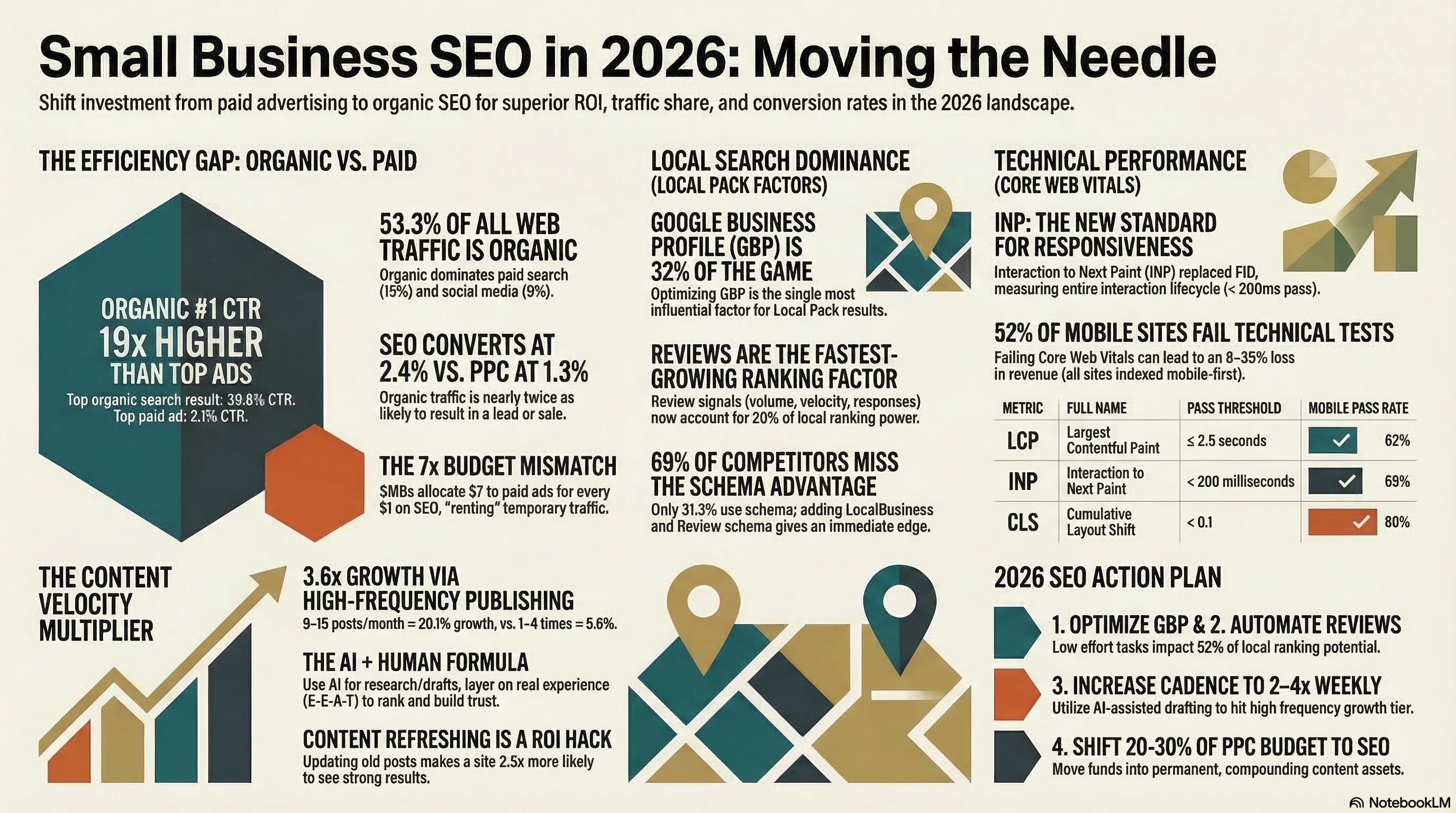
Let's talk about the elephant in the room. Small to medium-sized businesses invest seven times more in PPC campaigns than in SEO [7]. Seven times. And yet, organic search delivers 53.3% of all trackable website traffic — dwarfing paid search at 15% and social media at 5% [5].
That's like spending $7 on lottery tickets for every $1 you put in a savings account.
Click-Through Rate: Organic vs Paid
Organic position #1 gets nearly 19x the clicks of the top ad — Source: First Page Sage 2025
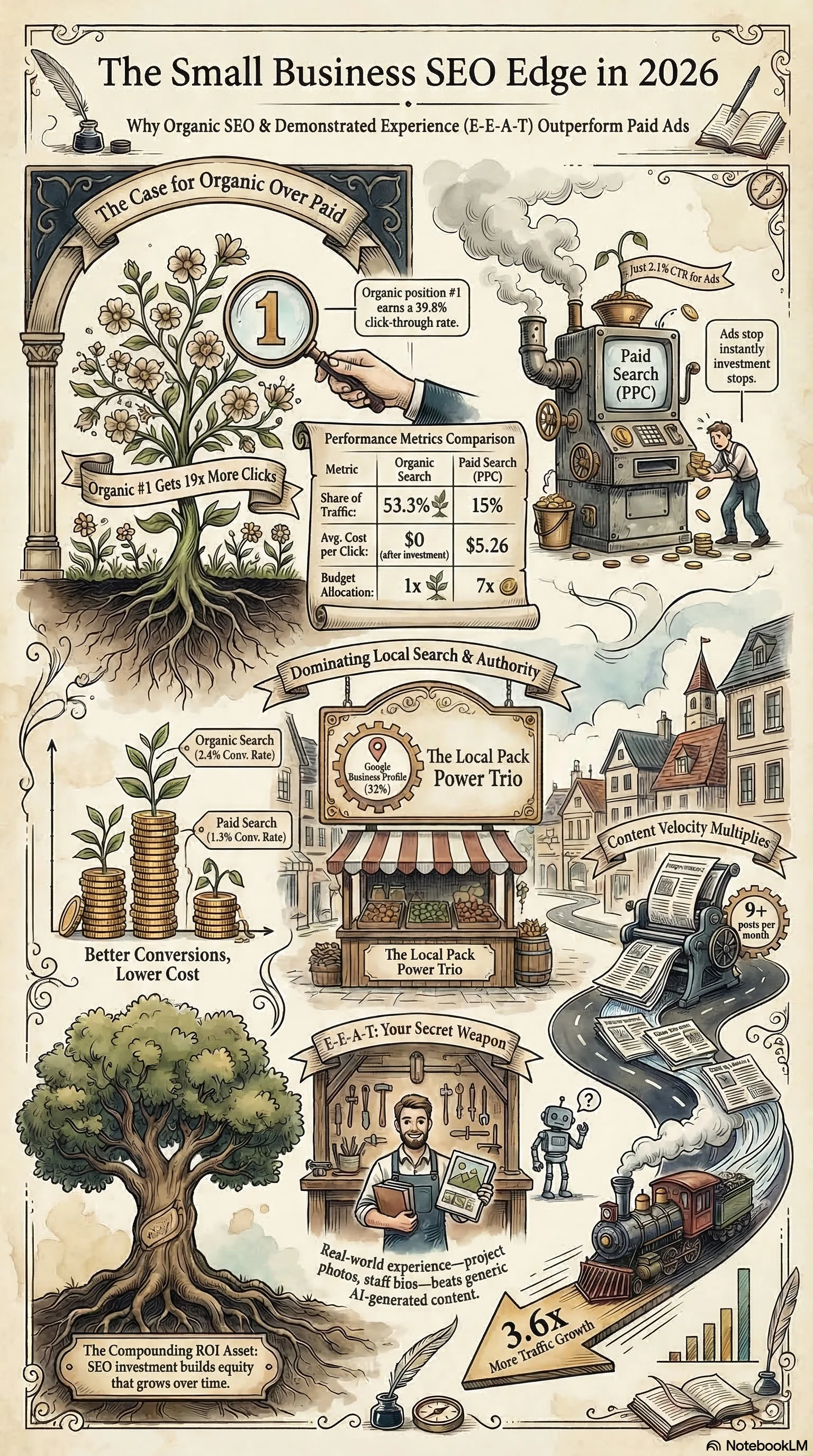
Look at those numbers. Organic position #1 gets a 39.8% click-through rate. The top paid ad? Just 2.1% [6]. Position #2 organic still pulls 18.7%, and position #3 gets 10.2%. Even the third organic result gets five times the clicks of the top ad.
And it gets worse for PPC. The average Google Ads cost per click in 2025 hit $5.26, with costs rising for 86% of industries [8]. So you're paying more per click, for clicks that convert at a lower rate. SEO advertising converts at 2.4% — nearly double PPC's 1.3% conversion rate [7].
The PPC Trap
Organic vs Paid: Head-to-Head
Across every meaningful metric, organic search wins for small businesses
| Metric | Organic | Paid | Source |
|---|---|---|---|
| Click-Through Rate (Position #1 vs Top Ad) | 39.8% | 2.1% | First Page Sage 2025 |
| Share of All Website Traffic | 53.3% | 15% | BrightEdge 2025 |
| Conversion Rate | 2.4% | 1.3% | Sagapixel / FirstPageSage 2025 |
| Average Cost Per Click | $0 (after investment) | $5.26 | WordStream 2025 |
| Long-Term ROI | ~25% higher | Baseline | Sagapixel 2025 |
| SMB Budget Allocation | 1x | 7x | Sagapixel 2025 |
I'm not saying kill your ad spend entirely. PPC has its place — launching a new product, targeting high-intent bottom-of-funnel searches, or running seasonal promotions. But if PPC is your entire digital strategy, you're renting when you should be building equity.
The smartest move for most small businesses: take 20-30% of your PPC budget and redirect it into SEO. You'll feel the PPC reduction in the first month. By month six, the SEO investment will be outperforming what you gave up.
E-E-A-T: Your Secret Weapon as a Small Business
How real experience beats corporate content — and why AI-generated slop can't compete
E-E-A-T stands for Experience, Expertise, Authoritativeness, and Trustworthiness. That first E — Experience — was added in late 2022, and it's become the most important letter for small businesses.
Here's the thing: big companies have expertise and authority in spades. They can hire credentialed writers, build thousands of backlinks, and publish at massive scale. But experience? That's where you win.
When a plumber writes about diagnosing a weird smell in someone's basement and discovers the issue was a cracked P-trap behind a finished wall — that's experience no content agency can fake. When a restaurant owner explains why they switched from a gas grill to wood-fired and how it changed their menu — that's real. When a tax preparer walks through a specific deduction strategy they used for a client's side hustle — that's E-E-A-T gold.
Google's AI spam detection got significantly better in 2026 [2]. But here's a nuance most people miss: Google doesn't penalize AI content just because it's AI-written [9]. What they penalize is low-quality content at scale — regardless of who or what wrote it. Semrush analyzed 20,000 articles and found that 57% of AI content appeared in the top 10 results, compared to 58% for human content — a negligible gap [10].
The winning formula: use AI as your drafting partner, then layer your real experience on top. That's how a two-person business competes with a company that has a 20-person marketing team.
5 Ways to Demonstrate E-E-A-T Today
A Rankability study of 487 Google search results found that 83% of top-ranking results use human-generated content over AI [11]. While AI content can rank, human-first content with AI assistance still wins. The human touch — especially real-world experience — still matters enormously. And as a small business owner, that touch comes naturally to you. It's not something you need to manufacture.
Core Web Vitals: The Technical Edge
52% of mobile sites fail these tests — fixing yours is free competitive advantage
I know what you're thinking: "I'm a business owner, not a web developer." Fair enough. But Core Web Vitals are worth understanding because they're one of the easiest ways to beat your competitors — precisely because most businesses ignore them.
Only 48% of mobile pages pass all three Core Web Vitals [4]. That means more than half of your competitors' websites are failing a test Google explicitly uses for ranking. Core Web Vitals account for roughly 10-15% of Google's ranking signals [12]. Not the biggest factor — but absolutely enough to be the tiebreaker when your content is otherwise similar to a competitor's.
Core Web Vitals Thresholds (2026)
INP replaced FID in March 2024 — many sites that passed FID now fail INP
LCP — Largest Contentful Paint
Pass threshold: ≤ 2.5 secondsHow fast the main content loads — the biggest visible element on the page
INP — Interaction to Next Paint
Pass threshold: < 200 millisecondsHow quickly the page responds when you tap or click — replaced FID in March 2024
CLS — Cumulative Layout Shift
Pass threshold: < 0.1How much the page jumps around while loading — those annoying content shifts
The biggest gotcha is INP — Interaction to Next Paint. It replaced the old First Input Delay metric in March 2024, and it's much stricter. FID only measured how long until the browser started processing your first interaction. INP measures the entire interaction lifecycle — from tap to visual response. Plenty of sites that sailed through FID now fail INP [13].
Quick CWV Wins (No Developer Needed)
Sites failing Core Web Vitals can see 8–35% losses in conversions, rankings, and revenue [12]. For most small business websites, fixing CWV is a one-time investment (a few hours of a developer's time, or a few WordPress plugins) that pays dividends permanently. And since 100% of new sites are indexed mobile-first [14], your mobile experience IS your site as far as Google is concerned.
Local SEO: Own Your Neighborhood
For brick-and-mortar businesses, local search is the whole ballgame
If customers come to your physical location or you serve a specific area, local SEO is where the majority of your effort should go. And the data makes the priority crystal clear.
The 2026 Local Search Ranking Factors survey from Whitespark and BrightLocal breaks down exactly what influences your Local Pack ranking — those three businesses that show up on the map at the top of local search results [15].
Local Pack Ranking Factors (2026)
Source: BrightLocal / Whitespark Local Search Ranking Factors Survey
Note: Reviews grew from 16% (2023) to 20% (2026) — the fastest-growing factor.
Google Business Profile signals account for 32% of your Local Pack ranking — nearly a third of the entire algorithm. That's massive. And the best part? Optimizing your GBP is completely free. Here's what "optimized" actually looks like:
GBP Optimization Checklist
Review Strategy That Works
Reviews now contribute 20% of your local ranking — up from 16% in 2023. The key signals include volume, velocity (how often new reviews come in), star rating, keywords in review text, and whether you respond to them [16]. That last one is free and takes five minutes per review.
Don't Forget Local Organic
One more thing: only 31.3% of websites implement any schema markup [18]. Adding LocalBusiness schema, FAQ schema, and Review schema to your site is a low-effort, high-impact move because roughly 69% of your competitors haven't done it. Ask your web developer — it's typically a 1-2 hour job.
Content Velocity: Why Consistent Publishing Wins
The data is unambiguous — more content = more traffic, and AI makes it achievable
Here's where it all comes together. You understand that organic beats paid. You know E-E-A-T rewards your real experience. Your site is technically sound. Your GBP is dialed in. Now the question is: how do you actually climb the rankings?
The answer is simple but uncomfortable: you need to publish. Consistently. More than you probably are right now.
Stratabeat's 2025 B2B SaaS SEO Performance Report found that websites publishing 9+ posts per month saw a 20.1% increase in monthly organic traffic — that's 3.6x the growth rate of sites publishing just 1-4 posts [19]. HubSpot data shows businesses publishing 16+ posts per month generate 4.5x more leads than those publishing 0-4 times [20].
Publishing Frequency vs Traffic Growth
Monthly organic traffic growth rate by publishing volume — Sources: Stratabeat 2025, HubSpot/DemandSage
Now, I can hear you: "I run a business. I don't have time to write 9 blog posts a month." And you're right — if you're doing it the old way. Orbit Media's 2025 survey found that about half of all marketers publish just 2-4 times per month [21]. The bar is low.
But here's the unlock: 25% of bloggers are now using AI tools to create full drafts [22], and 73% of marketers combine AI with human writing [10]. Only 9% reported worse SEO results from AI-assisted content. The math works: AI handles the research, structure, and first draft. You add your expertise, local knowledge, and real experience. What used to take 4-6 hours per post now takes 45 minutes.
The AI + Human Formula
And don't sleep on refreshing old content. Bloggers who regularly update older posts are 2.5x more likely to report strong results [23]. That blog post from 2023 with outdated statistics? Update the numbers, add a new section, improve the formatting. It's one of the highest-ROI activities in SEO and perfect for time-strapped small business owners.
Complete every field, add photos weekly, post updates, answer Q&A
Impact: 32% of local pack rankingAsk every customer, respond to every review, aim for steady velocity
Impact: 20% of local pack rankingUse AI + your expertise to maintain a consistent publishing cadence
Impact: 3.6x more traffic growthTarget LCP ≤2.5s, INP <200ms, CLS <0.1 — 52% of competitors fail this
Impact: 10–15% ranking signalImplement LocalBusiness, FAQ, and Review schema on your site
Impact: 69% of competitors don't have itRefresh old blog posts with new data, links, and improved formatting
Impact: 2.5x more likely to see strong resultsStop burning money on clicks that disappear — invest in assets that compound
Impact: SEO converts 2.4% vs PPC 1.3%Write from real jobs, add staff bios, share case studies and customer stories
Impact: Core ranking factor in every updateThe Bottom Line
SEO in 2026 isn't about tricks or hacks. It's about showing up consistently with genuinely useful content, maintaining a technically sound website, and owning your local presence. Small businesses have a structural advantage in the E-E-A-T era because they have something no content farm can replicate: real experience in the real world.
The biggest barrier for most small businesses isn't knowledge — it's time. You know your industry better than any marketing agency. The challenge is turning that knowledge into consistent content at a pace that moves the needle.
That's exactly what News Factory was built for. AI-powered content automation that turns your expertise into a steady stream of SEO-optimized articles — without requiring you to become a full-time writer. You bring the experience. The AI handles the heavy lifting. And your organic rankings start climbing.