Imagine you need a plumber. You find two websites. One has a single page that says "We do plumbing. Call us." The other has 40 articles: how to fix a leaky faucet, when to replace your water heater, why your water pressure is low, what to do when pipes freeze, how to choose a plumber in your area. Which one feels more trustworthy?
That gut feeling you just had? Google has it too — except Google can measure it across billions of pages.
Topical authority is the idea that Google rewards websites that thoroughly cover a subject, not just ones that mention the right keywords. When your site has dozens of interconnected articles about a topic, Google recognizes you as a genuine expert. And it rewards that recognition with higher rankings — on everything you publish about that topic [1].
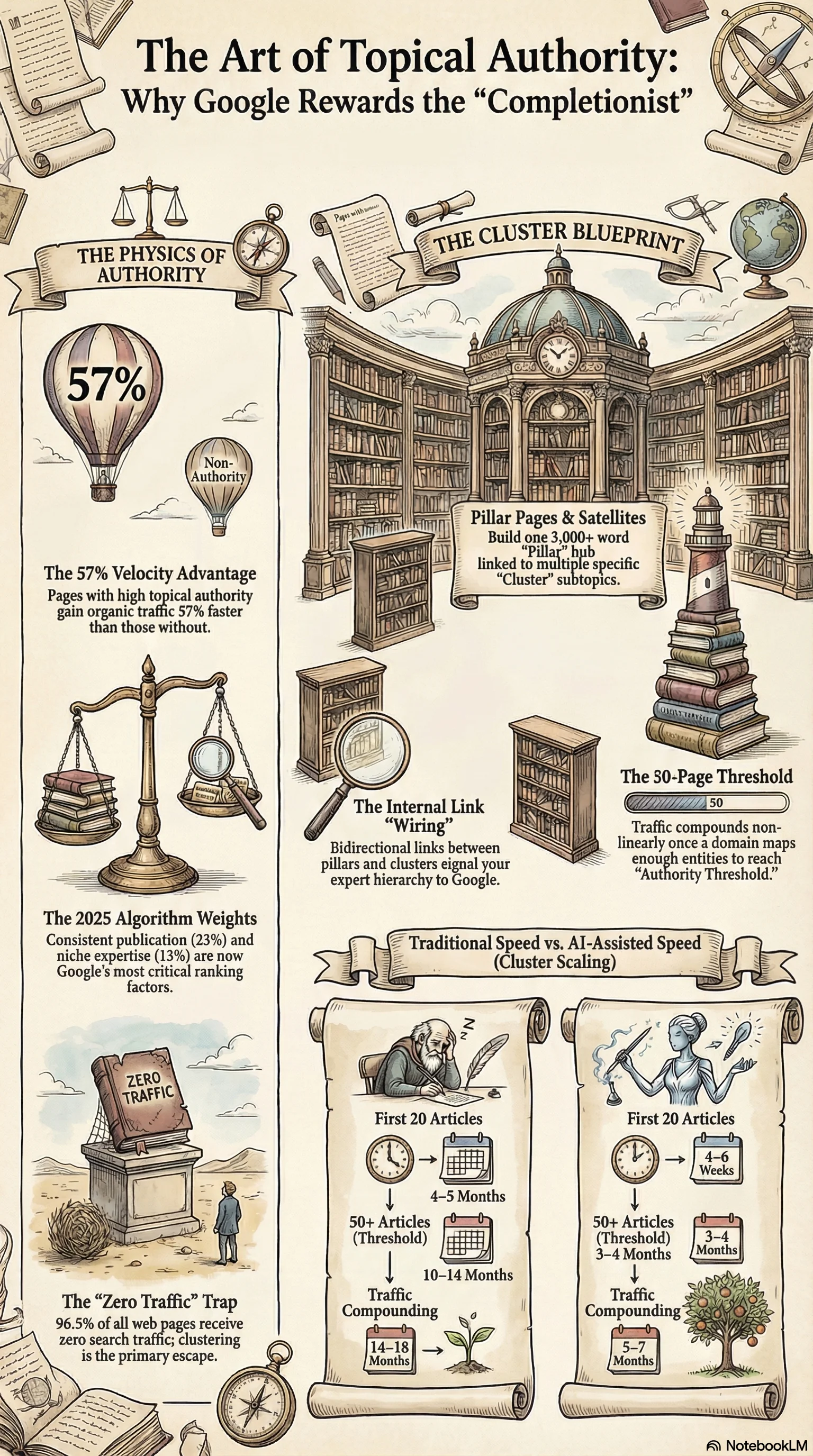
This isn't speculation. A 2024 study by Graphite analyzed 332 URLs across 12 websites and found that pages on sites with high topical authority gain traffic 57% faster than pages on sites without it. They're also 62% more likely to get traffic within the first week of publication [1].
The Compounding Effect
Every article you publish about a topic makes the next article easier to rank. High-topical-authority pages reach impression milestones 30% faster — your existing content literally pulls new content up the rankings.
— Graphite White Paper, 2024 [1]
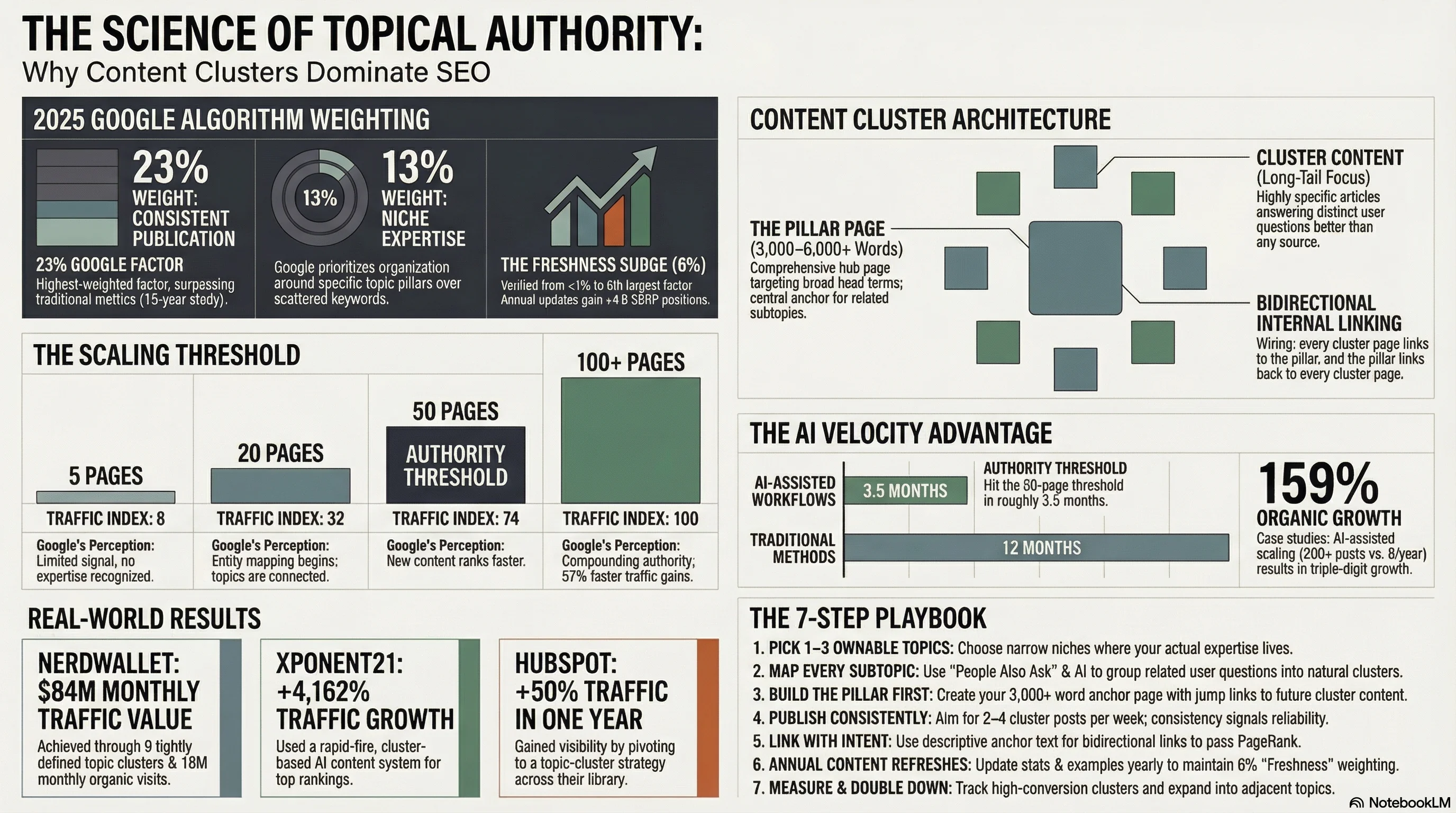
Google's algorithm reflects this directly. According to First Page Sage's continuous 15-year study of ranking factors, "Consistent Publication of Satisfying Content" is now the single biggest ranking factor at 23% — the highest-weighted signal in the entire algorithm [2]. "Niche Expertise" adds another 13%. Together, these two topic-authority signals account for more than a third of what determines your Google rankings.
The shift happened gradually. Google moved from matching exact keywords (the old way) to understanding topics semantically (the new way). Their Hummingbird update in 2013 started matching concepts instead of just words. BERT in 2019 added deep understanding of natural language. MUM in 2021 went even further — processing text, images, and video across 75 languages simultaneously [4].
The result: Google doesn't just check if your page mentions "email marketing." It checks whether your entire site demonstrates genuine expertise in email marketing. One great article helps. Fifty great, interconnected articles about every facet of email marketing? That's a different league entirely.
The Content Cluster Model — How It Actually Works
Pillar pages, cluster content, and internal links — the architecture behind topical authority
Topical authority sounds great in theory. In practice, it works through something called the content cluster model (sometimes called "topic clusters"). It has three pieces:
Pillar Page
Comprehensive hub covering the entire topic (3,000–6,000+ words). Targets the broad head term and links to all cluster content.
Example: "The Complete Guide to Email Marketing"
Cluster Content
Focused articles on specific subtopics, each targeting long-tail queries. Answers one specific question better than anything else out there.
Example: "Best Email Subject Lines for E-Commerce" or "How to Segment Your Email List"
Internal Links
Bidirectional hyperlinks connecting cluster pages to the pillar and to each other. Passes authority and signals topic relationships to Google.
Example: Every cluster page links back to the pillar; pillar links out to every cluster page
Think of it like a wheel. The pillar page is the hub. Cluster articles are the spokes. Internal links are what hold the wheel together. When Google's crawler follows those links, it maps out the entire topic — and recognizes that your site covers it comprehensively [5].
Here's what Google's algorithm actually weighs, according to First Page Sage's 2025 data [2]:
Google Algorithm Factor Weights (Q1 2025)
Source: First Page Sage — continuous 15-year study
Highest-weighted factor — up from prior year
Organizing content around pillars
Vaulted from <1% to 6th biggest factor in 2025
Amplifies the 23% and 13% factors within clusters
Notice something? The top two factors — Consistent Publication (23%) and Niche Expertise (13%) — are both directly about topical authority. Internal links at 1% may look small, but they're the mechanism that channels authority within your clusters. They amplify the bigger signals by telling Google how your content relates [16].
Internal Links Are the Wiring
Internal links pass PageRank between pages, signal hierarchical relationships to Google, improve crawl efficiency (Google discovers new content faster), and reinforce keyword relevance through anchor text. As BuzzStream put it: "Reinforce clusters with intelligent internal linking; anchor text and contextual passages strengthen entity signals that Google's embedding models trust." [16]
Freshness deserves a callout too: it jumped to 6% of the algorithm in 2025, up from less than 1% previously [2]. Pages that are updated at least once per year gain an average of 4.6 positions in search results versus pages left untouched. Topical authority isn't just about creating content — it's about maintaining it.
From 5 Pages to 50: How Volume Changes Everything
The scaling effect that separates sites that struggle from sites that dominate
Here's a number that should stop you cold: 96.55% of all pages get zero search traffic from Google [3]. Only 3.45% of pages get any traffic at all. And just 5.7% of pages will rank in the top 10 within a year of publication.
Those are brutal odds for any single page. But topical authority changes the math entirely.
When you have 5 articles on a topic, Google sees limited signal. Your domain might rank for a few long-tail keywords, but you're competing with sites that have far more coverage. When you hit 50+ articles covering every angle of a topic? Google maps your domain to that topic's entity graph. New content gets indexed faster, ranks sooner, and benefits from the authority you've already built [1].
The Topical Authority Scaling Effect
How traffic compounds as you expand content coverage within a topic cluster
Limited signal — Google doesn't see you as an expert
Entity mapping begins — Google connects your topics
Authority threshold — new content ranks faster
Compounding authority — 57% faster traffic on each new page
The threshold isn't a magic page number — it's about semantic coverage. For competitive topics like "personal finance," you might need 100+ pages. For niche local topics like "plumbing services in Austin," 20–30 thorough articles could establish authority.
The real-world proof? NerdWallet generates 18 million monthly organic visits and $84 million per month in traffic value by clustering content around just 9 core financial topics: credit cards, personal loans, mortgages, insurance, and so on [6]. 86% of their traffic comes from organic search. They rank for 4.8 million keywords — not because each page is magic, but because their comprehensive coverage of each topic cluster makes every page stronger.
Investopedia tells a similar story: roughly 80 million monthly visits, almost entirely through deep semantic coverage of financial topics [11]. The average top-ranking page ranks for nearly 1,000 other relevant keywords [3] — that's the topical authority effect spilling over into broader keyword visibility.
Why Each New Page Gets Easier
Google uses what researchers call a "Topical Authority Ratio" — when your domain has many indexed pages within a topic cluster, Google's ranking model predicts that your future content on that topic will also be relevant. The result: faster indexing, faster ranking, and inherited authority from day one. It's a flywheel.
Real Results — Case Studies That Prove It
From 400% ranking increases to 37,900% traffic growth — the data is clear
Theory is nice. Numbers are better. Here are six organizations that built topical authority — and what happened to their traffic.
NerdWallet
Monthly Organic Visits
Generates 18 million monthly organic visits and $84M/month in traffic value. 86% of all traffic from organic search.
Strategy: 9 tightly defined topic clusters (credit cards, mortgages, loans, etc.) with deep internal linking and frequent content updates.
Wolters Kluwer
Top-10 Rankings Increase
Boosted organic search results appearing in the top 10 by 400% after revamping SEO strategy around content clusters.
Strategy: Built high-performing content clusters tied to audience needs with clear pillar-cluster architecture.
HubSpot
Organic Traffic Increase
Increased organic traffic 50% in one year by shifting from keyword-centric to topic-cluster content strategy. Now generates 13M monthly organic visits.
Strategy: Pioneered the topic cluster model in 2017. Reorganized entire content library around pillar pages with systematic internal linking.
Digital Harvest
Organic Search Growth
Published 200+ blog posts in 2025 vs. only 6 in 2024. Total traffic grew 144%, organic search traffic grew 159%.
Strategy: AI-assisted content structured around niche, audience-specific angles. One destination → multiple audience-specific articles.
Xponent21
Traffic Growth
4,162% traffic growth in under a year. Achieved top rankings in Perplexity, ChatGPT, and Google AI Mode.
Strategy: Rapid-fire cluster-based content system: flagship articles + glossary + FAQs + webinars + podcasts, all cross-linked.
E-Commerce Client
Blog Traffic Growth
Grew organic blog traffic from 500 visitors/month to nearly 190,000 after implementing topic clusters.
Strategy: Pillar pages + subtopic cluster articles + hyperlink architecture. Blog transformed from afterthought to profit center.
Sources: NerdWallet data from Foundation Inc. analysis [6]; Wolters Kluwer from Conductor [7]; HubSpot from their own documented pivot [5]; Digital Harvest [8]; Xponent21 [9]; E-commerce client via HubSpot [5].
The pattern across all these cases is consistent: systematic topic coverage, structured internal linking, and sustained publishing cadence. None of them ranked by accident. They built authority deliberately — and the results compounded over time.
Expert Perspective
"I used to dismiss topical authority as an SEO ghost concept. But I was wrong: It's far from a ghost. Internal docs leaks and public signals from Google show that topical relevance — how completely a site covers related entities and questions — is a real and important factor in ranking."
— Kevin Indig, Growth Advisor (ex-Shopify/G2) [11]
Kevin Indig describes topical authority as "the new PageRank" — a durable, compounding moat that's hard for competitors to replicate quickly. Each article you publish reinforces every other article in the cluster. It's self-reinforcing, algorithm-resistant, and increasingly important as AI search tools (like Google's AI Overviews and Perplexity) preferentially cite sites with comprehensive coverage [4].
The AI Advantage — Scale Without Sacrificing Quality
How AI makes topical authority achievable for businesses that can't hire 10 writers
Here's the catch with everything above: building topical authority requires a lot of content. If your topic needs 50+ articles to reach authority threshold, and a skilled writer produces 2–3 quality articles per week, you're looking at 4–6 months of dedicated writing just for one topic cluster. For most small businesses, that's not realistic.
This is where AI changes the equation — not by replacing quality, but by making the volume achievable.
Digital Harvest's case study [8] is the clearest example. In 2024, they published 6 blog posts for the entire year. In 2025, using AI-assisted production, they published over 200 — and their organic traffic grew 159%. But the key detail: they didn't just blast out generic content. They developed what they call the "niche framework" — taking one broad topic and spinning it into 10–20 audience-specific articles.
Instead of writing one article on "fun things to do in Albuquerque," they created separate articles for families with toddlers, DINKs (dual income, no kids), budget travelers, and weekday visitors. Each article competes in a smaller, more specific search space — dramatically easier to rank — while collectively building topical authority around Albuquerque activities [8].
Traditional vs AI-Assisted Publishing Timeline
Time to reach topical authority milestones
Research & Topic Mapping
Traditional
4–6 weeks
AI-Assisted
1–2 weeks
First 20 Cluster Articles
Traditional
4–5 months
AI-Assisted
4–6 weeks
50+ Articles (Authority Threshold)
Traditional
10–14 months
AI-Assisted
3–4 months
Measurable Traffic Compounding
Traditional
14–18 months
AI-Assisted
5–7 months
The speed advantage is real: AI-assisted teams can reach the topical authority threshold in 3–4 months instead of 10–14. That's not a marginal improvement — it's the difference between seeing results this quarter and seeing them next year.
Volume Without Quality Backfires
"SEOs should shift from quantity to quality. Instead of producing thousands of low-value pages, focus on the 30 pages that drive revenue. Refine these high-value pages, improve click-through rates, promote them on social media."
— Lily Ray, VP SEO Strategy, Amsive Digital [12]
Lily Ray's warning is important: volume alone doesn't work. Google's March 2024 core update manually actioned hundreds of sites that had mass-produced AI content with zero editorial oversight [14]. The sites that got hit were pumping out thin, generic content across unrelated topics — the opposite of focused topical authority.
Google's official position is crystal clear: they don't penalize AI content. They penalize unhelpful content, regardless of how it was produced [14]. As First Page Sage noted in their 2025 analysis: "Average is the new bad. In the age of generative AI, anyone can create decent-to-good content. The only content Google seeks to reward with the #1 spot is content where a visitor would read every word on the page" [2].
The winning formula is AI velocity × human editorial judgment. Use AI to accelerate research, draft outlines, and produce first drafts. Use human expertise to add real experience, verify facts, inject genuine insight, and ensure every piece actually answers the reader's question better than what's already ranking.
Aleyda Solis, one of the most respected SEO consultants in the industry, puts it pragmatically: "Target and focus more on answering the long-tail queries of your users. We are going to see a much bigger and more important impact from those as a consequence of AI overviews and personalised AI results" [13]. Long-tail queries are exactly what cluster content targets — and AI makes producing that volume of specific, targeted content viable for the first time.
Building Your Topical Authority — A Step-by-Step Playbook
A practical framework for business owners who want to start building topical authority today
Enough theory. Here's the step-by-step framework distilled from the case studies above and from the research on how topical authority actually gets built. This is designed for small business owners — not enterprise SEO teams with unlimited budgets.
Don't try to cover everything. A local plumber doesn't need to rank for "home renovation." Choose topics where your actual expertise lives.
For each core topic, find every question your audience asks. Google's "People Also Ask," AnswerThePublic, and AI tools make this fast.
Create a comprehensive hub page for each core topic. This is your anchor — everything else links back to it.
Each cluster article targets one specific subtopic. Aim for 2–4 posts per week. Consistency matters more than bursts.
Internal linking isn't optional — it's the wiring that makes clusters work. Every cluster page links to the pillar. Related clusters cross-link.
Pages updated at least once per year gain an average of 4.6 positions in search results. Stale content decays.
Track which clusters drive traffic and conversions. Double down on what works. Expand into adjacent topics once you've earned authority.
The 80/20 for Small Businesses
You don't need 200 articles to start seeing results. Focus on one topic cluster. Publish your pillar page. Add 2–3 cluster articles per week. Link everything together. Within 3–4 months (especially with AI-assisted production), you'll start seeing the compounding effect — each new article ranking faster than the last.
The businesses that win at SEO in 2026 aren't the ones with the biggest budgets. They're the ones that pick a topic, cover it thoroughly, link it intelligently, and keep publishing consistently. Topical authority is a compounding asset — the earlier you start building it, the harder it becomes for competitors to catch up.
And with AI-assisted content tools, the barrier to entry has never been lower. A single person with the right tools can build what used to require a team of 5–10 writers. That's the real unlock: not AI replacing quality, but AI making quality achievable at the volume topical authority demands.
If you're looking for a tool that helps you publish at the cadence topical authority requires — with AI-generated drafts, built-in editorial workflows, and the consistency Google rewards — that's exactly what News Factory was built for. The strategy above works whether you write everything yourself or use a tool to help. The important thing is to start.
References & Sources
Primary sources cited in this article
- Graphite — Topical Authority White Paper (2024)
graphite.io/five-percent/topical-authority-white-paper
Key data: 57% faster traffic gain, 62% more likely to get traffic in first week, 30% faster to impression milestones. Study of 332 URLs across 12 domains. - First Page Sage — 2025 Google Algorithm Ranking Factors
firstpagesage.com/seo-blog/the-google-algorithm-ranking-factors/
Key data: Consistent publication = 23%, Niche Expertise = 13%, Freshness = 6%. Pages updated annually gain avg. 4.6 positions. - Ahrefs — 124 SEO Statistics for 2024
ahrefs.com/blog/seo-statistics/
Key data: 96.55% of pages get zero traffic; top-ranking pages rank for ~1,000 other keywords; 68% of online experiences begin with search. - Search Engine Land — Semantic Depth in SEO Guide
searchengineland.com/guide/semantic-depth
How RankBrain, BERT, and MUM evaluate semantic depth; topical authority vs. semantic depth distinction; entity mapping. - HubSpot — How to Ignite Organic Growth With Topic Clusters
blog.hubspot.com/customers/ignite-organic-growth-topic-cluster-strategy-hubspot
37,900% traffic increase for e-commerce client; 7–10x organic growth for agency clients; 90-day visibility improvements. - Foundation Inc. — NerdWallet SEO Topic Clusters Strategy
foundationinc.co/lab/nerdwallet-seo
18M monthly visits, $84M traffic value, 86% from organic, 9 topic clusters, 4.8M keywords. - Conductor — Wolters Kluwer Case Study
conductor.com/customer-stories/wolters-kluwer/
400% increase in top-10 organic search results through topic cluster revamp. - Digital Harvest — AI SEO Case Study: 144% Traffic Growth
digitalharvest.io/ai-seo-case-study-how-we-grew-organic-traffic/
200+ posts in 2025 vs. 6 in 2024; 144% total traffic growth; 159% organic growth; niche framework strategy. - Xponent21 — AI SEO Case Study: 4,162% Traffic Growth
xponent21.com/insights/ai-seo-case-study-engineering-top-ai-ranks/
4,162% traffic growth in under a year; cluster-based content ecosystem; top AI search rankings. - Keyword Insights — How to Build Topical Authority in SEO
keywordinsights.ai/blog/how-to-build-topical-authority-in-seo/
7-step topical authority framework; SERP-based clustering methodology. - Kevin Indig — Growth Memo: How to Measure Topical Authority (2025)
growth-memo.com/p/how-to-measure-topical-authority
Kevin Indig on topical relevance as confirmed Google ranking signal; internal docs leak confirmation. - Moz — How To Prepare for the Future of SEO: Lily Ray (2025)
moz.com/blog/how-to-prepare-for-the-future-of-seo-17-tips-from-lily-ray
Lily Ray on E-E-A-T, quality over quantity, brand strength, content recovery. - Majestic — Aleyda Solis: SEO in 2025
majestic.com/seo-in-2025/aleyda-solis
Long-tail queries, AI Overviews impact, topic clustering as 2025 priority. - Google Search Central — Guidance on AI Content (2023)
developers.google.com/search/blog/2023/02/google-search-and-ai-content
Google's E-E-A-T framework; official AI content policy: quality over method of production. - Google — How Search Works: Ranking Results
google.com/intl/en_us/search/howsearchworks/how-search-works/ranking-results/
Freshness factor varies by query type; content freshness guidance. - BuzzStream — Building Topical Authority with Kevin Indig (Podcast)
buzzstream.com/blog/topical-authority-podcast/
Internal linking + entity signals in Google's embedding models. - Search Engine Land — Topic Clusters Complete Guide
searchengineland.com/guide/topic-clusters
Pillar page architecture, cluster linking methodology, AI Overviews connection.
Article also available in: