How is AI changing traditional industries?
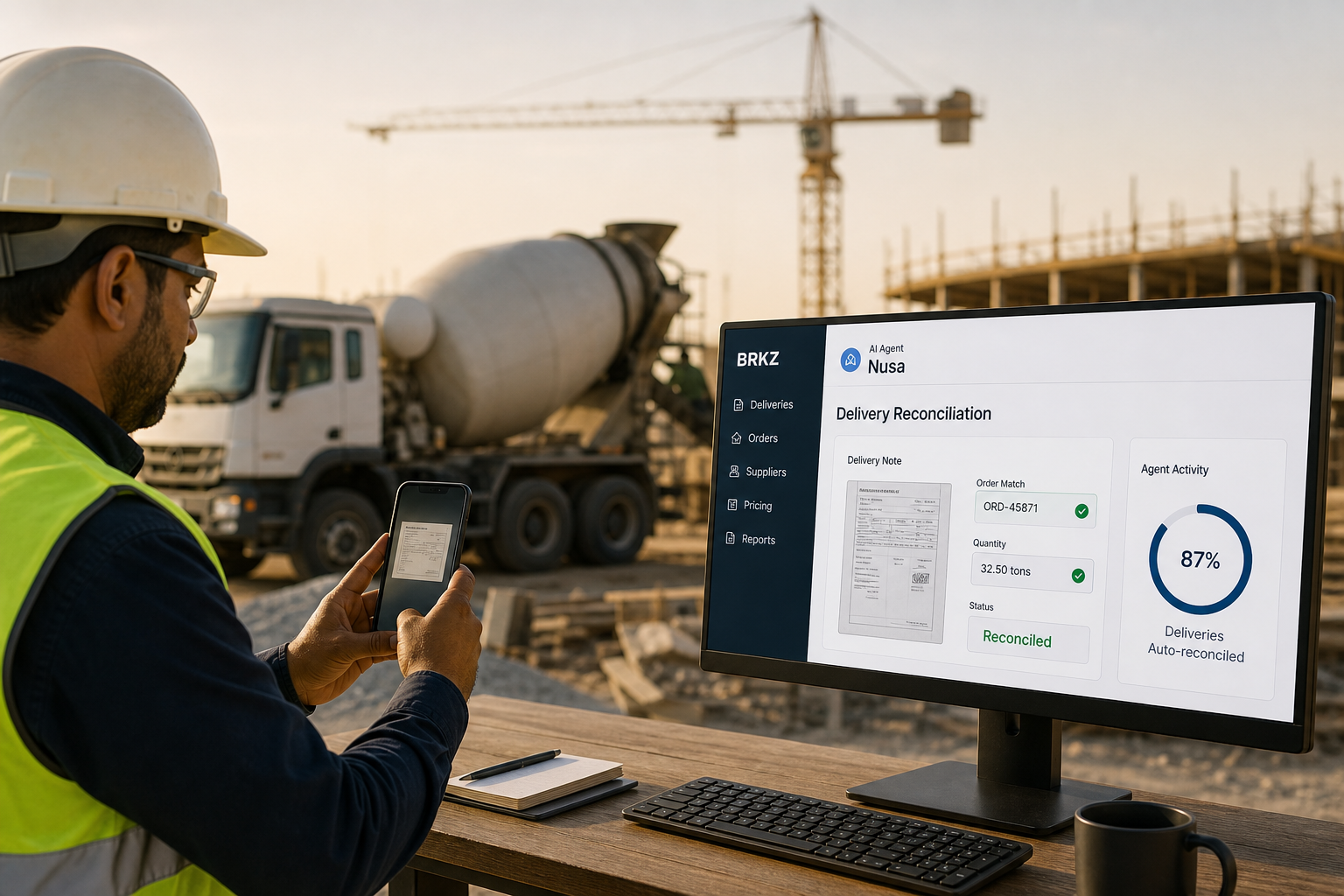
A transporter pulls up to a construction site outside Riyadh, unloads a delivery of bulk cement, and sends a photo of the delivery note through WhatsApp. For most of BRKZ’s history, that photo was the start of a chain of human work. Someone had to read the document, find the matching order, verify the quantity, update the system and close the delivery.
Today, an agent we call Nusa does most of that. It reads the image, extracts the details, matches them against our systems, verifies the quantities and closes the delivery. The team handles uncertain matches and exceptions. Nusa now closes the majority of deliveries in our reconciliation workflow, and its share grows every month.
What are the benefits of AI in industries?
Bulk cement isn’t a glamorous AI use case. That’s exactly why I like it. The conversation around AI is moving past copilots and headcount reduction toward a more interesting question: Can AI fundamentally change the operating model of a company? I think it can. And I believe some of the biggest opportunities are in the industries where technology has historically struggled most: physical goods, fragmented supply chains, credit and logistics.
When we started BRKZ, our first problem was more basic: the industry needed systems. Building-material procurement was deeply manual and fragmented. Requests for quotation (RFQs), pricing, supplier relationships, orders, deliveries, credit and collections lived across phone calls, WhatsApp messages, spreadsheets, PDFs and people’s heads.
We spent our first three years doing something less fashionable but essential. We brought our core workflows onto shared systems: how demand enters, how suppliers are evaluated, how quotations are created, how orders are fulfilled, how deliveries are reconciled, how customers pay and how every transaction is recorded. That gave us something valuable: every workflow started leaving a digital trail. Every RFQ, quotation, supplier interaction, delivery and payment became data.
Over time those trails accumulated into tens of millions of structured data points across products, suppliers, transactions and payment behavior. We don’t have to ask every contractor and transporter to change how they communicate. An RFQ can still arrive on WhatsApp and a delivery note as a photo. Agents turn those inputs into structured records the business can act on.
You can’t add meaningful intelligence to a business you haven’t first made observable. I’ve come to think the AI journey for traditional industries follows a progression: systemize, capture, understand, automate, agentize. By agentize, I mean giving agents responsibility to act within clear limits.
Once we had enough transaction history, we started asking different questions. Could the system learn how we price? Could it work out which suppliers were relevant for a given RFQ? Pricing building materials is surprisingly hard. The same product can carry different prices depending on quantity, location, delivery requirements, timing and market conditions.
So we built a pricing engine on our historical RFQs and transactions. Mizan, our AI procurement agent, is now live on our first product categories. It generates price recommendations almost instantly for procurement officers to review and adjust before submission. The data we’d spent years collecting stopped describing what had happened and started helping us decide what should happen next.
Prediction is useful. Execution is more interesting. Nusa taught us that AI becomes far more powerful when it can act inside a system rather than simply answer questions about it. Instead of asking “where can we add AI?”, we started asking “which parts of the transaction can an agent own?”
A transaction breaks naturally into domains (sales, procurement, credit, operations and finance), and each has inputs, decisions, actions and exceptions. In procurement, an agent can interpret an RFQ, identify products, predict prices, select suppliers and quote competitively.
Companies don’t only have labor costs. They have coordination costs. A single customer request might touch sales, procurement, operations, logistics, finance and credit before it becomes a completed transaction. Each handoff creates latency. AI can remove enormous amounts of this invisible work, and I suspect that will ultimately matter more than automating individual tasks.
My strongest takeaway from the US was that the interesting question isn’t “how many people can AI replace?” It’s “how much more can every person accomplish?” I want AI to turn a great salesperson into someone with capabilities that would previously have required an entire support team.
Imagine every salesperson with a digital twin. It knows which customers are likely to reorder, which have quietly reduced their purchasing, which quotations didn’t convert and which products a customer should be buying but isn’t. Who should I call? Why now? What should I sell, and at what price?
The physical world has to be made visible. In physical industries, much of what matters still happens outside the data a company captures. A truck arriving at a site is data. A pallet being unloaded is data. AI can only reason about what it can see.
This leads to a counterintuitive idea: operational complexity can become a moat. But if one operations employee can oversee dramatically more transactions because agents handle routine coordination, and one procurement person can manage dramatically more spend, then the economics change.
The opportunity for our region is significant. We have enormous industries still early in their digitization: construction, manufacturing, logistics, healthcare and wholesale trade. Many people look at that and see a technology disadvantage. I see the opposite.
We have a chance to skip an entire generation of software. We don’t need to spend the next twenty years reproducing every system and workflow that was built elsewhere. We can systemize these industries now, on the assumption that intelligence and agents will sit inside those systems from day one.
The test is in the economics. Over the next few years every company will call itself AI-powered, so the term will soon mean about as much as saying your company uses the internet. Can we process significantly more transactions without growing headcount at the same rate? Can each salesperson generate more output?
Those are the AI metrics I care about, not tokens consumed or copilots deployed. The question I keep coming back to is this. How much more output can BRKZ generate from every colleague, every dollar of working capital and every transaction because of this technology?
Start from the resource, not the feature. BRKZ is still early in this journey. We’re experimenting, learning and getting plenty wrong. But one principle has become clear to me. Don’t start by asking how to add AI to your company. Start by asking how you’d build your company differently if intelligent machines were simply another resource available to you, alongside people, capital and software.
For us, the path has been: systemize, capture, understand, automate, agentize. For another company it may look different. But the objective should be the same. Don’t use AI to make the old way of working slightly more efficient. Use it to discover a fundamentally better way of operating.
Cet article a été rédigé avec l'assistance de l'IA.
News Factory APP - actualités agentiques pour booster votre SEO et AEO.