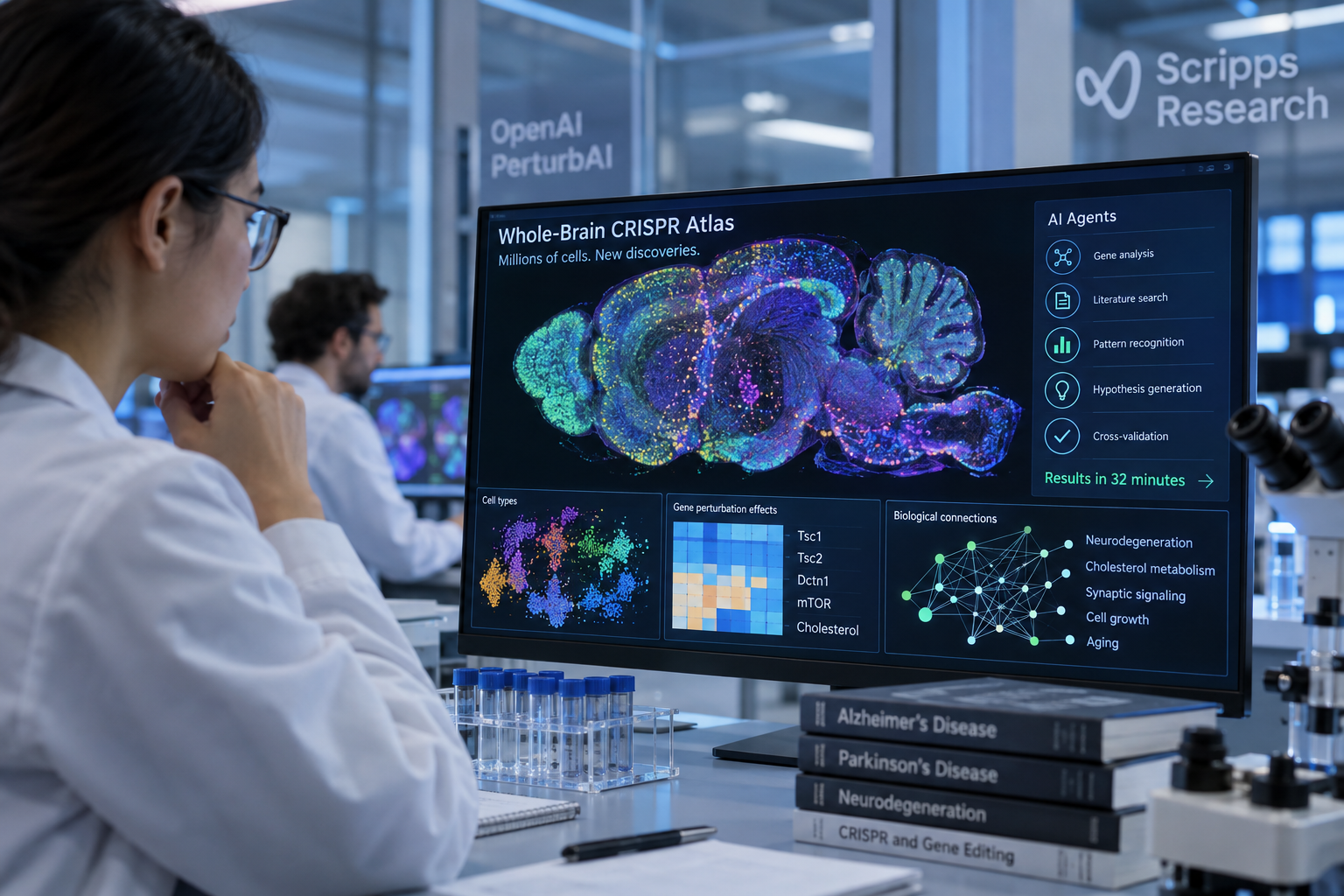
Thousands of AI agents working in parallel can sift through years of experimental data and flag biological connections that human researchers might take months to find. That is the central claim of a new project from OpenAI, PerturbAI and Scripps Research, which used agents powered by GPT-Rosalind to analyze data from millions of mouse brain cells in just 32 minutes.
How do AI agents analyze a whole-brain CRISPR atlas?
The agents worked on a whole-brain CRISPR atlas, a dataset showing how disrupting individual genes affects different cell types across the mouse brain. Each agent took on one gene disruption, analyzed the cellular response, searched the scientific literature and proposed explanations for what it saw. The reports were then merged into what the team calls a reasoning atlas, which links genes, cellular effects, relevant publications and possible biological mechanisms.
The approach addresses a growing problem in biology. Researchers can now alter thousands of genes and measure the effects across millions of cells, but the results are only useful if scientists can connect them with decades of scattered research. Sarah Teichmann, chair in stem cell medicine at the University of Cambridge and founding co-chair of the Human Cell Atlas, said the goal is to help other scientists find what the original researchers did not anticipate.
“We build cell atlases so that other scientists can make discoveries we haven’t imagined yet,” Teichmann said. “AI could help more researchers explore these resources and turn unexpected observations into new questions to test.”
The research team estimated that a comparable human effort, carried out one perturbation at a time, would take months to a year. The agents reproduced findings from earlier human analyses and identified additional leads. Their judgments on novelty and scientific value matched those of blinded human experts.
A gene pair with different effects
Some of the most useful findings came from details that fell outside the questions the original experiment was designed to answer. The agents flagged a difference between Tsc1 and Tsc2, two genes that work together to control mTOR, a major regulator of cell growth, metabolism and aging. Disrupting either gene had similar effects in several groups of neurons. In the cerebellum, which helps coordinate movement, however, disrupting Tsc2 changed the activity of dozens of genes involved in neuronal communication, while disrupting Tsc1 produced little change.
That gap may matter for patients. In people with tuberous sclerosis, cerebellar abnormalities are strongly linked to TSC2 mutations. Medicines that reduce mTOR activity can treat certain brain tumors and seizures, but the learning and behavioral difficulties associated with the disease remain hard to address. Nowakowski, an associate professor of neurological surgery at UCSF, said the agents' work points to specific cell groups and changes worth investigating, which gives researchers a narrower set of questions to test in the lab.
The agents also identified a possible link between cholesterol regulation and neurodegeneration. In the CRISPR atlas, disrupting Dctn1, a gene involved in moving cargo inside neurons, increased the expression of genes that make cholesterol. The agents connected that result with research suggesting that problems in cholesterol transport may cause cells to produce more of it. Mutations in the human version of the gene, DCTN1, cause Perry syndrome, a neurodegenerative disease with Parkinson-like symptoms.
That connection led to a testable question: could DCTN1 disruption change how cholesterol is distributed within neurons, and could those changes contribute to neurodegeneration? If so, could restoring normal distribution help protect neurons? Human experts who reviewed the hypothesis described it as novel, consequential and worth following up.
Could one agent do the same work?
Could a single AI agent match a distributed team?
The team also tested whether a single agent given the entire dataset could perform as well as the distributed group. Keeping the model and resources fixed, they found that the single agent searched less of the literature as the workload grew. At the largest workload, it cited only 11 references, while the distributed agents cited more than 700. In blinded comparisons, human experts preferred the distributed-agent reports 75% of the time.
Scientists have limited time, and they often concentrate on the strongest signals in their data. Distributed agents can examine a wider range of responses, including subtle or unexpected ones, and connect them with the literature. Running many agents at once allows a large number of perturbations to be investigated simultaneously.
The reasoning atlas is now available, allowing researchers to compare related genes, examine unexpected responses and choose which leads to pursue. The companies framed the work as a way to support scientists rather than replace them. AI can help researchers decide which ideas to pursue, design experiments and interpret results, the team said, with the aim of turning more of the information in biological experiments into knowledge that can guide the development of better medicines.
Cet article a été rédigé avec l'assistance de l'IA.
News Factory APP - actualités agentiques pour booster votre SEO et AEO.