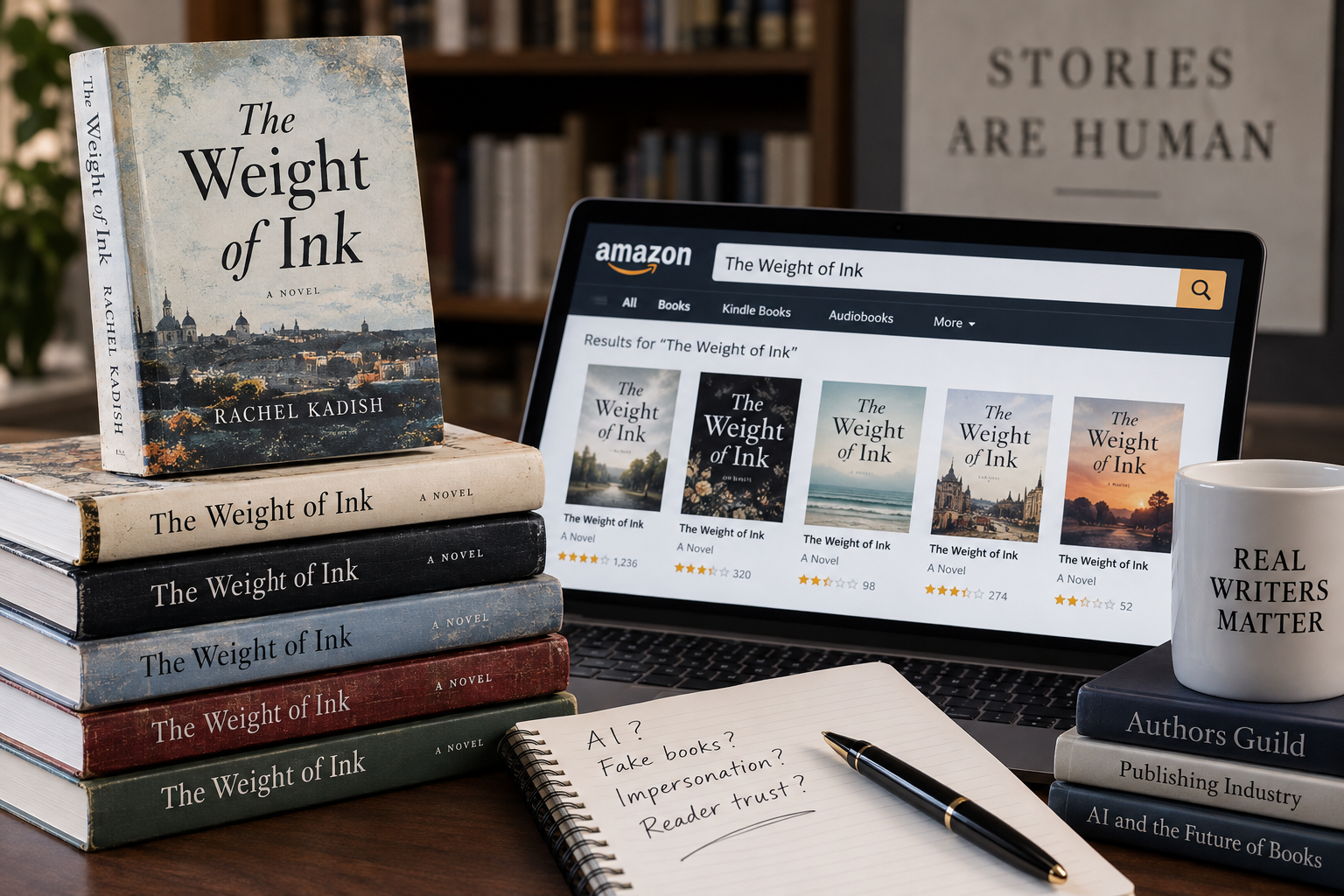
How is AI affecting trust between readers and writers?
Novelist Rachel Kadish says generative AI is eroding the trust between readers and writers, and she points to a chatbot that misdescribed her own book as evidence. In an essay, Kadish describes a moment at a book signing in late 2025 that she says made the problem personal.
A middle-aged man approached her table with his wife and explained that he had Parkinson’s disease. He had not read Kadish’s 2017 novel, The Weight of Ink, but he understood that it featured a character with Parkinson’s who chooses assisted suicide. He had objections. Kadish told him the account was wrong. The character, Helen Watt, does not end her life.
Kadish said she had a guess about where the mistake came from. A few weeks earlier, she had asked ChatGPT several questions about the novel, and it gave her a false version of Helen’s storyline. She had worried ever since that the misrepresentation could spread, and now it appeared to have done so.
Are books with identical titles appearing on Amazon?
The problem extends to the book’s title. Kadish says no other book shared the name The Weight of Ink in English until the fall of 2025. Since then, at least five other novels with identical titles have appeared on Amazon, three of them within a three-week span. Several other books with nearly identical titles are also listed. Kadish could not determine whether AI wrote them, and she found only one that includes a disclaimer acknowledging AI authorship. She cited Will Oremus of The Atlantic, who reported that new-book releases on Amazon jumped after 2022, around the time AI models became widely available. Kadish found it hard to believe that the flood of books was the product of a sudden burst of human creativity.
Her friend, novelist Daphne Kalotay, had a worse experience. In late 2024, Kalotay found a new novel on her Amazon author page that she had not written. She described it as “an AI hallucination based on descriptions of Russian Winter,” her 2010 novel. The fake book had been paired with a title and cover from an unrelated work published decades earlier. Kalotay told Kadish that the hardest part was proving the book was worthless. The Authors Guild, an advocacy group of which Kalotay is a member, eventually persuaded Amazon to remove it from her page. The group has also launched a certification program meant to separate human-written books from AI-generated ones.
Producing a book-length text with AI costs very little, and Amazon allows individuals to upload up to six books a week. A seller needs only a few buyers to be fooled by a borrowed title or author name to make money from each book. Mary Rasenberger, chief executive of the Authors Guild, told Kadish that Amazon works to block such titles, but “it’s always a game of catch-up.”
What are AI phishing scams targeting writers?
Writers are also being targeted by AI-generated phishing emails that pose as appreciative readers. Kadish says many of her peers now hesitate to open reader mail. The messages often start with personal praise and then turn into pitches for paid marketing services. One recent example opened with, “Dear Rachel, This feels scary to send, but I’m trusting my heart today.” The Authors Guild keeps a running list of these scams. Writers who pay for the promised services often lose their money.
Some fraudulent emails are sent under the names of published authors. Kadish says a writer she doesn’t know forwarded her an email from someone calling themselves “Rachel Kadish,” who reached out to him “author to author.” The message included links to her real website, Amazon page and Goodreads page. When Kadish asked the sender to explain, the reply admitted the impersonation and said it was meant to help. Kadish says the sign-off read: “Going forward, I will communicate under my own name and will not use your identity to contact other authors.”
Kadish draws a sharp line between this kind of fraud and earlier literary hoaxes. She points to The Education of Little Tree, published in 1976 as the true story of a Cherokee boy and later revealed in 1991 to be the work of a former Ku Klux Klan member. She also cites Binjamin Wilkomirski’s Fragments, whose exposure gave rise to the term “Wilkomirski syndrome.” Those scandals, she writes, revealed human motives and the way readers’ wishes can blind them. The new fakes offer nothing comparable. “We can glean no meaning from a marketing bot spitting out derivative novels,” she writes.
Kadish says the stakes of reader-writer exchanges are high. She notes that Charles Dickens revised his depiction of Jews after a reader criticized his work, and that a reader outcry helped persuade Arthur Conan Doyle to bring Sherlock Holmes back. She quotes Toni Morrison’s 1993 Nobel lecture: “Narrative is radical, creating us at the very moment it is being created.” Kadish argues that AI threatens that exchange. The couple who confronted her, she writes, deserved to know whether she had written her characters with care, and she deserved a conversation about the story she actually wrote.
Cet article a été rédigé avec l'assistance de l'IA.
News Factory APP - actualités agentiques pour booster votre SEO et AEO.