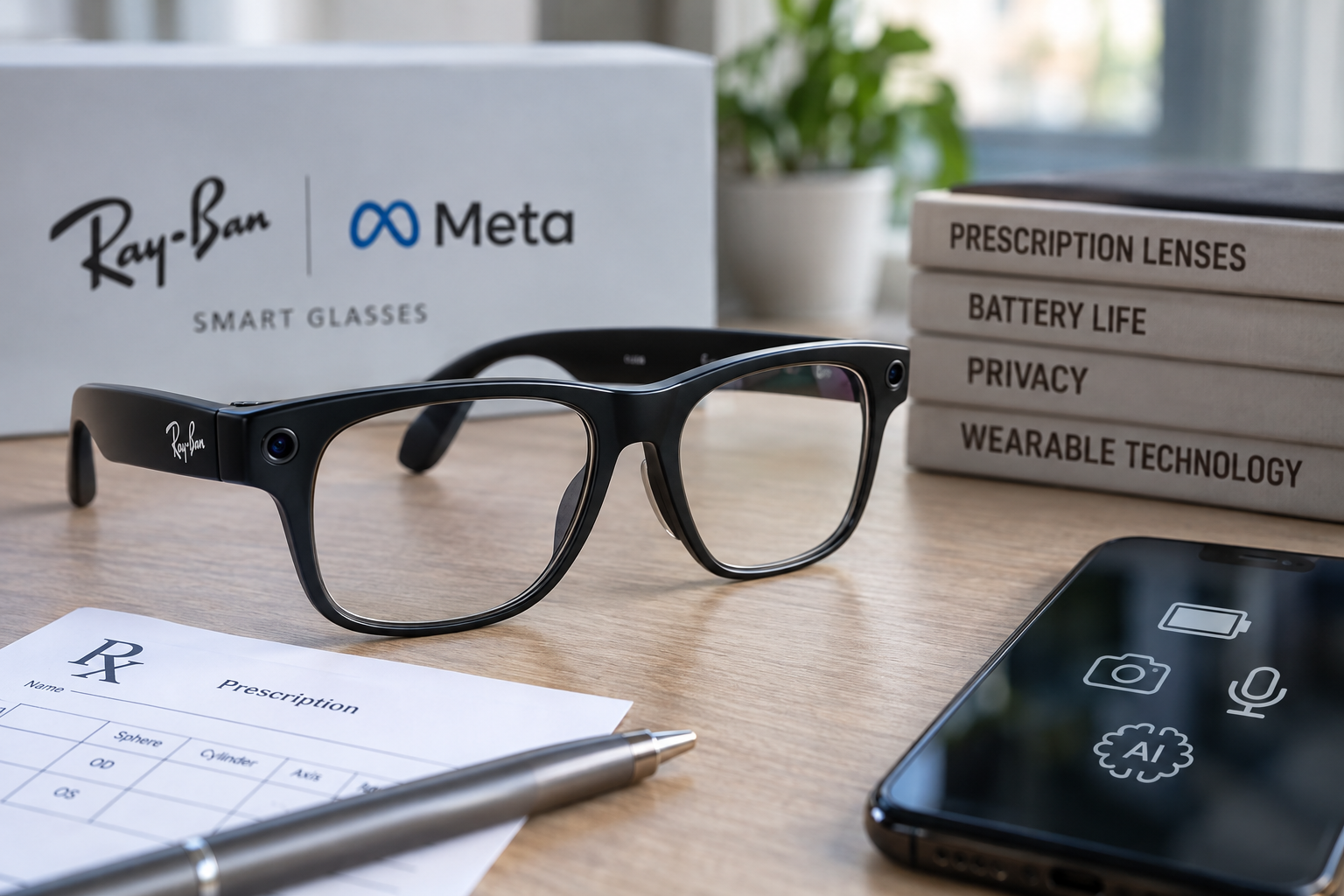
Yes, you can get AI glasses with prescription lenses. Ray-Ban Meta glasses, for example, can be ordered with prescription lenses installed, with buyers uploading their prescription. For everyday wearers, though, weight of up to 80 grams, three to five hours of battery life and growing privacy restrictions mean smart eyewear remains a second option rather than a full replacement.
Yes, you can get AI glasses with prescription lenses. For people who wear glasses every day, though, the technology still carries trade-offs that make smart eyewear a second option rather than a true replacement.
AI-powered smart glasses have drawn plenty of attention, and not all of it flattering. A German nonprofit has filed a criminal complaint over privacy concerns tied to Meta's smart glasses. Still, the practical question of whether they can stand in for a regular pair is one many wearers are asking, and the answer depends on how the glasses will be used.
Can you get AI glasses with prescription lenses?
Most of these devices are built on ordinary frames. Ray-Ban Meta glasses, for example, look like regular eyewear from a short distance, and their lenses can be replaced with prescription ones. Ray-Ban lets customers order Meta's smart glasses with prescription lenses already installed. Buyers upload their prescription, and the company handles the rest. The prescription, in other words, is the easy part.
Weight and battery life
Are AI glasses too heavy and short on battery for all-day wear?
Comfort is the first hurdle. Regular glasses typically weigh between 20 and 30 grams, or 0.7 to 1.1 ounces. Smart glasses can weigh up to 80 grams, or 2.7 ounces. A few hours in a pair is manageable, but the difference becomes noticeable over a full day.
Battery life is the second. AI glasses last an average of three to five hours before the battery dies. Occasional use may not be a problem, but wearing them all day means recharging constantly. When the battery runs out, the glasses still work as regular eyeglasses, but the AI features stop.
Privacy rules are tightening
Where are AI glasses banned?
Privacy is the bigger obstacle. Wearing AI glasses in public is not illegal, but the list of places banning them keeps growing. Courts in England and Wales have barred Meta glasses from courtrooms, and New York followed suit in July. Many schools around the world have also prohibited students from wearing them during class. Reports of bans in corporate settings have surfaced as well.
The camera is usually the main worry, but audio can be a concern even when the camera is off. A real-time translation feature, for instance, could end up uploading confidential conversations to a third-party server. Meta has faced scrutiny for allowing outsourced workers to access intimate images and videos captured by its AI smart glasses. The company says the content is sometimes reviewed by humans to improve the product experience.
The social side matters too. Some people have stopped wearing AI glasses in public, a shift the backlash against Meta's glasses has helped drive. After a run of negative stories, users say they fear being labeled as stalkers or weirdos.
The upshot: prescription AI glasses are available, but for anyone who depends on their eyewear every day, they are not yet the best choice. Buyers weighing the switch should consider comfort, battery life and where they plan to wear the glasses.
Cet article a été rédigé avec l'assistance de l'IA.
News Factory APP - actualités agentiques pour booster votre SEO et AEO.