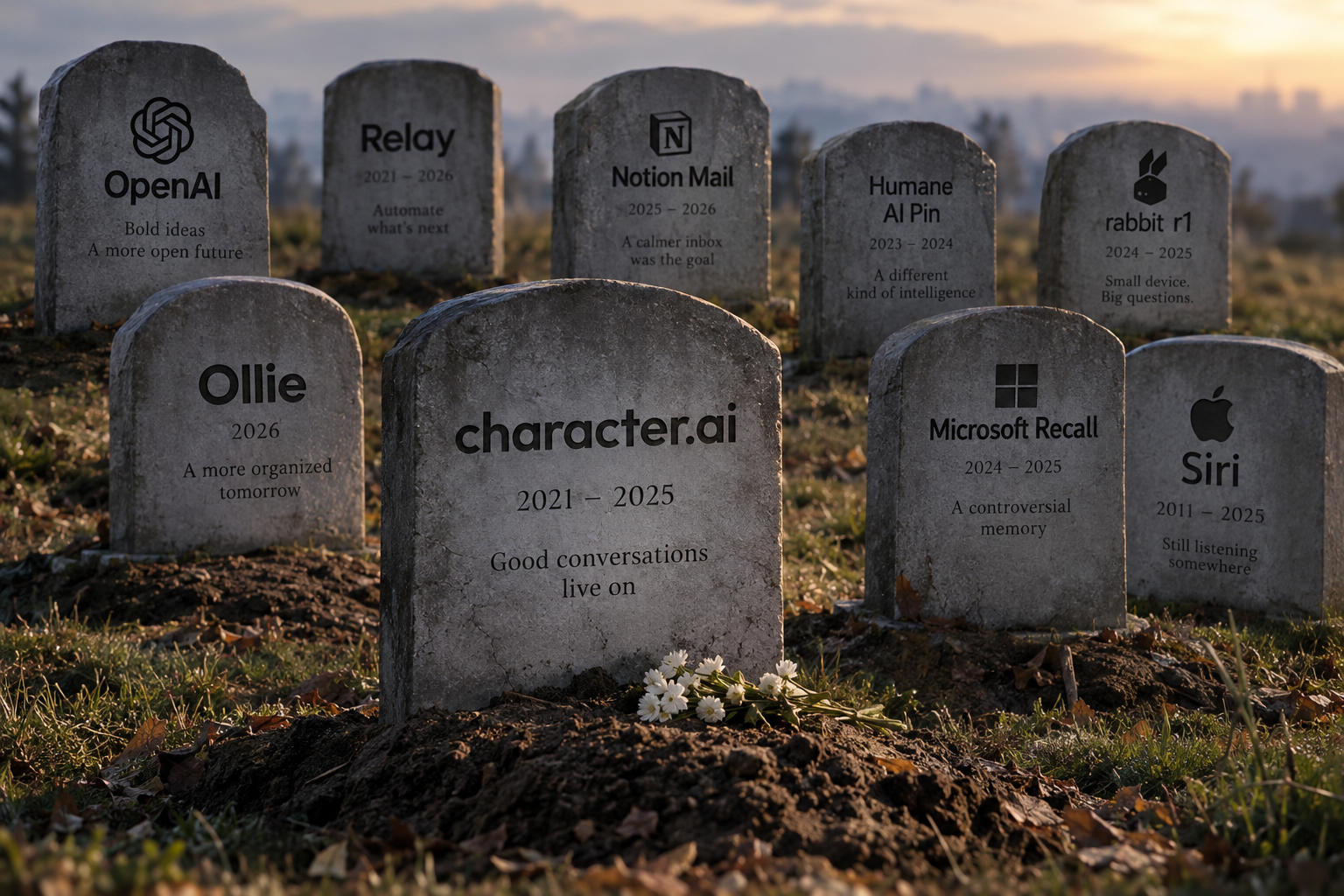
Why do so many AI products shut down?
Roughly 42% of AI initiatives are ultimately abandoned by the companies that launch them, according to S&P Global Market Intelligence. The reasons vary. Some projects run out of money, others hit technical walls, and a few simply fail to attract users. A growing number of closures show that even well-funded AI products can struggle to find a lasting place in the market.
Why did Character.ai file for bankruptcy?
Character.ai filed for bankruptcy in early October, just five years after the chatbot platform launched. The company, founded in 2021 by former Google researchers Noam Shazeer and Daniel De Freitas, let people chat with customizable bots, many of them modeled on celebrities and fictional characters. It raised $150 million at a $1 billion valuation in 2023. The next year, Google paid a reported $2.7 billion to license its technology and bring the founders into its orbit, leaving the startup to carry on without them.
The legal troubles piled up from there. Families sued, alleging the chatbots contributed to teen suicides and self-harm, and Disney sent a cease-and-desist letter over unauthorized use of its characters. Character.ai barred under-18 users from open-ended chats late last year and agreed to settle several of the suits, along with Google, in early 2026. It wasn’t enough. The company cited legal, regulatory and operational headwinds in its filing. In an ironic twist, Disney is now the opening bidder, offering $20 million for a license to some of Character.ai’s intellectual property. The app remains online during the process, and the sale is expected to wrap up by late November or early December.
Ollie took a different route. The app launched in June 2026 as one of the first mainstream apps to achieve SOC 2, a privacy compliance standard. It aimed to pull together the scattered information families rely on, including school messages, calendars, task lists and group chats, and keep it in sync. Co-founder and CEO Bill Lennon said the app would shut down on November 6. He pointed to difficulties standing out, failing to grow and not raising enough capital. Ollie was competing with heavier names in the same space, including Muse and Instinct.
OpenAI, one of the most valuable private companies in the world, has also stumbled. On July 9, the company updated ChatGPT to combine several experiences, including separate “Chat,” “Codex” and “Work” modes, and renamed the traditional version “ChatGPT Classic.” Users found the new interface confusing and cluttered. OpenAI rolled back the change soon after and restored the familiar interface.
Which big AI companies have shut down their own products?
The company has since leaned toward folding products into ChatGPT rather than keeping them separate. ChatGPT Atlas, a stand-alone AI-powered web browser, lasted less than a year before it was discontinued on August 9, and its most useful features were absorbed into ChatGPT. OpenAI did something similar with Operator, an AI agent that could browse the web and complete tasks for users. Image generation now lives inside ChatGPT, reducing DALL-E’s role as a separate destination. Sora, the video-sharing platform, struggled with high operating costs and user retention and shut down in March 2026.
Relay, an AI-powered workflow automation tool built as an alternative to Zapier, shut down entirely in August 2026. It let users automate email and task workflows with AI agents. But as OpenAI, Google and other large platforms built similar automation into their own tools, the five-year-old company struggled to justify its existence as a stand-alone product. Notion Mail followed a similar path. The email product launched in April 2025 to help users organize and automate their inboxes, but the company noticed users were handling their inboxes with separate AI agents instead. Notion Mail is scheduled to shut down on September 22.
Hardware has produced some of the most visible failures. Humane raised $230 million for its AI Pin, a wearable meant to deliver AI features without a smartphone. The device struggled with performance, and Humane warned customers to stop using its charging case because of a potential battery fire risk. The company shut down its AI Pin business in February 2025, and HP acquired most of its assets for $116 million. The Rabbit R1, unveiled at CES in January 2024, was also heavily hyped. Rabbit said it sold 100,000 units shortly after launch, but early reviews described the device as unfinished, with unreliable performance and few useful integrations. The company has kept updating the R1 and recently announced a new hardware project, “Project Cyberdeck,” aimed at a portable device built for vibe-coding.
Apple’s delays with Siri carried a financial cost. The company unveiled Apple Intelligence in 2024 with an improved Siri as a highlighted feature. Apple then repeatedly pushed back the release, citing engineering issues and bugs. The delay contributed to a $250 million settlement over claims about how Apple marketed the AI capabilities of the iPhone 16. The new Siri appeared in the iOS 27 beta in July and began rolling out to English-language users this month, with other languages expected to follow.
Not every project fails on the market. Microsoft’s Recall, announced at its 2024 Build developer conference, drew immediate criticism over privacy and security. The feature periodically took screenshots of a user’s activity so people could search their digital history, and critics warned it could create a searchable archive of passwords, private messages and financial details. Microsoft delayed the feature for nearly a year. A cybersecurity researcher recently built a tool that could extract and display data Recall had captured, raising questions about whether the underlying problem has been fixed.
Other casualties were smaller but telling. Huxe, an AI audio app built by former developers of Google’s NotebookLM, shut down in May 2026 as larger platforms began offering similar experiences to large existing audiences. Spotify has been expanding its own AI-powered audio tools. Yupp, a free playground that let users compare responses from more than 800 models side by side, shut down in March 2026. According to its founders, the product never achieved strong enough product-market fit to survive. Figgs AI, which operated from 2023 to 2024, reportedly drew more than 1 million users, but its developers said keeping the service free became too expensive to sustain.
Cet article a été rédigé avec l'assistance de l'IA.
News Factory APP - actualités agentiques pour booster votre SEO et AEO.