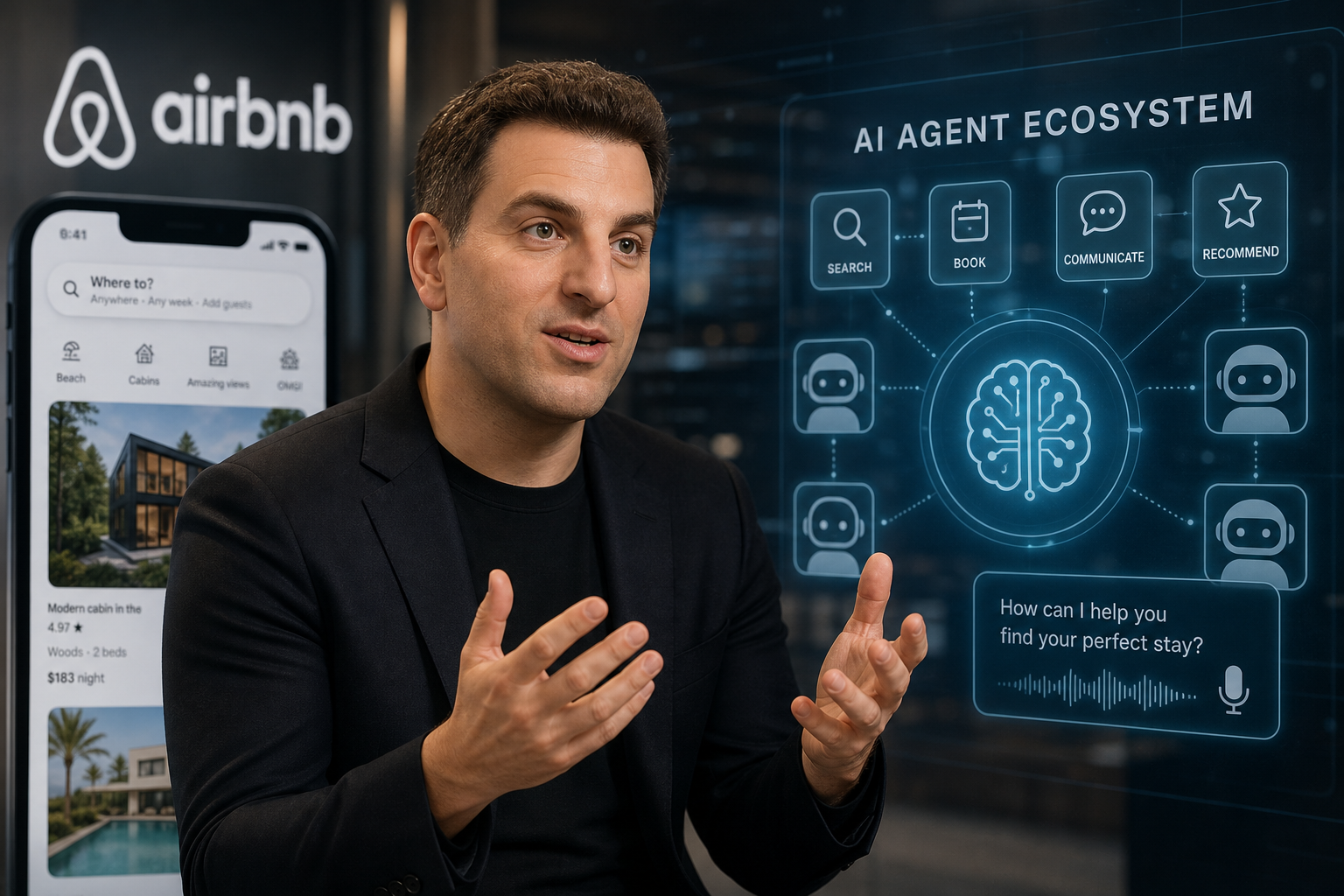
Airbnb CEO Brian Chesky believes AI agents need their own operating system to function effectively, and the company is working towards making its platform more agent-friendly
What is the future of AI search optimization?
Airbnb rolled out its new AEO-powered search, utilizing answer engine optimization this week as part of its fall update, a significant step for a company that has been slow and deliberate about AI. Co-founder and CEO Brian Chesky has said in the past that a chatbot-only interface is not fit for travel discovery. With more AI on the way to the Airbnb app, Chesky shared his thoughts on how the company is approaching it, where interfaces are headed, and what role voice will play.
Chesky hasn't changed his mind on chatbots, stating they aren't good for browsing or shopping because they give you a few options at a time, and you have to take multiple turns before reaching a result. He believes the current version of Airbnb's search is not the final form, and its interface will evolve over time. Chesky thinks that there's going to be some interface that is between a chatbot and what you see in the first version they shipped.
Airbnb is exploring interfaces that enable "multiplayer" AI, meaning AI that several people can use at once. Chesky sees a second problem with chatbots, which is that they are built for one person and aren't a collaborative interface. The company is preparing for consumer AI agents, which are tools like Instinct and Muse that carry out tasks on a person's behalf. Agents will need robust software infrastructure on Airbnb's end, and the company wants to make itself more agent-friendly.
How will AI agents interact with each other?
Chesky argues that the industry lacks a true operating system built for AI. He thinks that in an ideal world, AI would be operable at the kernel level, and all components like agents would interact with each other. Chesky believes that apps have not always been interoperable unless companies struck a business deal, but agents are like "apps with faces," and when they talk to each other, all apps can become interoperable.
The Airbnb CEO is planning for agent-to-agent interactions through the platform, and he explained there might be some interactions within the platform and some with agents of other apps. Chesky thinks that there are two misconceptions in Silicon Valley: first, that the interface is going away and people will just talk and type; second, that software will be completely generative. He argues that a designer can prompt better software than a consumer can.
Chesky also thinks that as long as the iPhone remains dominant and Apple and Google control the major platforms, apps will likely remain a central fixture. He believes it's up to Apple or Google to build a new platform to make the true shift from apps to agents. Otherwise, we're going to have apps that have agents inside them, rather than the whole app being a robust agent that's interoperable with other agents.
Before wrapping up, Chesky discussed voice, which is gaining ground as apps like Wispr Flow, Willow, and Superwhisper get people talking to their devices more. He thinks people will eventually speak to computers more than they type. Voice will play a key part for Airbnb in search and customer service, and the company plans to roll out voice agents this fall to help users.
Cet article a été rédigé avec l'assistance de l'IA.
News Factory APP - actualités agentiques pour booster votre SEO et AEO.