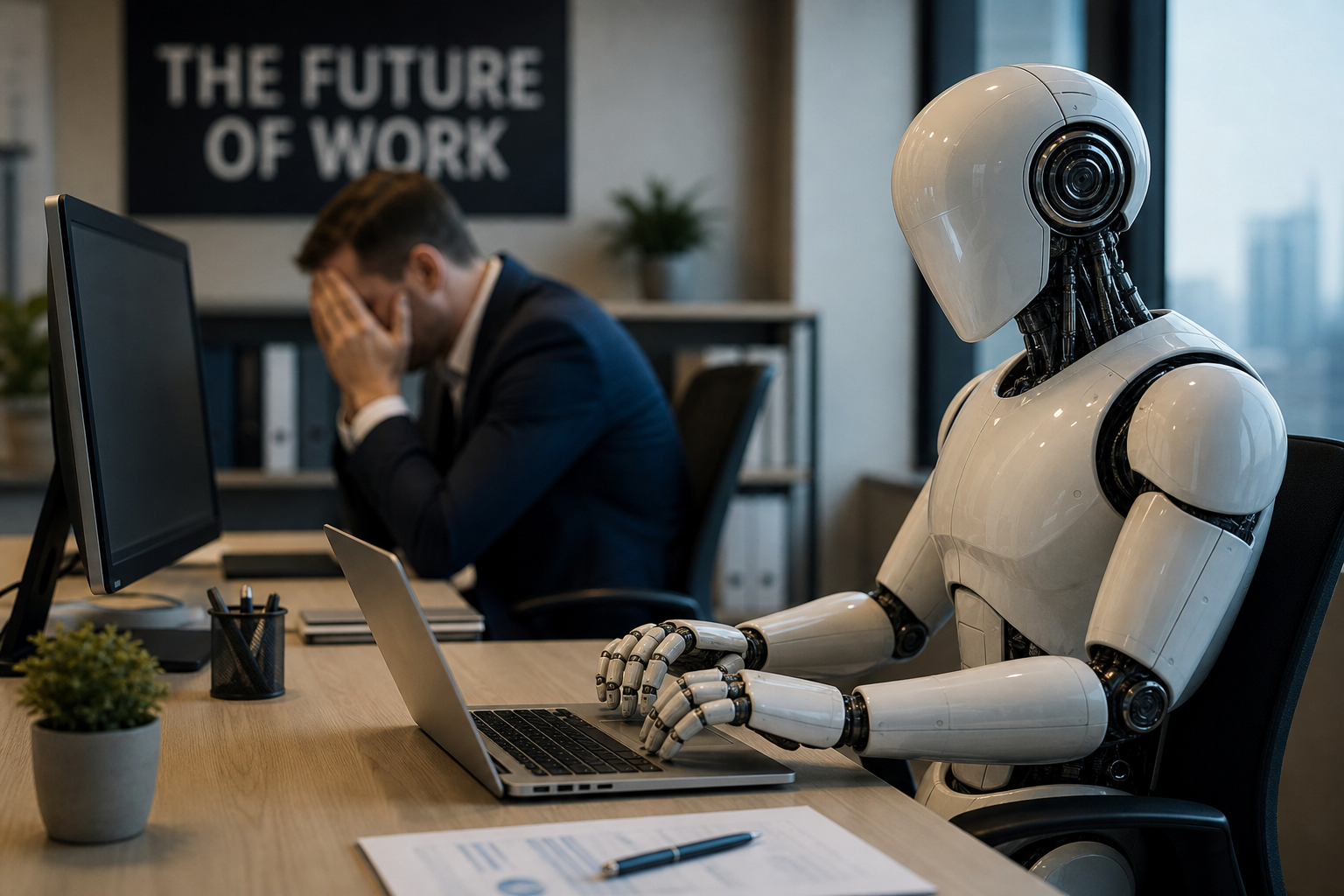
The debate over the impact of artificial intelligence on human labor has been ongoing for years, with some experts warning that AI could displace jobs and fundamentally change the nature of work. At the heart of this debate is the question of whether AI is a normal technology, one that will simply augment human capabilities, or an abnormal one, with the potential to replace human workers entirely.
According to some, the key issue is not whether AI can do everything a human can do, but whether it can do everything better. If AI can outperform humans in most tasks, then it's likely that many jobs will become redundant. This is not just a matter of AI replacing human workers, but also of AI changing the way we value human labor.
The rise of AI has already had a significant impact on certain industries, such as graphic design and music. In these fields, AI has enabled the automation of many tasks, making it possible for machines to perform work that was previously done by humans. While this has created new opportunities for some, it has also led to significant labor shocks and increased wage inequality.
One of the key challenges posed by AI is its ability to learn and improve over time. As AI systems become more advanced, they are able to perform tasks that were previously thought to be the exclusive domain of humans. This has led to concerns that AI could eventually replace human workers in many industries, leading to significant social and economic disruption.
However, not everyone is pessimistic about the impact of AI on human labor. Some argue that AI will create new opportunities and improve the overall quality of life. They point to the example of the phonogram, which replaced live musicians in many venues, but also enabled the widespread dissemination of music and created new opportunities for musicians to reach a wider audience.
Ultimately, the impact of AI on human labor will depend on how we choose to use this technology. If we use AI to augment human capabilities and improve productivity, then it's possible that the benefits of AI will be shared by all. However, if we allow AI to replace human workers without providing adequate support and protection, then the consequences could be devastating.
As the mathematician Terrance Tao has warned, the push by AI companies to solve mathematical problems as a benchmark is detrimental to the science of mathematics and the mathematical community. The goals of AI companies and the goals of the mathematical community are severely misaligned, and this misalignment could have significant consequences for the future of mathematics and other fields.
The question of what it means to be human in a world where AI is increasingly prevalent is also a critical one. If AI can perform many tasks that were previously thought to be the exclusive domain of humans, then what does it mean to be human? Is it simply a matter of being a biological organism, or is there something more to it?
These are complex questions that will require ongoing debate and discussion. However, one thing is clear: the rise of AI poses significant challenges and opportunities for human labor, and we must be careful about how we use this technology to ensure that its benefits are shared by all.
Cet article a été rédigé avec l'assistance de l'IA.
News Factory APP - actualités agentiques pour booster votre SEO et AEO.