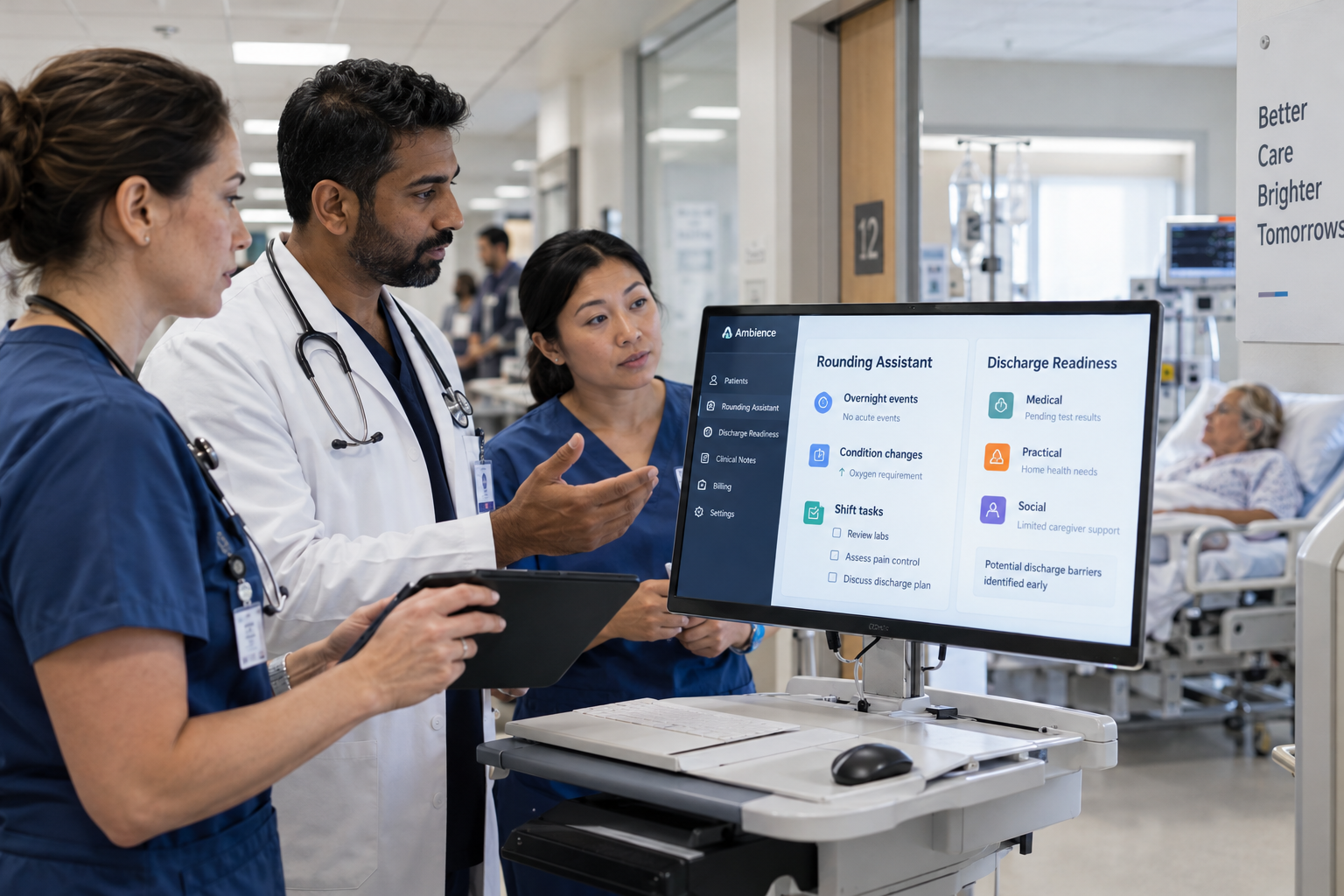
Ambience Healthcare has added two AI tools to its hospital software: Rounding Assistant, which pulls together overnight events, condition changes and shift tasks, and Discharge Readiness, which flags medical, practical and social problems that could delay discharge earlier in a stay. Ambience aims to raise hospitals' case mix index with them, but its figures are not from independent research.
Ambience Healthcare has added two artificial intelligence tools to its hospital software that help care teams decide what to do next for each patient, the company announced Tuesday.
What do Rounding Assistant and Discharge Readiness do?
The new products, Rounding Assistant and Discharge Readiness, join the company's existing software, which writes clinical notes and suggests billing codes for hospital stays. Rounding Assistant pulls together overnight events, changes in a patient's condition and a list of suggested tasks for each shift. Discharge Readiness flags medical, practical and social problems that could delay a patient from going home, and it does so earlier in the stay, giving teams more time to act.
How do the tools affect hospital case mix index?
Much of the pitch is about money. Ambience aims to raise hospitals' case mix index, a measure of how sick patients are that helps set what insurers pay. The company says discharges handled with its tools at Onvida Health scored 6.5% higher than a year earlier.
Mike Lewis, chief financial officer of Onvida Medical Group, said the investment had to pay off. “To justify the investment, we needed roughly a 1.5% improvement in case mix index,” Lewis said. He added that Onvida's own finance team checked the results.
Are Ambience's AI results independently verified?
Ambience also says admission notes written with its tool captured 59% more of the diagnoses used in quality rankings. That figure comes from one health system's review of 1,100 stays. None of the company's figures come from independent research.
Ambience is backed by Andreessen Horowitz, Kleiner Perkins and the OpenAI Startup Fund. It counts Cleveland Clinic and Mayo Clinic among its customers and ties its fees to results. Cleveland Clinic has also backed Dyania, another hospital AI startup.
The launch comes as AI note-taking tools draw scrutiny. In August, England's patient watchdog warned that AI scribes were getting drug names and diagnoses wrong. Competition is heating up, too. Heidi raised $340 million in September, and Google launched Gemini for healthcare last week.
Cet article a été rédigé avec l'assistance de l'IA.
News Factory APP - actualités agentiques pour booster votre SEO et AEO.