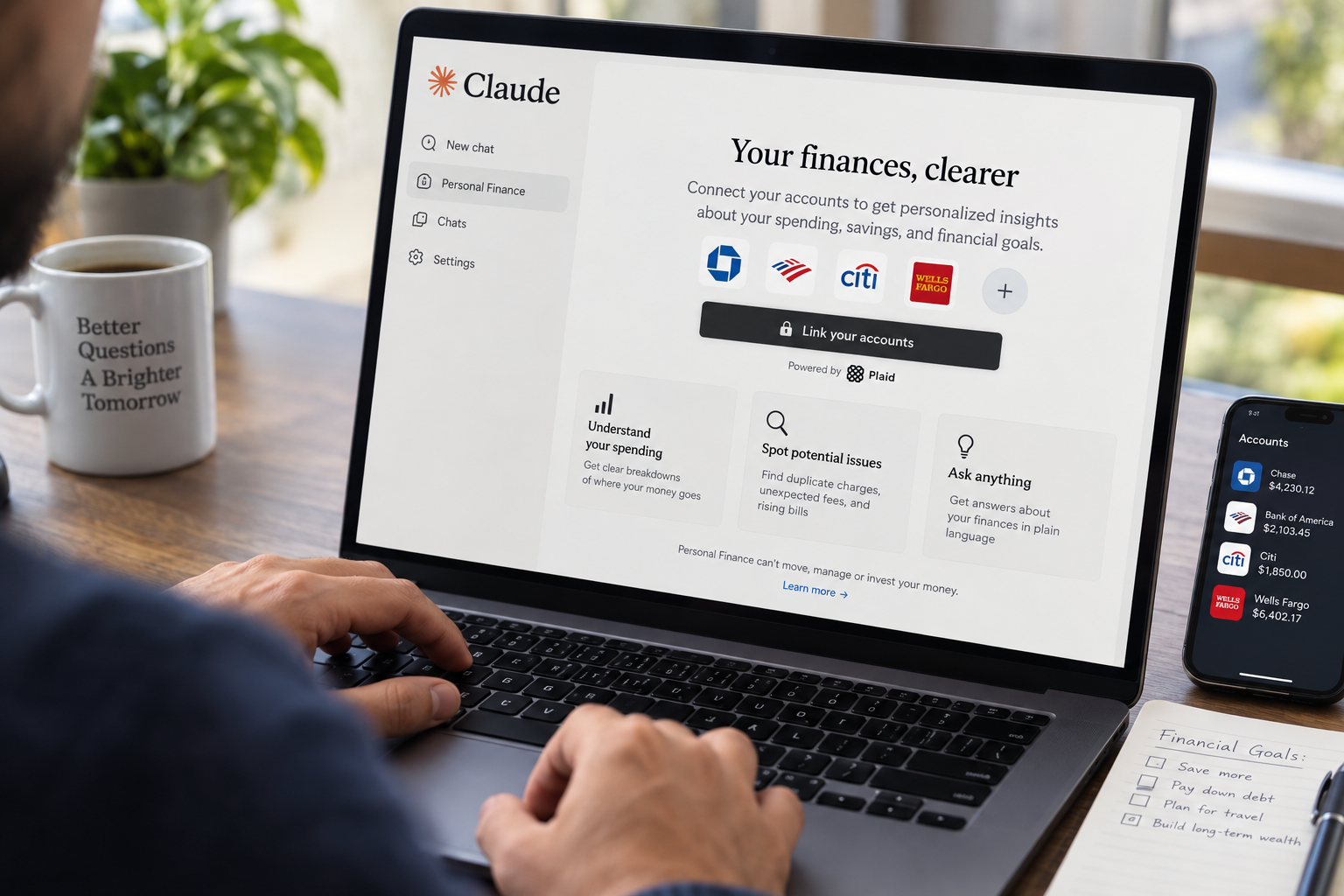
Anthropic is giving users of its Claude chatbot a way to look at their own money. The company announced Thursday a new feature called Personal Finance, which lets people connect their bank and credit card accounts and ask Claude questions about their spending. The rollout starts in beta this week for Pro, Max and Ultra subscribers in the United States.
Can Claude Move or Invest Money Through Personal Finance?
Connections run through Plaid, the financial data company. Anthropic says Plaid's network reaches more than 12,000 financial institutions, including large banks such as Citi and Chase. Once an account is linked, Claude can read it but cannot act on it. "Personal Finance can't move, manage or invest your money," the company said in a blog post.
The launch brings Claude into a space OpenAI entered first. ChatGPT added similar personal finance tools in May, with the same basic idea of linking accounts and asking questions about spending patterns and long-term planning. Anthropic is positioning its product as something closer to a financial companion, one that helps people make sense of what they already have rather than handing out generic advice.
The day-to-day use is meant to be simple. A user could wrap up the month by asking, "Where did my money go this month?" Claude adds up spending across the linked accounts and sorts it into categories such as rent and utilities, food and drink, and shopping. From there, a follow-up like "Is that more than usual?" or "Anything else I'm missing?" lets the user dig further.
Anthropic says the tool goes beyond simple summaries. Claude scans transactions across accounts to flag possible problems, including duplicate charges, unexpected fees and bills that have crept up over time. Users can also ask broader questions, such as whether they are spending more than they earn. If a term is unfamiliar, like APR, or annual percentage rate, Claude can explain it and calculate how much interest the user paid over the past year.
What Can Claude See in Linked Bank Accounts?
Handing financial records to an AI chatbot will worry some people, and Anthropic has spelled out what Claude can see. Access is limited to each connected bank's name, the account name and type, the last four digits of the account number, balances, credit limits and up to two years of transaction history. Anthropic also says conversations held in the Personal Finance hub are not used to train its models. Chats about financial information outside the hub fall under a user's regular privacy settings, the company said.
How Does Claude's Personal Finance Differ From ChatGPT's?
That distinction is one Anthropic is eager to draw against OpenAI. "Personal Finance has no ads or sponsored recommendations, and it doesn't offer credit cards, loans or savings accounts of its own, so your money questions get a straight answer," the company said. Anthropic also contrasts its approach on training data. According to one comparison, OpenAI applies a user's existing data control settings to its personal finance experience, which means people who do not change those settings are enrolled in model training by default.
Beyond those differences, the two products look broadly similar. Both can flag unusual fees and rising bills, generate spending charts and budget breakdowns, and explain financial terms.
Anthropic also said it is exploring how Claude could work alongside licensed professionals and regulated firms to offer financial advice. The company did not say what that would look like, but it asked banks and wealth managers to get in touch.
The Personal Finance launch follows a broader push into specialized areas. Anthropic introduced Claude for Legal and Claude for Financial Services earlier this year. One analysis of the timing noted that the announcement comes as the company is expected to complete an initial public offering in the next few weeks.
Cet article a été rédigé avec l'assistance de l'IA.
News Factory APP - actualités agentiques pour booster votre SEO et AEO.