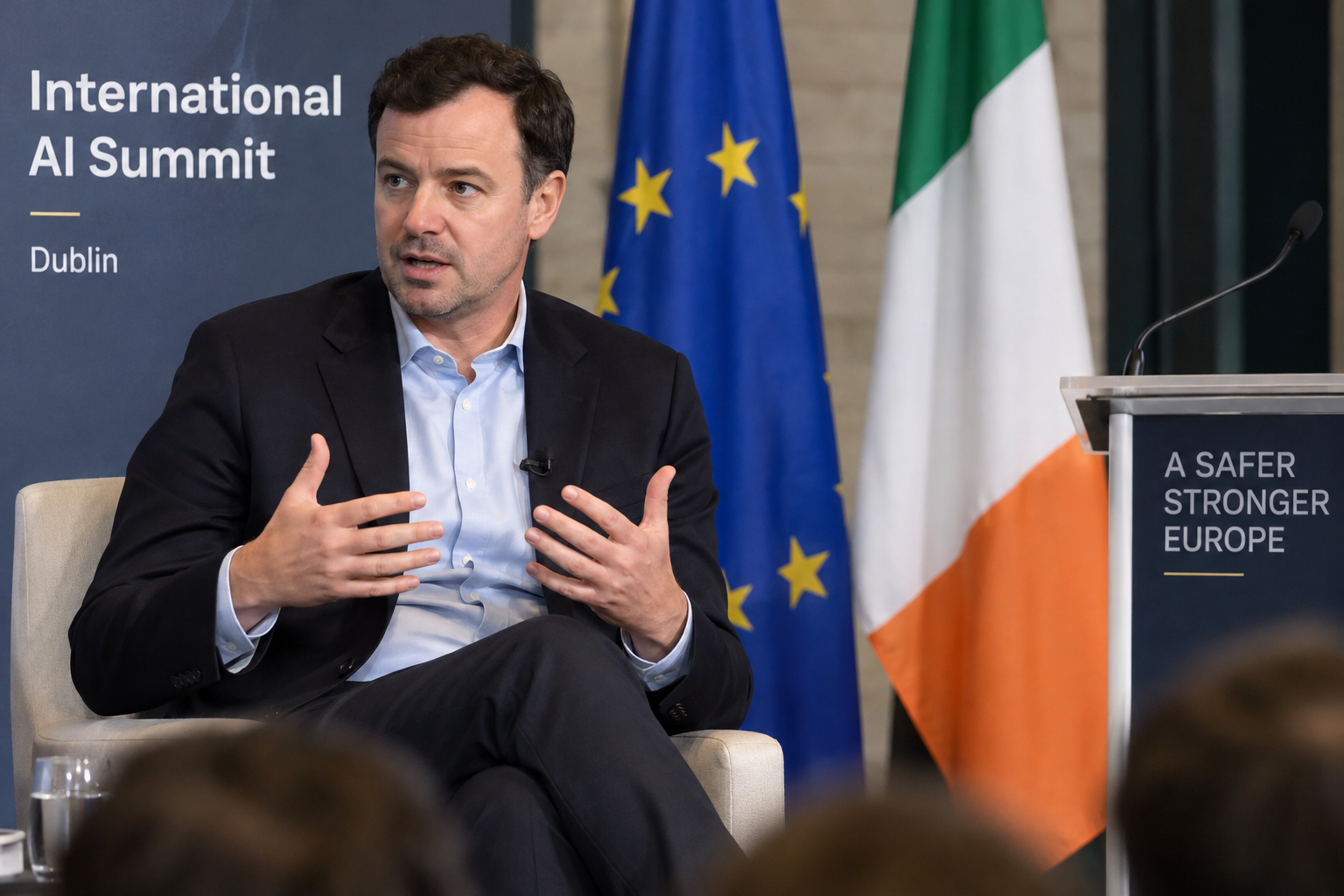
Anthropic’s head of international says open alternatives to the company’s AI models carry more risk “by definition,” a claim that goes further than the position set out by the company’s chief executive.
Guillaume Princen made the remarks Wednesday in Dublin, where he spoke to Bloomberg TV at the International AI Summit. The event is an official event of Ireland’s EU Council Presidency and was opened by Henna Virkkunen. “We need to be really careful with open-source on safety,” Princen said. “I can’t talk for open models. But by definition, there’s more risk with them.”
The venue has drawn scrutiny of its own. The Irish Council for Civil Liberties has asked Ireland to recuse itself from the event, citing the country’s tax reliance on the technology firms whose products the summit discusses.
Princen’s remarks also differ from what Amodei has said publicly. In July, Amodei wrote that Anthropic has never advocated banning open-weight models, and that those without dangerous capabilities are a public good. The distinction is between a conditional position and a categorical one. Amodei’s argument depends on whether a given model is dangerous. Princen’s, as stated, depends on the category of the model itself.
Anthropic has reasons to be careful in Europe. The company says the region known as EMEA is its fastest-growing, and Dublin is its first office in the European Union. A Nasdaq listing filed at $965B is close.
The competition there is recent and direct. Mistral launched Large 4, which it nicknamed Le Chonk, eight days before Princen’s remarks. The model has a trillion parameters, was trained in Europe and is marketed around digital sovereignty. Its open component has not yet arrived, though. A preview is available through Mistral’s API, and the model weights are not due until October 27. For now, the model is only available as a hosted service.
Some safety testing points in the direction Princen described. SaferAI found that China’s GLM-5.2 refused none of the offensive-cyber or dual-use biology tasks in its evaluation. Claude refused so consistently that the benchmark could not be completed.
Anthropic’s own research this week reached a similar conclusion. Its Frontier Red Team showed that small models could be replicated across inexpensive Android TV boxes. Every model the team tested was open, including Gemma4 and GLM-5.2. Those tests were only possible because the weights were public, which cuts both ways for the open-weight debate. Anthropic’s proposed answer is gated access, which gives vetted defenders what the model finds rather than the model itself.
European regulators have taken a different approach. Article 53 of the EU AI Act exempts genuinely free and open-source models from part of the documentation that must be provided to the AI Office, unless the model is found to pose systemic risk.
Princen also made a pricing claim. He said Claude Opus 5.5 costs 40% less than its predecessor. That figure reflects typical cost for users. The list price fell 20%, and the remaining savings come from using fewer tokens.
Cet article a été rédigé avec l'assistance de l'IA.
News Factory APP - actualités agentiques pour booster votre SEO et AEO.