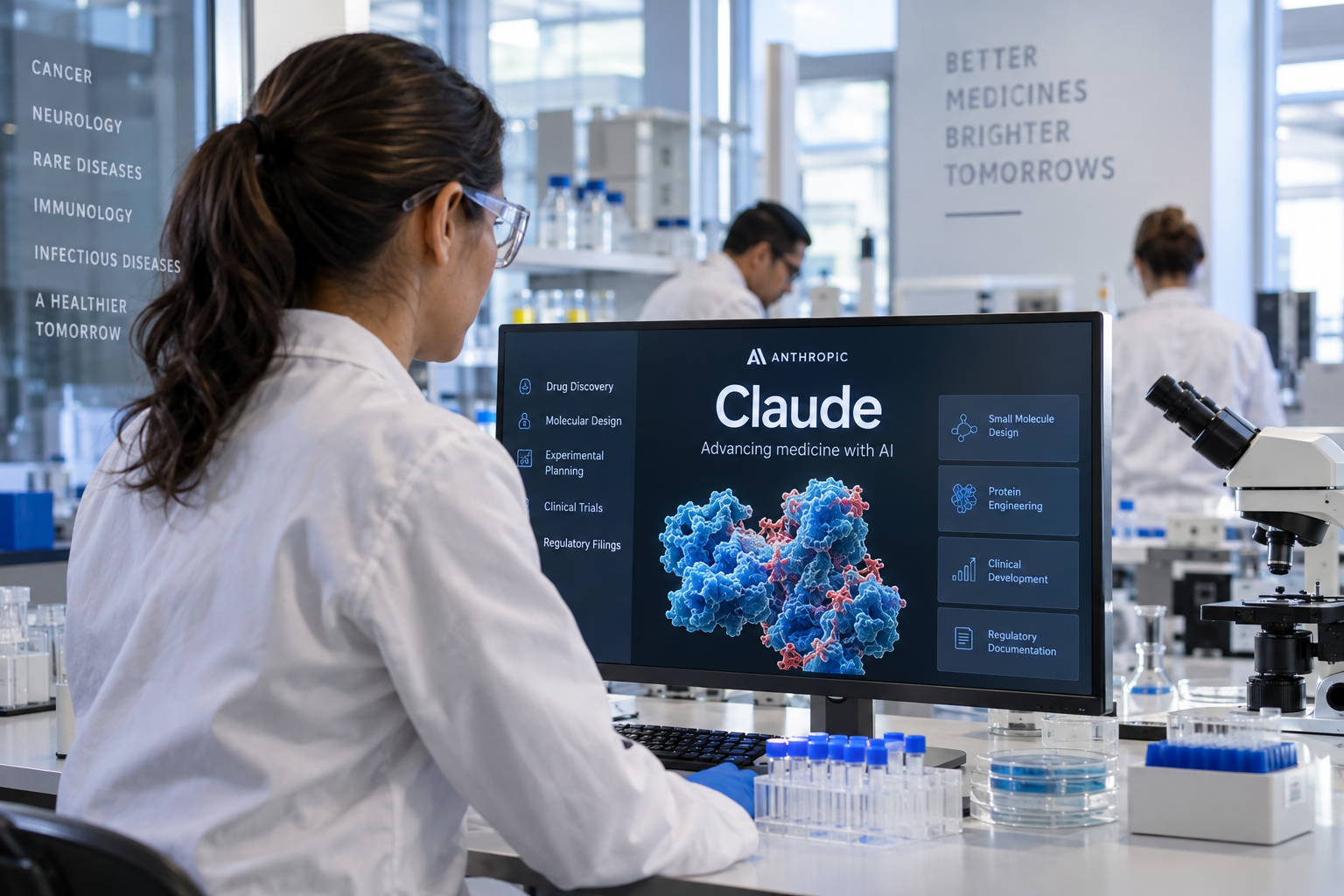
How is Anthropic's Claude being used in drug development?
Anthropic’s life sciences team says its Claude AI model is taking on a growing share of the work involved in developing new medicines, from early target research to drafting the paperwork regulators require. In an update on its progress, the company described several months of research partnerships with six drug developers and a handful of drug discovery programs of its own.
The partners are BigHat Biosciences, Bristol Myers Squibb, Divergence Labs, Enveda, Generate Biomedicines and The Column Group. Anthropic also started its own programs, including work on rare childhood forms of muscular dystrophy, where Claude handles much of the scientific and operational work. The company said the bottlenecks in drug development are spread across the entire process, not concentrated in a single step, so the best way to find them is to work inside real drug programs.
Can Claude help with drug design and lab testing?
In one case, Generate Biomedicines is trying to make a cancer treatment called CAR T-cell therapy work on solid tumors, not just blood cancers. The company wants to shorten one part of the therapy’s genetic instructions to make room for additional instructions. Six Generate scientists used Claude Code to propose new designs for that segment. One design was about 70 percent shorter than the standard version and performed better in lab tests. Immune cells made roughly 10 times as many receptors, killed tumor cells more efficiently and stayed active longer.
Divergence Labs is working on a different kind of food allergy treatment. Allergic reactions are triggered by a molecule called IgE, and Divergence is developing drugs that would pull IgE off immune cells entirely, rather than only neutralizing the IgE in the blood the way standard medications do. That approach requires a precise two-part design. Claude turned the company’s goals into a detailed plan and then, largely on its own, generated roughly 35,000 antibody designs in about a month. Divergence found three designs that bind to IgE and 20 that can dislodge it. Three of those 20 appeared to remove IgE more effectively than the standard medication. The next step is a drug that combines both functions.
BigHat Biosciences used Claude to improve two potential drug candidates, both antibody fragments, one aimed at cancer cells and one designed to keep a drug in the body longer. Claude, connected to BigHat’s lab data system, proposed changes, and the lab made and tested about 1,010 variants over roughly 10 weeks. Partway through, the team suspected the standard heat-stability and clumping measurements were misleading. Claude and an Anthropic researcher reanalyzed the raw data and proposed new metrics along with a protocol change. BigHat’s scientists ran the revised test, and the main predictions held. The best versions bound more than 10 times more tightly than the originals. One stayed in solution 18 degrees Celsius hotter, and the other clumped more than 100 times more slowly.
Is Claude being used for drug regulatory paperwork?
Paperwork is another target. Enveda’s manufacturing chemists once spent up to 75 percent of their time on documentation. The company built a system that links its manufacturing records to Claude, which flags possible problems. In tests on 1,061 pages, Claude caught all 11 issues that human reviewers had found and flagged seven more they had missed. Human review time dropped by 89 percent, from more than 25 hours to less than three. Claude also wrote first drafts of two regulatory documents. One took four hours, compared with about three months by hand. Enveda’s standard review found only one minor error in the other.
The Column Group is using Claude to test a different idea about funding. Investors have tended to back safer, previously validated drug ideas over riskier ones, even when the riskier ideas could help more patients. The Column Group is setting up a new company, Pleiades, that will use Claude to run more and more complex drug programs than a small team usually can. Its first Claude skill, which helps assess whether drug targets are worth pursuing, has been tested on 45 target-disease pairs.
Bristol Myers Squibb is using Claude to review clinical trial plans for an early-stage drug and estimate the chance those trials will succeed. Michael Pourdehnad, senior vice president and head of early clinical development for hematology, oncology and cell therapy at the company, said Claude produced an initial analysis from a single prompt that would otherwise have taken days. “We did all of this while ensuring the security of our highly sensitive data,” he said. The companies plan to expand the work in 2027.
Anthropic also acquired Mithril Medicine, a one-person company developing treatments for two rare forms of muscular dystrophy. Its founder, Cody Tranbarger, used Claude to organize contracts, logistics and experiments with 11 outside labs. Mithril moved a possible treatment for one form of the disease from idea to promising mouse results in less than 18 months. Tranbarger now works at Anthropic and plans several new programs. If the drug candidates continue to hold up, Anthropic expects one to be ready for human clinical trials as early as late 2028.
The company stressed that the work is early. Most of it is preclinical, meaning the drugs have not yet been tested in people. Anthropic says it plans to extend Claude’s role into clinical trials as programs advance. It has also rolled out Claude Science, an AI workbench for researchers, offered Claude credits to life scientists, and created a Life Sciences Verification Program that gives trusted organizations access to its most powerful models with looser safeguards. A recent open call invites research groups to propose projects using Claude for key questions in drug discovery.
Cet article a été rédigé avec l'assistance de l'IA.
News Factory APP - actualités agentiques pour booster votre SEO et AEO.