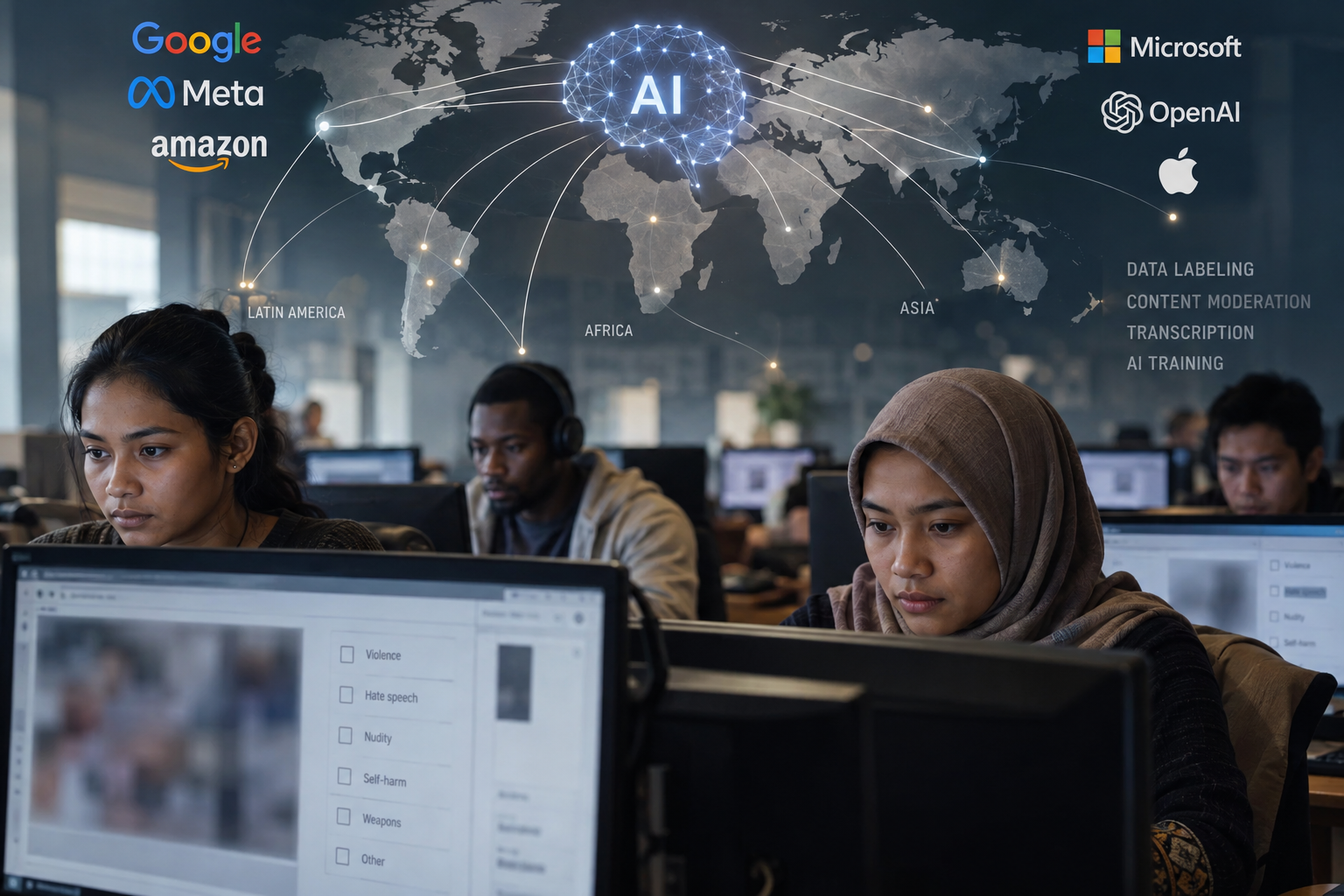
Most people know that artificial intelligence sorts their social media feeds, plans their driving routes and suggests what to watch next. Far less visible is the human work that makes those systems function. A Brown University undergraduate wants to change that.
Cunyan Ma, a senior working with Brown’s Center for Technological Responsibility, Reimagination and Redesign, has created an interactive map that connects technology companies and their intermediaries to data workers across the globe. The map is freely available online. It pulls together existing data worker databases, Ma’s own data collection and news reports describing the conditions many data workers face.
“My primary motivation is to visualize the idea of AI colonialism in an impactful and immediately accessible manner,” Ma said. “The gap I’m trying to fill is that most of what we know about data workers comes from anecdotal reports from authors and journalists. Those are great because they give us a very detailed look at working conditions and pay, etc. But I’m hoping this might start to fill in a larger picture of what AI colonialism actually looks like.”
Work that stays out of sight
What hidden human work makes AI systems function?
An AI model cannot do much until people train it. At the most basic level, that might mean labeling objects in photos or tagging parts of speech in a sentence. It can also involve transcribing long stretches of speech, rating good and bad responses from chatbots, or marking tumor boundaries in medical scans.
Some of that work is tedious. Ma says some of it is far worse. To filter out disturbing images or posts, or to keep chatbots from producing that material, AI systems have to learn to recognize it. That means data workers have to look at horrifying images and read disturbing text so the systems can flag it.
Most large companies, from social media platforms and tech firms to retailers and defense contractors, send their data labeling work to firms that specialize in it. Many of those firms look for inexpensive labor.
“How that manifests in reality is that companies outsource that work to the Global South — Kenya, Indonesia, Colombia and elsewhere,” Ma said. “So you have folks around the world who have to read paragraph after paragraph of AI-produced child pornography, bestiality, violent content or whatever else, just to try to train AI to be safe.”
For Ma, that arrangement is the core of AI colonialism: difficult, low-paid labor extracted from the Global South to serve profit in the West.
Mapping the power structure
Ma set out to trace that chain of labor, which she says is deliberately kept opaque to avoid accountability. She drew on existing databases of data labeling firms and their corporate clients. She also built her own database of the delivery centers those firms operate, which serve as a proxy for where data workers are located. The map draws lines between those points.
How does the map show who does AI data labor?
In its current form, the map shows links between 13 data labeling companies, 141 of their corporate customers and 31 countries that host data worker sites. Ma acknowledges it is not a comprehensive picture of AI labor. She hopes it is an illustrative one.
“One purpose for this is as a public education tool,” she said. “When people want to learn about AI and its social impact, the map puts it in the context of this larger economic and political structure.”
Venkatasubramanian, a Brown computer science professor who leads the center, said work like this helps people see past the technology itself. “It’s all humans underneath,” he said. “That’s the real story behind the generation of AI. The problem with a lot of current discourse around AI is that it seeks to ignore that. The result is that we start constructing stories around AI as its own sentient being, as something that’s alive. But it’s not. It’s something that’s built — something that’s constructed by us, by people, all across the world.”
Ma plans to keep expanding the map and to examine other parts of the physical and human infrastructure beneath AI. She said she hopes to map the labor involved in the semiconductor industry next. She describes the approach, known as power mapping, as a way to understand how global power structures shape where labor is distributed around the world.
She also sees the map as a potential tool for workers themselves. Data workers are often scattered and do not know their counterparts exist.
“One of the things about this is that it’s distributed,” Ma said. “People don't even know about their fellow co-workers. That makes unionizing or anything like that just kind of impossible. Maybe they can use a future iteration of the map to identify each other.”
Ma’s broader hope is that by showing who sits at the base of AI’s supply chain, the map might help bring about a more equitable distribution of AI labor and the benefits it produces.
Cet article a été rédigé avec l'assistance de l'IA.
News Factory APP - actualités agentiques pour booster votre SEO et AEO.