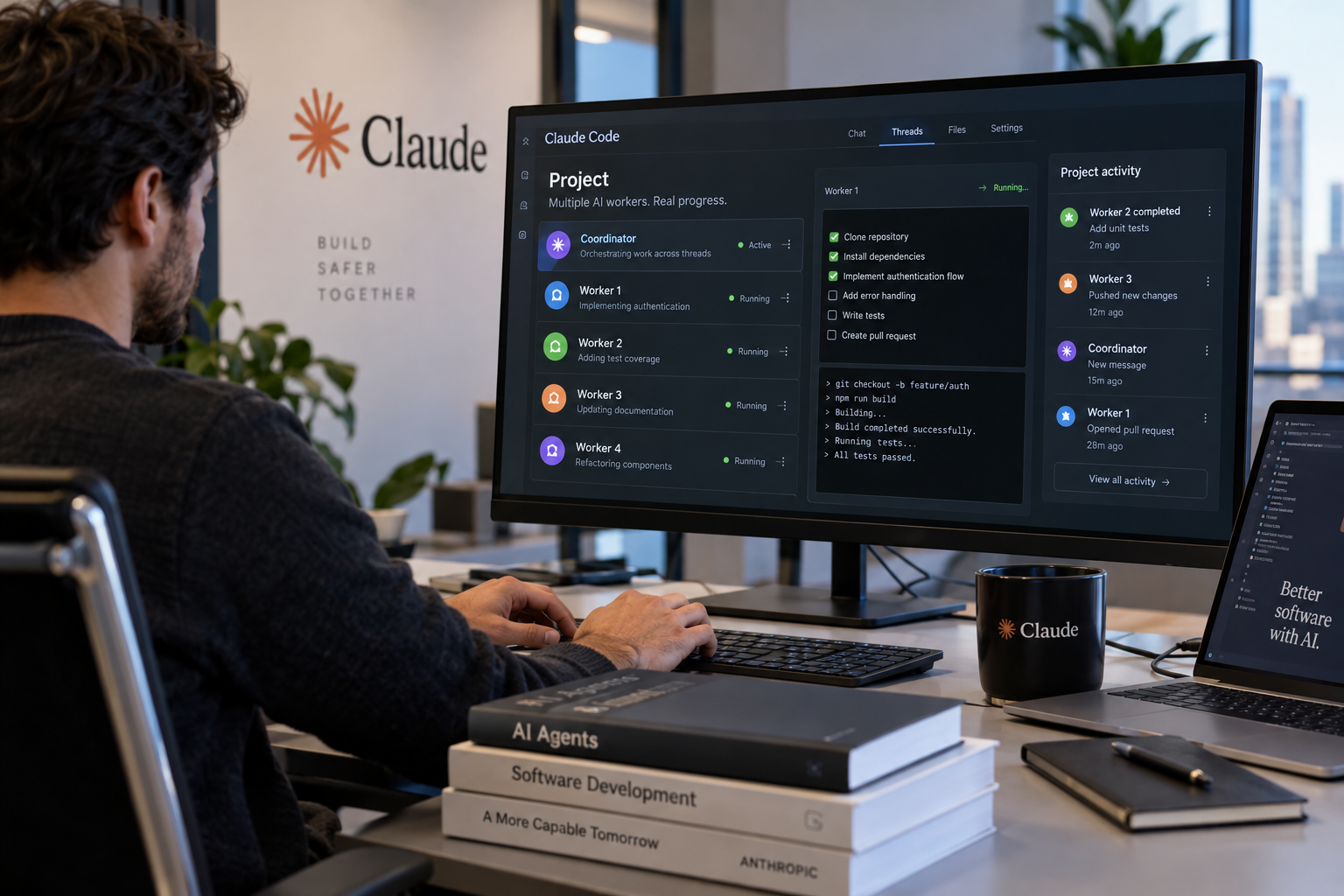
Anthropic has updated Claude Code Projects with a set of changes aimed at cutting the amount of babysitting required when several AI sessions work at once. The update adds proactive coordinator messages, read-only thread sharing, reminders, branching commands and a reworked threads panel.
A Project is a long-running conversation with a coordinator that assigns work to threads. Each thread runs as an independent Claude Code cloud session with its own copy of the repository and its own Git branch. The coordinator steers the project using reports from those threads. When two threads touch the same code, the overlap shows up as standard Git merge conflicts when the branches are combined.
How do Claude Code Projects workers report progress?
Until now, developers had to watch the thread list to find sessions that were waiting for input. The coordinator now answers questions directly in project chat and posts status updates as threads move forward. Pending decisions, completed tasks and blocked work land in the main conversation, so a developer can see what needs attention without hunting for it.
Sharing threads and keeping local data private
How do you share a Claude Code Projects thread?
Individual threads can now be shared through read-only links. Anyone signed in to Claude can open one. To create a link, a developer opens the thread menu, selects Share and sends the generated URL. The rest of the project stays private.
Threads that have accessed a local computer cannot be shared. Anthropic designed that restriction to keep shared transcripts from exposing local file contents, shell output or other machine data gathered during the session.
Parking work with reminders and branches
Reminders hide a thread until a set time, then return it to the thread list and notify the coordinator. Anthropic suggests them for work that depends on a later review, a deployment or an outside response.
The slash commands /btw and /fork handle the other common interruptions. The /btw command opens a separate thread for a tangent while keeping the current thread's goal and context intact, which is useful for looking into a related issue without derailing active work. The /fork command creates a new thread from the current thread's state, which suits testing an alternative implementation or a different debugging path. Both commands already existed in regular Claude Code sessions. Their addition to Projects brings the same branching workflow to multi-thread work.
The threads panel also changed. Recently opened, updated and pinned threads now sit in a row at the top. Threads can display thumbnails for generated documents, diagrams and other artifacts, and the previews are controlled through view settings. The redesign also simplifies project settings and local-folder access. Anthropic has released the changes on the web, in desktop clients and in the latest mobile app.
Who can use it and what it costs
Who can use Claude Code Projects and what does it cost?
Anthropic introduced the public beta for Pro and Max subscribers who joined the waitlist. Team and Enterprise plans are not supported yet. Eligible subscribers who do not yet have access can still join the waitlist.
Projects carry no separate fee. Every worker, however, uses the subscriber's existing Claude Code allowance. Anthropic limits accounts to 200 new threads per day across all projects. A thread that hits a usage limit pauses and resumes automatically once capacity returns. Project usage appears separately in the usage controls.
Developers can pick the model and effort level for the coordinator and the worker threads. New projects default to Opus for both roles, with low effort for the coordinator and high effort for workers. Anthropic cautions that several high-effort sessions running at once can exhaust plan limits faster than a single Claude Code session would.
Anthropic points to engineering work that can be split into independent tasks and then reconciled through branches and pull requests. Its examples include performance work, where separate threads profile endpoints, test optimizations and open pull requests. Another is cross-repository migrations, where a developer connects API, web and mobile repositories, creates one thread per codebase and reports the required merge order. The third is batch changes, such as distributing refactors, dependency upgrades, test repairs or bug-triage items across parallel sessions.
Not every task fits. Work with strict dependencies still requires developers to sequence pull requests and resolve conflicts by hand. Projects also remain cloud-only and limited to Claude Code, and parallel workers draw from the same plan limits. Small changes that fit on one branch and within one context window generally use fewer resources in a regular Claude Code session.
Cet article a été rédigé avec l'assistance de l'IA.
News Factory APP - actualités agentiques pour booster votre SEO et AEO.