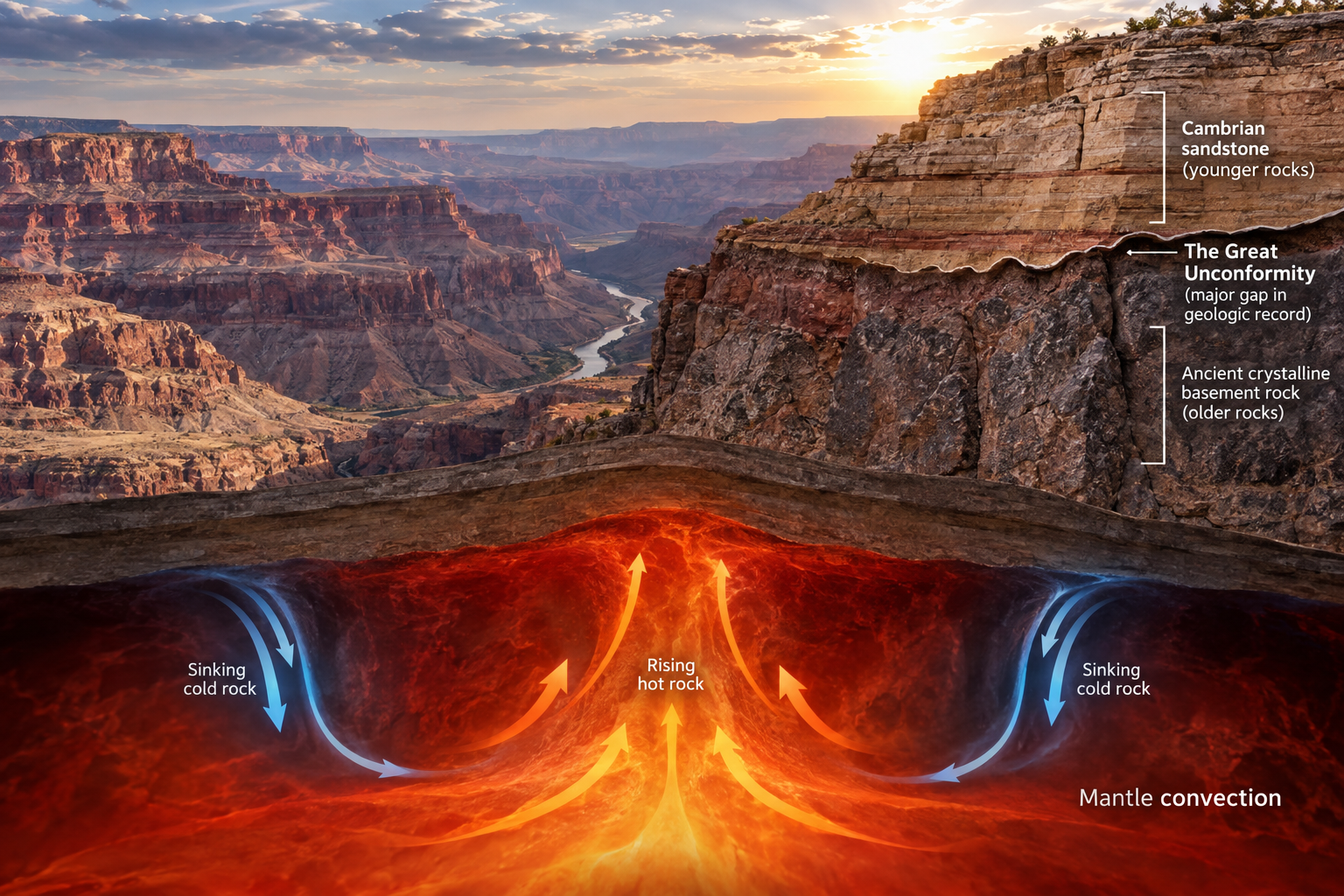
Deep beneath the surface, slow-moving rock may have helped carve out one of the largest gaps in Earth’s history. A new study in Nature argues that currents in the planet’s mantle pushed continents upward for hundreds of millions of years, setting the stage for glaciers to scour away enormous amounts of stone.
What is the Great Unconformity?
The gap, known as the Great Unconformity, is visible in the Grand Canyon. Ancient crystalline rocks form its bottom layer, while sandstones laid down as life began to diversify during the Cambrian explosion sit on top. “It’s called the Great Unconformity, and it’s a gap in the geologic record,” said Nicolas Flament, a geoscientist at the University of Wollongong in Australia. “This gap can be anywhere between 200 million years, which is not that impressive, to more than a billion years.”
Could mantle currents have carved the Great Unconformity?
Flament and his colleague Santosh Dhungana say the gap was shaped with help from deep inside the planet. Their models show slow currents of hot rock lifting entire continents, which allowed glaciers to grind them down. The continents then sank, and fresh sediment buried the eroded surface.
Glaciers were not enough on their own
The oldest sediments resting on the Great Unconformity in North America are between 635 and 482 million years old. Geologists have traced the gap across most of North America and parts of northern Europe and northern China. Glaciation had long been the leading explanation. Between roughly 720 and 635 million years ago, glaciers reached the tropics, and some scientists think the entire planet froze over in a scenario called Snowball Earth.
Flament said ice sheets are highly effective at wearing down rock. He noted that glaciers are about 10 times more effective than rivers at eroding rock away. But if the whole planet had frozen, the gap should appear everywhere, and it does not.
Why was the Great Unconformity so hard to explain?
Other explanations also fell short. Rifting, the pulling and stretching of Earth’s crust, mostly affects the edges of continents. A global drop in sea level should have affected all continents alike. “There’s no doubt that there was extensive glaciation. There’s no doubt that there have been sea-level changes throughout time. The question is, was that enough to put the Great Unconformity puzzle together?” Flament said.
A fourth idea, known as dynamic topography, held that the mantle itself moves continents up and down. Flament said the idea had been proposed but never tested quantitatively. His team set out to do exactly that.
A lava lamp beneath the continents
From roughly 100 to 200 kilometers beneath the surface down to nearly 3,000 kilometers, Earth’s mantle slowly churns. “An analogy would be a lava lamp, where some stuff comes up and some stuff comes down,” Flament said. “Cold rock sinks and hot rock rises.”
The mantle is solid, yet a piece of rock can travel from the surface to the deep Earth over some 200 million years. That motion tugs on the crust above. Where cold slabs of ocean floor sink at subduction zones, the ground is pulled down. Where hot mantle rises, the ground is pushed up. Scientists still debate the size of this motion. “The short of it is several hundreds of meters, and it’s still to be worked out exactly what that [precise value] is,” Flament said.
Dhungana and Flament ran six simulations of mantle convection going back 1 billion years, guided by reconstructions of how tectonic plates moved over that span. The team then grouped regions where the ground rose and fell in similar ways to identify where the gap should have formed and where it should have survived to the present.
The models carry real limits. Magnetic records in ancient rocks show how far continents were from the equator, but not their longitude. “It’s possible that some continents may be in the wrong hemisphere,” Flament admitted. The ancient ocean floor, long since recycled into the mantle, had to be built from scratch in the simulations. Flament also said the starting configuration of the simulations remains uncertain. Even so, the models produced a consistent picture.
In those models, Laurentia, the ancient core of North America, saw little or no subduction along its edges between about 930 and 510 million years ago. It sat above rising mantle and was pushed up. Five of the six models showed this pattern, with uplift followed by sinking during the Cambrian. The same pattern appeared in four models for northern Europe and North China.
The uplift alone, however, was too gentle to strip away enough rock. The team concluded that something else was needed.
Why North America shows the gap most clearly
“The uplift could create a tilt for the whole continent, but it’s not great at creating a steep slope,” Flament said. In his view, the missing piece was glaciers that could grind through rock even on low ground and gentle slopes. The models show the uplift was still building when Snowball Earth hit. “This gentle uplift that’s continuous, and then that glacial erosion that comes on top, work together,” Flament said. “They’re not coupled. They just happen to coincide in time.” When the continents sank during the Cambrian, seas flooded in and buried the eroded surface.
The models also explain why the gap is so obvious in North America but harder to find elsewhere. Compared with sediment records on each continent, North America and Eurasia show one long rise followed by one long fall. The researchers describe that pattern as the ideal recipe for the Great Unconformity.
South America and Australia went through two cycles instead. “This would form potentially two unconformities, and then the Great Unconformity would be more difficult to see,” Flament said. Africa was different again. Mountain belts hemmed it in at the time, so its erosion and sediment were shaped more by those mountains than by the mantle beneath.
If the mantle cycles up and down regularly, why is there only one Great Unconformity? The team says the answer lies in a combination of factors: a rise-and-fall cycle lasting more than 900 million years, a near-global glaciation that happened at the right moment, and rock records that become harder to read the farther back they go.
Flament suspects an older candidate may exist, tied to a glaciation 2.4 billion years ago. Rocks that old, however, lack the fossils that make younger sediments easier to date. “Having life in sediments makes it a lot easier to have a sense of time,” he said.
The work may also help explain what happened right after the gap formed. The intense erosion that carved the Great Unconformity washed rock material into the oceans, possibly fertilizing them just before the Cambrian explosion, when calcium became abundant in seawater. “That’s when life learns to mobilize calcium and create skeletons and shells,” Flament said. He cautioned that mantle dynamics were likely not the only process behind the Cambrian explosion. “I think it would be misleading to say the mantle set the pace here. But I think it was one of the forces that worked together.”
Cet article a été rédigé avec l'assistance de l'IA.
News Factory APP - actualités agentiques pour booster votre SEO et AEO.