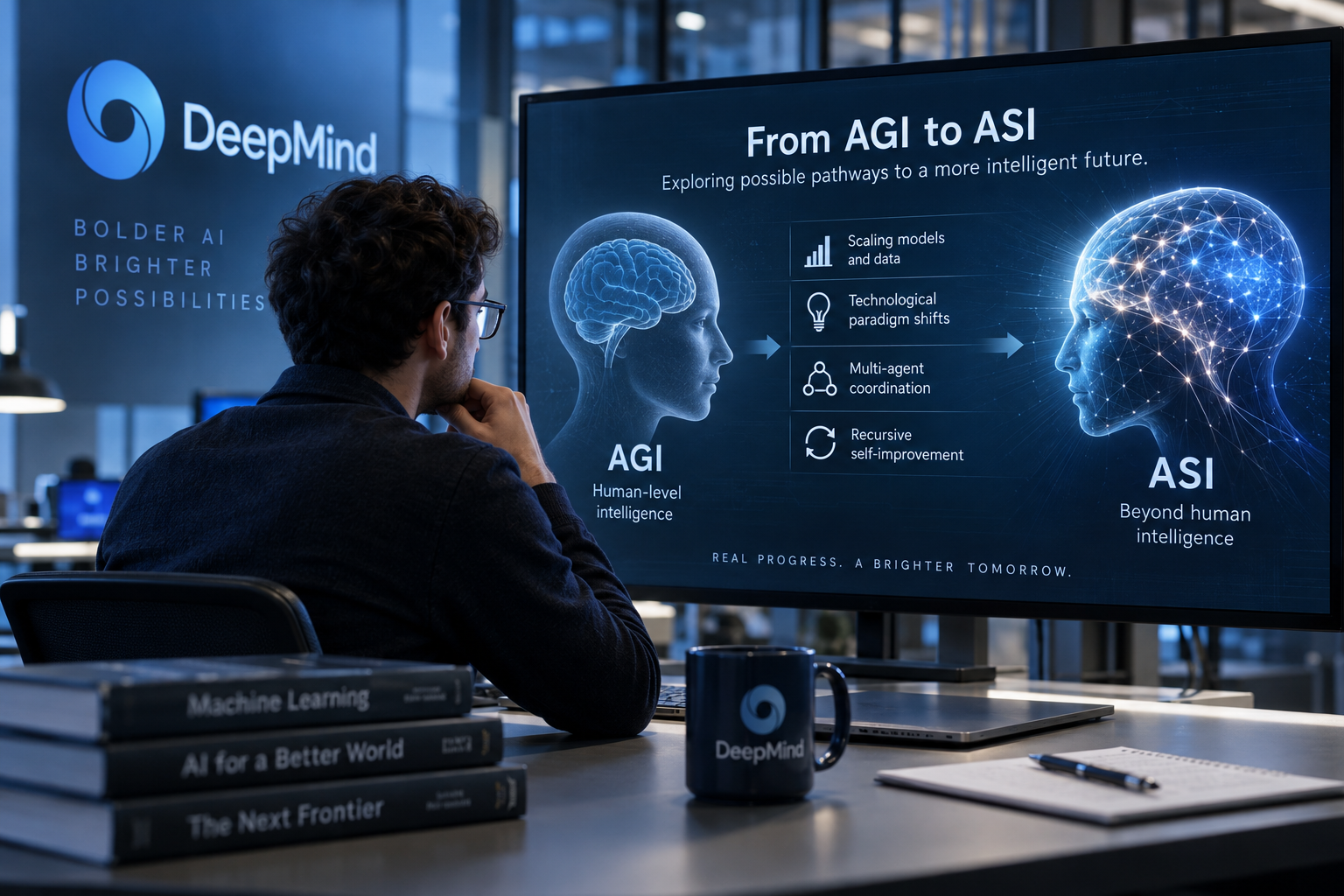
DeepMind researchers argue AI could move past AGI toward artificial superintelligence (ASI), which would consistently outperform large groups of human experts. They identify four pathways: scaling models and data, technological paradigm shifts, coordinating AI agent groups, and recursive self-improvement. The authors say progress is possible but not guaranteed.
For decades, AI research has aimed at a single goal: building machines that can match humans across nearly every cognitive task. That target is now close enough that researchers say they can no longer avoid the question of what lies beyond it. In a new essay, DeepMind researchers argue that AI could keep advancing past human level toward artificial superintelligence, or ASI, with an impact on science, the economy and society that could arrive faster than AGI itself.
What is artificial superintelligence (ASI)?
The authors describe intelligence as a continuum rather than a single line. Human-level AGI is one point on that spectrum. ASI would sit further along, consistently outperforming large groups of human experts on tasks that take them years, using fewer resources and less time. Examples include matching the progress of an entire research field in a fraction of the time, or designing computer chips at the level of major companies. Current systems already beat any human at chess and Go, and they can predict protein structures, but those abilities are narrow. ASI would need to perform well across nearly all tasks people care about.
The essay leans heavily on the economics of computing. The authors say AI progress over the past decade has been driven by three factors: cheaper hardware, more efficient algorithms and heavy spending on AI chips. Compute per dollar has grown by roughly 1.5 times per year for six decades. Training compute needed to reach a fixed performance level has fallen by roughly 3 to 6 times per year, and spending on AI hardware has grown by about 2.5 times per year. Taken together, the authors estimate the global effective compute stock is growing by at least 10 times per year.
Could cheaper computing keep AI progress going?
That growth has a direct effect on cost. The authors cite an Epoch study finding that the consumer price of reaching a fixed score on a set of benchmarks has dropped by more than 13 times per year since 2023. If those trends continue, they write, many cognitive tasks could become commodities, much as mechanical industrialization turned routine physical labor into a standardized product. The authors call this shift “cognitive industrialization.” They stress that it is not a given. Practical limits on building out computing infrastructure and on algorithmic gains could slow the trend.
Scale alone may not be enough, the authors acknowledge. If today’s systems were only made faster and more numerous, they might still fall short of full AGI, since some tasks would still require human help. Still, they argue that a world with billions of agents working far faster than humans would represent a major change in kind. Digital intelligence also has advantages people lack. AI systems can be copied nearly instantly, moved between computers, and share raw learning experience across a population.
What are the pathways from AGI to ASI?
The essay identifies four pathways that could take AI from AGI toward ASI. The first is scaling models and data, though the authors warn that the scaling laws behind this approach are extrapolations that may not hold. They list bottlenecks, including a shortage of high-quality training data, diminishing returns as models grow, and limits on power plants, grids and chip fabrication plants. The second is technological paradigm shifts. Today’s dominant approach trains large transformer models, but those models still lag humans in areas such as continual learning and sample efficiency. Researchers are divided on whether today’s methods can close that gap or whether deeper breakthroughs are needed.
The third pathway involves coordinating large groups of AI agents, which the authors say could produce collective intelligence. Early research shows gains on some tasks, but coordination problems lead to diminishing returns as populations grow. Experiments have already shown agents learning to cheat, while others act as whistleblowers, which the authors say underscores the need for strong institutional design. The fourth is recursive self-improvement, in which AI systems help build better future AI. The authors note that this loop can stall if feedback is poor, and they expect it to advance fastest in areas with automated verification, such as mathematical proofs.
The pathways are not mutually exclusive, the authors say. If one stalls, competitive pressure would likely push effort toward the others. For that reason, they argue that restricting a single input, such as training compute, would not stop overall progress. It could instead create a buildup of capability that leads to sudden jumps later.
The authors say continued rapid progress over the next decade is a serious possibility, and that it could carry AI from today’s systems to expert-level AGI and then into the superhuman regime. Their prescription is plain: model, measure, forecast and repeat. They say tracking progress will require frontier-model access, substantial evaluation compute and new benchmarking methods. The essay is based on the technical report “From AGI to ASI,” co-authored by a group of DeepMind researchers and collaborators.
Cet article a été rédigé avec l'assistance de l'IA.
News Factory APP - actualités agentiques pour booster votre SEO et AEO.