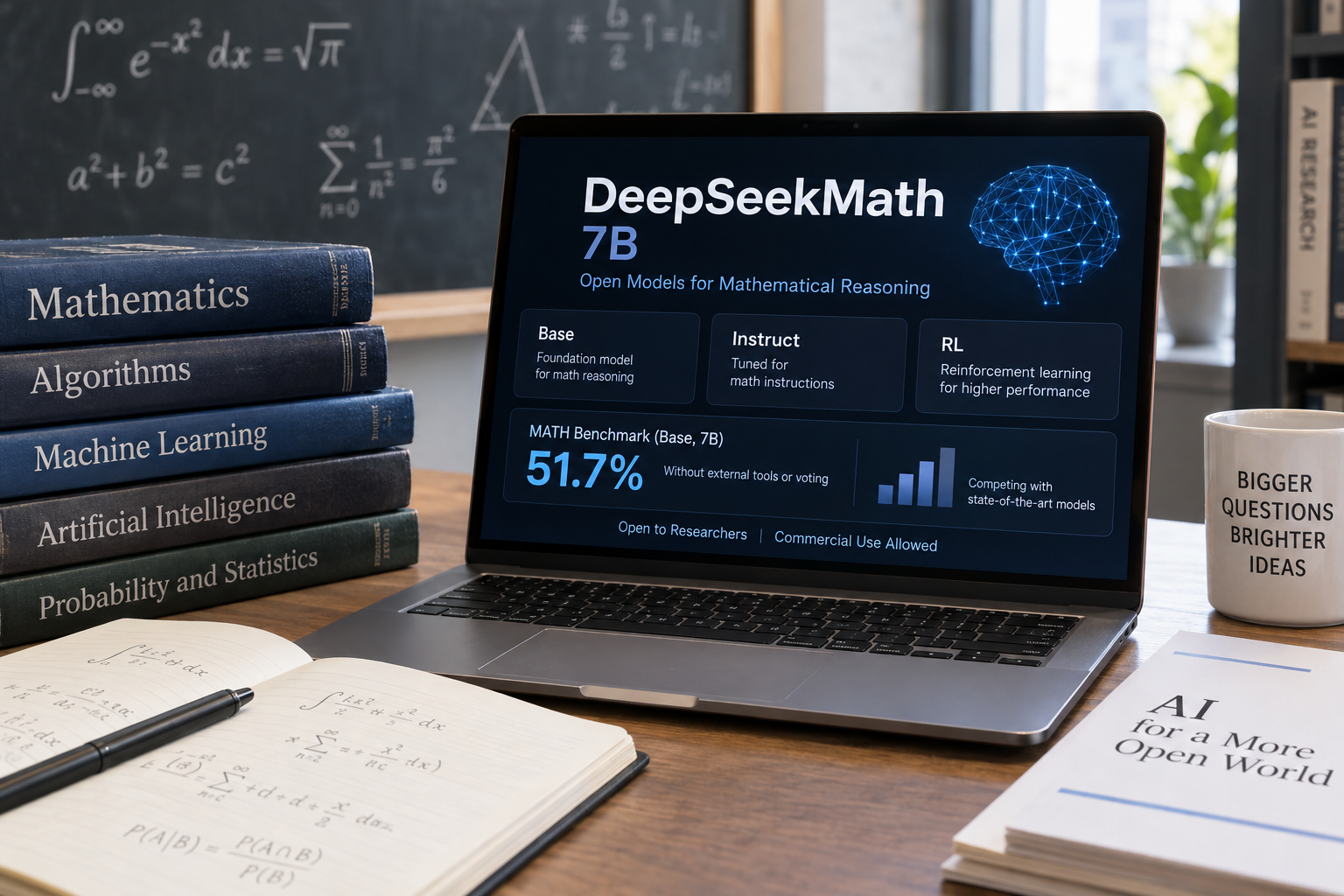
DeepSeek has released DeepSeekMath, a 7-billion-parameter language model designed to solve math problems, and it is making the model's base, instruct and reinforcement learning versions available to the public. The project's documentation says the base model scored 51.7 percent on the MATH benchmark, a set of competition-level math problems, without relying on external toolkits or voting techniques. That score approaches the performance of Gemini-Ultra and GPT-4.
The model starts from DeepSeek-Coder-v1.5 7B, a model originally trained on code. DeepSeek then continued pretraining on math-related tokens drawn from Common Crawl, the large public archive of web pages, along with natural language and code data. The total training run covered 500 billion tokens. The math portion came from a targeted web collection the team assembled step by step.
How the math training data was gathered
How was DeepSeekMath's math training data gathered?
The team began with OpenWebMath, a collection of high-quality mathematical web texts, and used it as the seed corpus for training a FastText model. That classifier then searched the deduplicated Common Crawl database for math web pages. Researchers next ran statistical analysis to identify domains likely to host math content, and they manually annotated URLs within those domains that were tied to mathematics. Pages linked from those annotated URLs were added to the seed corpus, and the process repeated.
After four iterations, the effort produced 35.5 million mathematical web pages, totaling 120 billion tokens.
Benchmark results across the three versions
How does DeepSeekMath perform on the MATH benchmark?
The documentation describes three evaluations for the base model: solving math problems with step-by-step reasoning, solving them with tool use, and general natural language understanding, reasoning and coding. On the MATH dataset, DeepSeekMath-Base 7B outperforms existing open-source base models by more than 10 percentage points using few-shot chain-of-thought prompting. It also surpasses Minerva 540B, a much larger model.
Continued pretraining with DeepSeekCoder-Base-7B-v1.5 also helps the model write programs to solve and prove math problems, according to the project's summary. In reasoning and coding, the base model performs comparably to DeepSeekCoder-Base-7B-v1.5.
DeepSeekMath-Instruct 7B is a version tuned on math instructions and derived from the base model. DeepSeekMath-RL 7B builds on the instruct version and is trained with Group Relative Policy Optimization, or GRPO, an algorithm the team proposed. The researchers tested both versions on four quantitative reasoning benchmarks in English and Chinese, with and without tool use. The instruct model shows strong step-by-step reasoning. The RL model approaches 60 percent accuracy on MATH when it uses tools, which the documentation says surpasses all existing open-source models.
What license covers DeepSeekMath's models?
DeepSeek is releasing the 7B base, instruct and RL models, with a sequence length of 4,096 tokens, through Hugging Face. The code repository is licensed under the MIT License, and the models fall under a separate Model License. The company says the license allows commercial use. The project provides sample code for running the models with Hugging Face's Transformers library.
The work is documented in a paper, DeepSeekMath: Pushing the Limits of Mathematical Reasoning in Open Language Models, listed by arXiv under the identifier 2402.03300. The authors are Zhihong Shao, Peiyi Wang, Qihao Zhu, Runxin Xu, Junxiao Song, Mingchuan Zhang, Y.K. Li, Y. Wu and Daya Guo.
Cet article a été rédigé avec l'assistance de l'IA.
News Factory APP - actualités agentiques pour booster votre SEO et AEO.