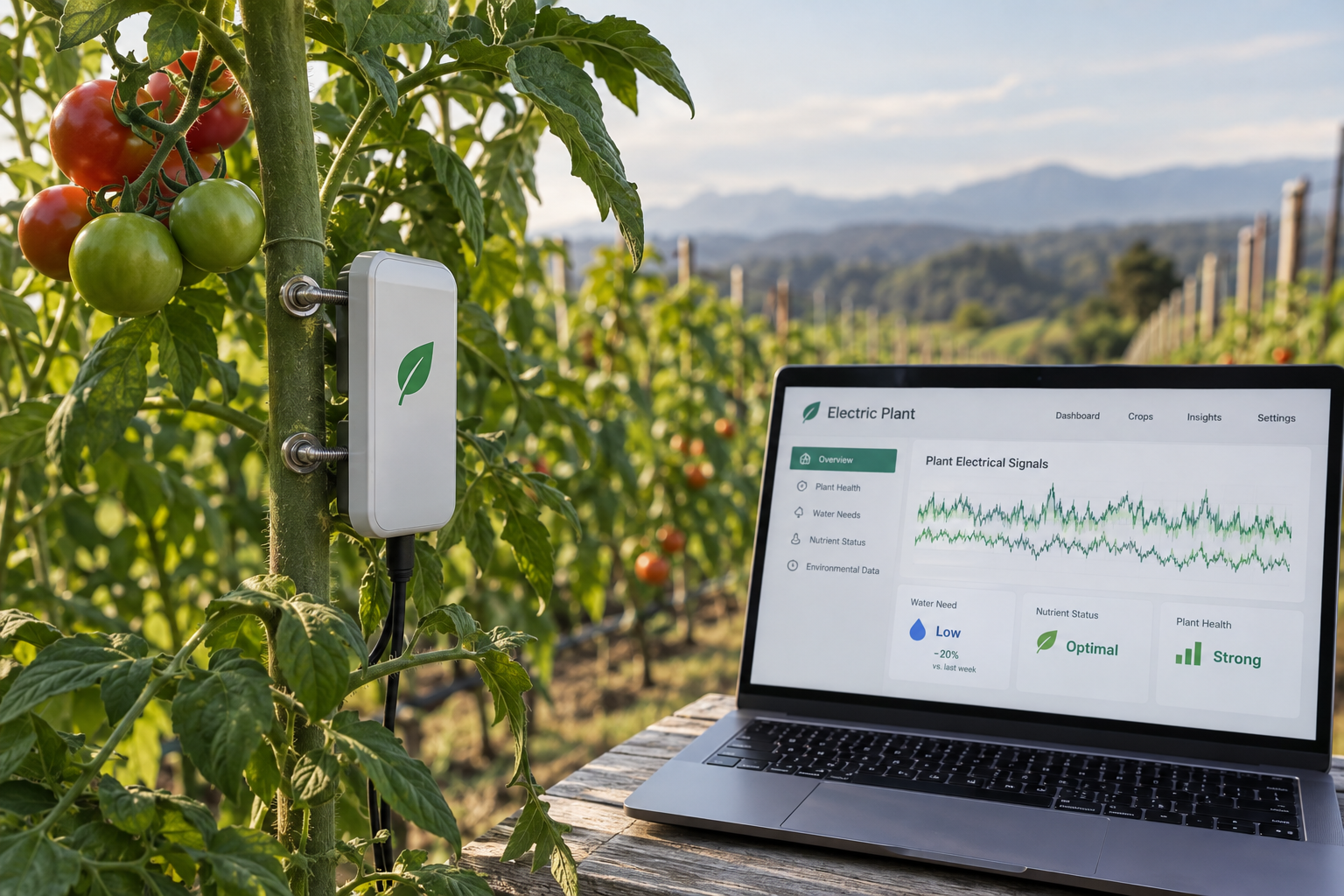
A houseplant wired to a motorized stand helped set Justin Mast on a new career path. Years ago, while reading scientific literature, Mast came across research describing a plant that signaled when it wanted more light. Electrical impulses moved through its living tissue, a control board sensed the current, and the stand rolled the plant toward the light source.
“I’m like, what the heck?” Mast told TechCrunch. “That was the entry to the rabbit hole for me.”
How does Electric Plant's Bombadil model work?
Mast teamed up with Lee von Kraus, a neuroscientist who has worked with DARPA, to found Electric Plant. Over the past three years, the company has collected data to build a large language model called Bombadil. The model is designed to interpret the subtle electrical signals running through a plant’s stem and translate them into information about what the plant needs.
Can people talk to plants with this technology?
The founders say the work could eventually lead to a tool that lets people “speak” with plants. “We’re listening more than we’re speaking, but listening’s the first step,” said Mast, who is co-founder and chief executive of Electric Plant.
The company recently raised an $11.2 million seed round to bring its sensors and Bombadil to market. Onto Ventures and Climactic led the round. Ponderosa, Endeavor Catalyst, Ludlow, Michigan Rise, The Fund, Schox VC and Dug Song also participated.
Mast argues that growers lack a full picture of what their crops require, even in the most controlled greenhouses. Farmers, growers and foresters have traditionally relied on coarse tools that respond to a plant’s demand for water, nutrients or light after the need has already emerged. Soil probes, handheld spectroscopes and satellite imagery can be useful, Mast said, but they fall short.
“That technology is sophisticated, but its ability to get at the inside of the plant isn’t very sophisticated,” he said. “Most of that stuff still lags quite a bit behind the real-time needs of the plant.”
Electric Plant used those conventional devices to train Bombadil. The model can now interpret electrical signals from about 125 species. “We know the model will surpass a lot of that equipment,” Mast said.
The sensors themselves are roughly the size of a regular iPhone folded lengthwise. They attach to a plant with stainless steel screws, which must penetrate the cambium, the layer of living tissue just beneath the bark, to pick up microvolt changes inside the plant. A low-power wireless network sends the data to a base station.
Mast said the company needs only a couple of sensors per acre to produce accurate results. Bombadil processes the data in the cloud, and the results go back to the customer. A grower could use them to adjust watering or fertilizer schedules. Mast claims that this approach can boost yields while reducing water use by 20% or more.
How much do Electric Plant's sensors cost?
The price is a central selling point. Most comparable tools cost thousands of dollars. “This is tens of dollars,” Mast said.
Mast would not say who the company’s initial customers are. He did note that the potential applications in agriculture and forestry are easy to picture.
Bombadil’s first group of more than 100 species spans a wide range of plant forms, from ferns and redwoods to tomatoes and dahlias, Mast said. “This is the most diverse model ever created on biological electrical signals,” he said. “No one’s ever done anything equivalent to this in the animal world.”
Cet article a été rédigé avec l'assistance de l'IA.
News Factory APP - actualités agentiques pour booster votre SEO et AEO.