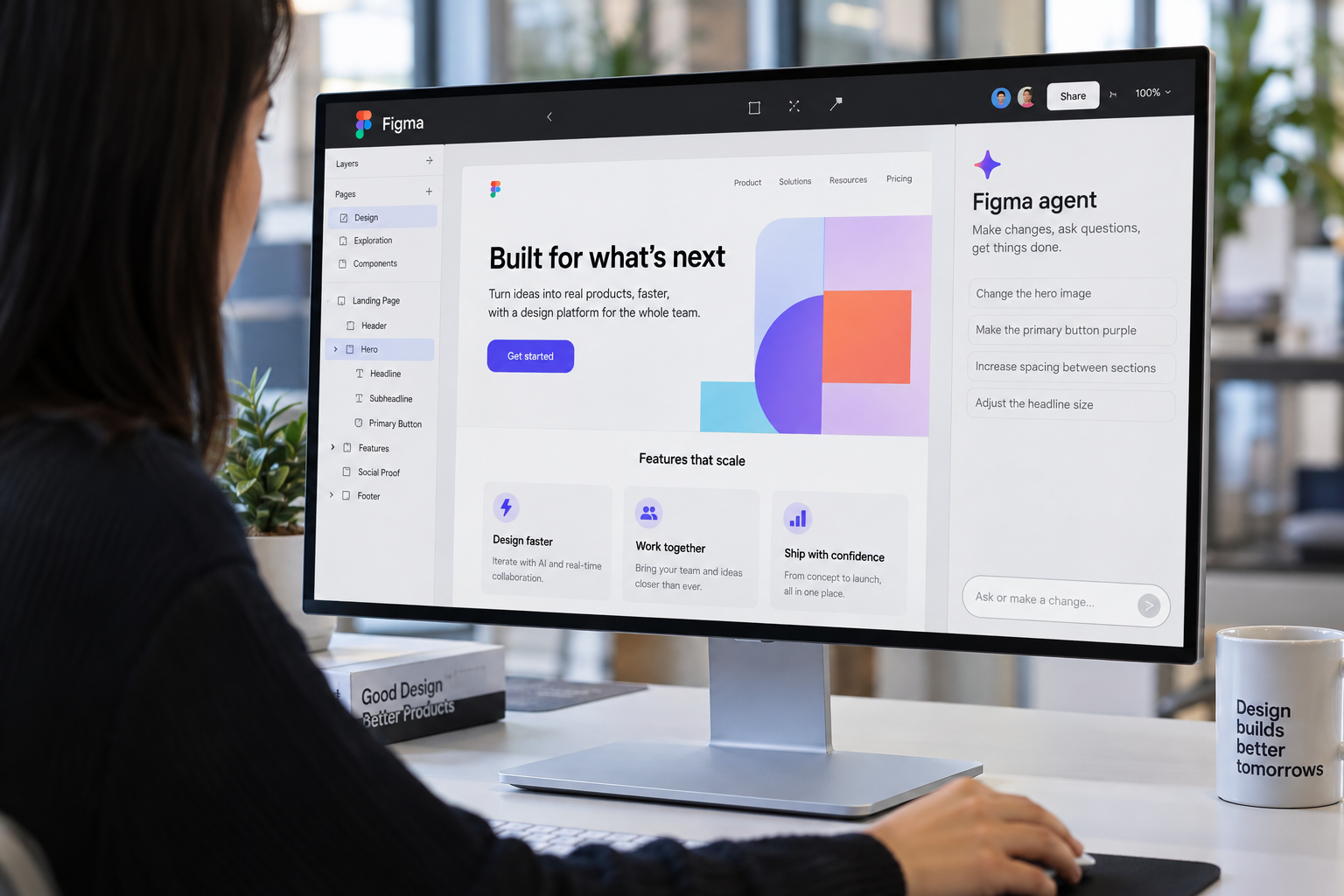
Figma has trained its own AI model to handle the small, everyday edits designers make on their canvases, and the company says the model is now a central part of the Figma agent, which rolled out to all users earlier this month.
What edits does Figma's own model handle?
The focus is on iterative work rather than big creative leaps. Designers adjust spacing, change a color or rework a layout after someone leaves feedback. Each change builds on earlier decisions, and the edits are hard to verify automatically. Figma said speed matters, since an edit that takes too long can interrupt the workflow the agent is supposed to support.
How did Figma train its editing model?
When the team started, frontier models could not understand Figma's syntax. Getting them to work would have required lengthy system prompts that consume a large number of tokens. Instead, Figma invested in supervised fine-tuning. Each training example paired a starting design with a synthetic edit request and a successful version of the change. Designs were represented in Figma's native file format, so the model learned to produce changes the company could apply directly back to the canvas. For tasks involving design system assets, the team generated synthetic prompts covering themes and components.
Larger teacher models attempted those edits, and their candidates were checked by deterministic validators and visual model judges. The generation pipeline could revise an edit based on evaluator feedback. That approach went surprisingly far. An earlier Llama 3.3 70B model, trained on more than 250,000 examples, became competitive on editing tasks with the top models of the time.
Since then, Figma has shifted toward more capable base models, including the newer Qwen models, Muse Spark Open and Inkling. The company also found limits to relying on supervised fine-tuning alone. Imitation learning produces designs that closely resemble the training data, which can hurt generalization. It is also less sample efficient, meaning it takes many examples covering the different facets of a task. Figma is now investing in reinforcement learning as part of its latest training recipe. The work includes better reinforcement learning environments for design, a wider range of training examples, reward models and expert-written criteria meant to reflect what designers actually care about.
Figma judges candidate models on several measures: how well they work inside Figma, how closely they follow instructions, whether they make useful changes to existing designs, and how fast and cheap they run. Because design quality is partly subjective, the company scores each dimension separately. A design can have good alignment and poor contrast. An edit can look polished and still miss the request. Common AI-generated errors include overlapping icons and text, clipped arrows and overlapping text elements. Figma combines structural checks with visual judges, and expert designers calibrate and review the results. The company said these evaluations are one input among many in deciding which models to use in its product.
The agent now runs both Figma's own model and leading third-party models, assigning each to the work it handles best. Third-party models are used for tasks like image generation, vectors and brand-new design explorations. Figma's model handles precise edits and iterations. The agent also relies on context from the canvas and the design system, along with tools that carry out the requested changes.
How much faster is the new Figma agent?
Early results are encouraging, Figma said. Even between the beta and general availability releases, typical tasks became about 20% faster. In head-to-head testing with expert designers, the new agent beats or matches the previous production agent 62% of the time. User ratings are 33% higher, and users undo the agent's work 60% less often. Figma also said it has more than doubled the share of work powered by its post-trained design model and reduced the average cost per message. The company credited those gains to improvements across the models, tools and harness.
The company framed the project as evidence that post-trained models can compete with frontier models on a specialized task. Starting with a narrow problem, Figma said, lets it turn model progress into product updates that save designers time on repetitive edits. The company is also hiring for roles focused on design and post-training models for non-verifiable domains. Figma said it trains its models in a way that respects customer privacy and preferences.
Cet article a été rédigé avec l'assistance de l'IA.
News Factory APP - actualités agentiques pour booster votre SEO et AEO.