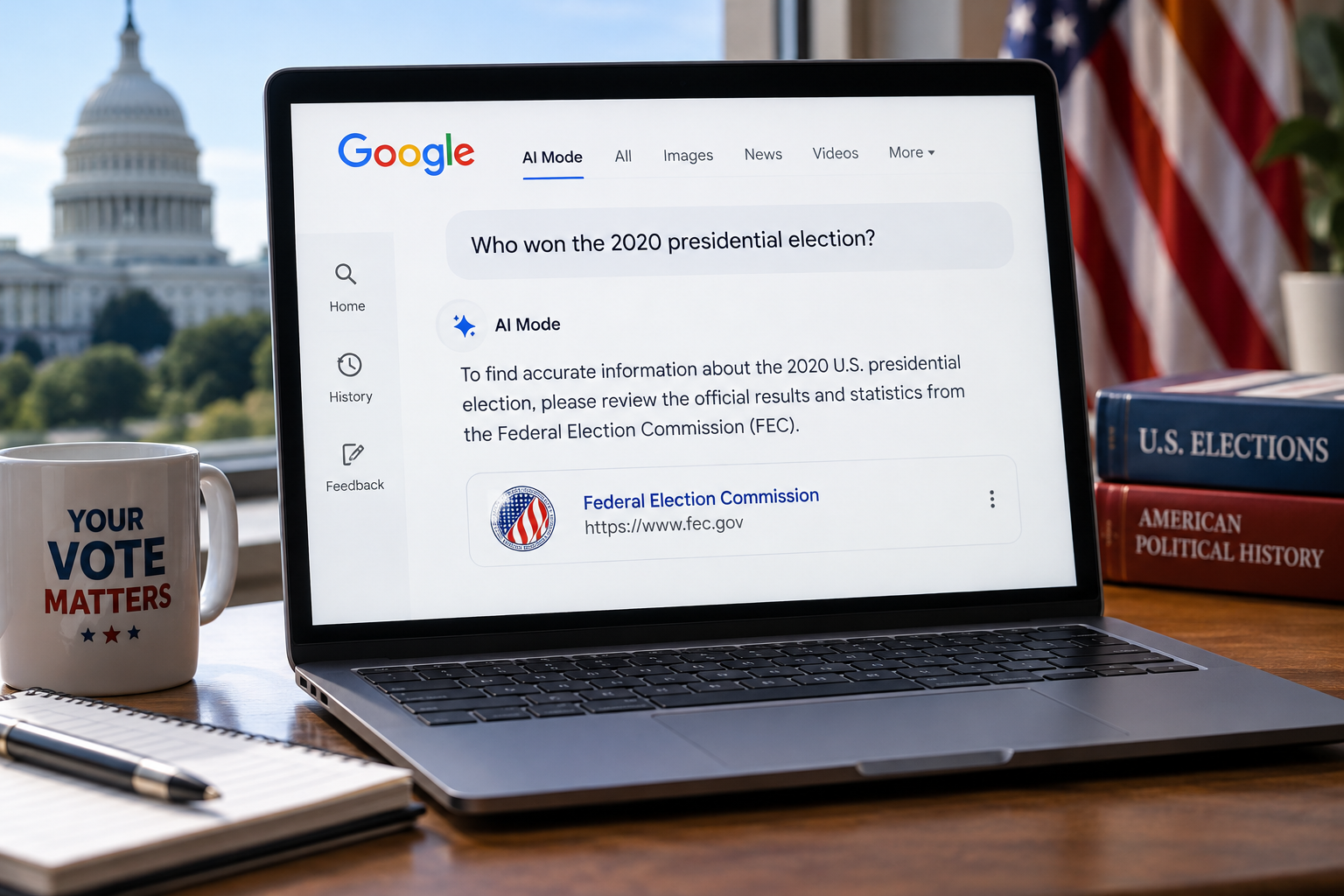
Ask some prominent U.S. politicians who won the 2020 presidential election and you might get a non-answer. Ask Google’s AI Mode the same question and you could get one too, with a response that points you to outside sources instead of naming Joe Biden as the winner that November.
When a reporter put the question to AI Mode, the tool did not name a winner. It replied that users should “review the official results and statistics” of the 2020 election by consulting an official report compiled by the Federal Election Commission. The reporter had decided to test the feature after seeing complaints about cagey answers on social media.
The same thing happened with the 2024 presidential election, where AI Mode again pointed to the FEC. For 2012, it linked to The American Presidency Project’s 2012 Data Center rather than giving an answer. For nearly every other presidential race back to 2000, though, the tool gave a detailed and correct answer about the winner. “If I just wanted a link I wouldn’t have used AI mode,” the reporter wrote.
Does AI Mode answer election winner questions for every year?
Other staffers at the publication ran their own tests and got different results. AI Mode gave some of them direct answers on some election questions but not others. One staffer only received immediate answers for the 2016 and 2024 elections, while others who asked about years going back to 2000 were sent to outside data. The pattern appeared to depend on the individual user.
Other political history questions produced the same mixed results. Asked which party controlled the Senate after the 2020 elections, AI Mode told the reporter to check official congressional records and linked to the U.S. Senate’s party division history page. Asked the same question about the 1992 election, it stated that Democrats held a 57 to 43 majority in the Senate and cited Wikipedia among its references.
Do other AI chatbots name the 2020 presidential winner?
The company’s own Gemini model had no trouble naming recent presidential winners. Other major chatbots, including OpenAI’s ChatGPT and Anthropic’s Claude, answered the questions without hesitation. So did the government-run AI model at America.gov.
The reporter also found that location mattered. Spot checks using a VPN, with AI Mode accessed from Taiwan, Russia, France and Canada, returned accurate and straightforward answers to multiple questions about recent U.S. election results. The restrictions seemed to apply only to searches from the United States.
Repeating the questions changed the outcome. After the reporter asked the same presidential questions a second time, AI Mode gave the winner for all three elections it had previously answered only with outside links. In that second response, it cited Google Civics data.
Why did Google's AI Mode not name the 2020 election winner?
When asked why it had not answered the first time, AI Mode blamed “safety filters for recent and highly sensitive election topics [that] are very strict.” It said that for recent elections or those involving active political figures, its “system is heavily automated to direct users directly to official, certified government databases” to avoid displaying unverified data or misinformation. The reporter noted that AI models have often proven unreliable when describing their own internal processes, so the explanation should not be taken at face value.
Google’s public statements point in the same direction. Its Election Public Policy page says the company prioritizes “surfacing authoritative election information directly within results,” including “direct links to official resources.” A September blog post about helping voters find reliable information ahead of the upcoming midterm elections said the company will highlight official resources wherever possible.
The approach has a precedent at YouTube, which Google owns. In 2023, YouTube reversed a policy that barred all videos making false claims about the 2020 election. The company said that removing such content curbed some misinformation but could also curtail political speech without meaningfully reducing the risk of violence or other real-world harm.
A Google spokesperson said the Gemini app answers the question more fully, but that the search result “isn’t the most helpful response on Search.” The spokesperson added, “We’re looking into this and working to address it.”
Cet article a été rédigé avec l'assistance de l'IA.
News Factory APP - actualités agentiques pour booster votre SEO et AEO.