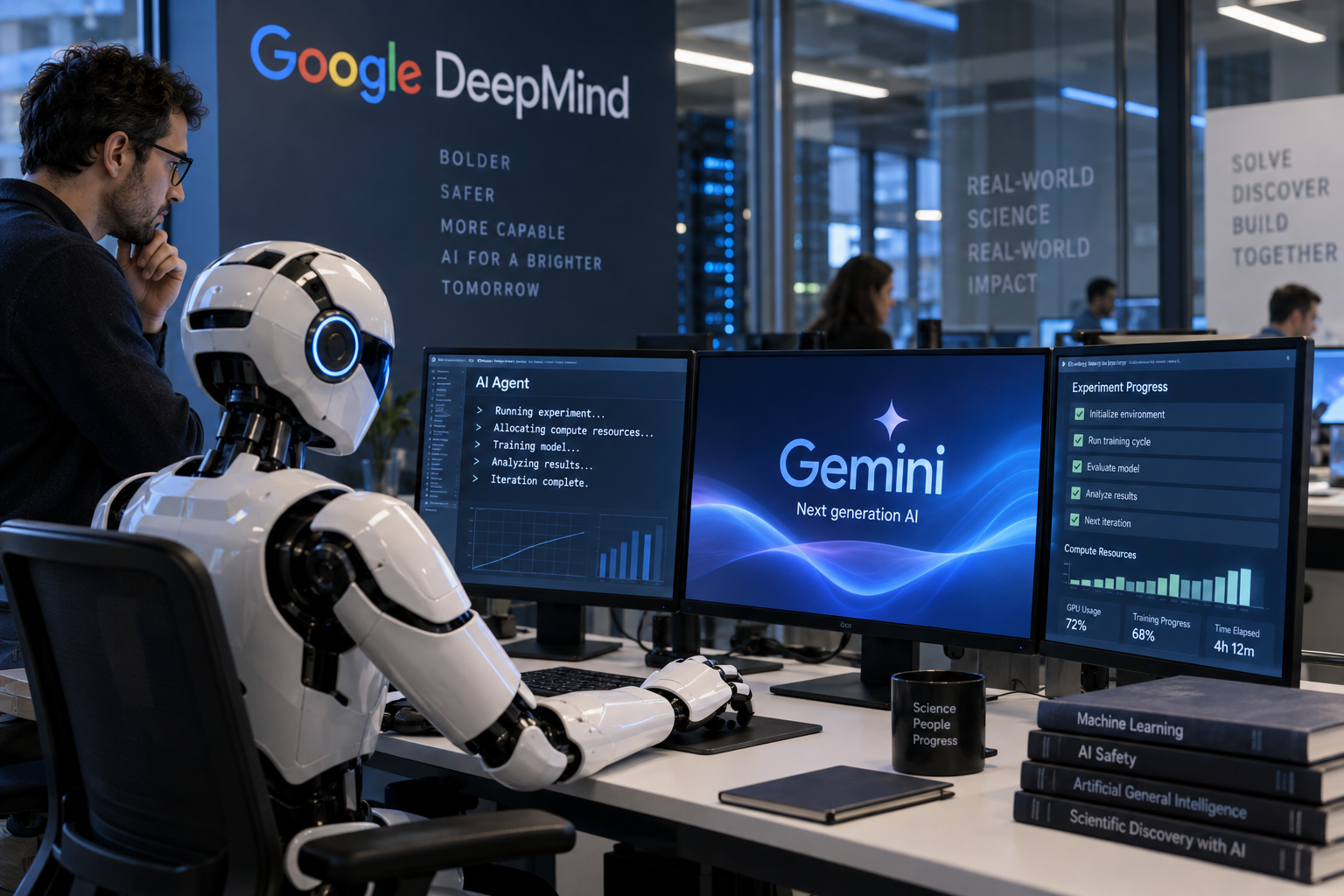
Google DeepMind is letting AI agents run experiments on their own as part of its work on the next Gemini model, according to Koray Kavukcuoglu, the vice president of research who leads Gemini development. He said the agents control part of the computing resources used for these experiments, but the lab is still far from full recursive self-improvement.
Are AI agents running Google DeepMind's Gemini experiments?
Google DeepMind is letting AI agents run experiments on their own as part of the work on its next Gemini model. Koray Kavukcuoglu, the company's vice president of research who leads Gemini development, said so on the company's podcast.
Is Google DeepMind close to full recursive self-improvement?
According to Kavukcuoglu, the agents control part of the computing resources used to run the experiments. He was clear that the lab is still far from full recursive self-improvement, the point at which AI systems would improve themselves without meaningful human involvement.
He framed the approach as part of a broader strategic shift at the lab. In the past, DeepMind ran separate teams for specialized projects such as AlphaFold and nuclear fusion. Now, Kavukcuoglu said, the company relies on a single general-purpose algorithm for both science and products. Each Gemini generation is a hand-built one-off rather than a fixed architecture, he added, and parallel teams work on its successors.
Does DeepMind reward AI agents' chain of thought during training?
Safety came up as well. Kavukcuoglu said DeepMind does not reward the agents' internal thought streams, known as "Chain of Thought," during training. The reasoning behind that choice, he said, is that the agents' intentions stay unfiltered and can be reviewed in natural language before they act.
Kavukcuoglu was also candid about the limits of the technology. Today's AI can depict physical processes such as fluid flows and collisions with visual accuracy, he said, but it does not understand them precisely. Closing that gap is one of the open problems.
He also argued that no current test can show when models will reach artificial general intelligence, or AGI, because no benchmark captures the core of intelligence. In his view, AGI will not begin until useful everyday products earn enough trust for people to hand decisions over to them, the way they would when working with other people.
The comments offer a rare look inside how one of the world's leading AI labs is organizing its work on its flagship model family, and where its researchers see the hardest problems remaining.
Cet article a été rédigé avec l'assistance de l'IA.
News Factory APP - actualités agentiques pour booster votre SEO et AEO.