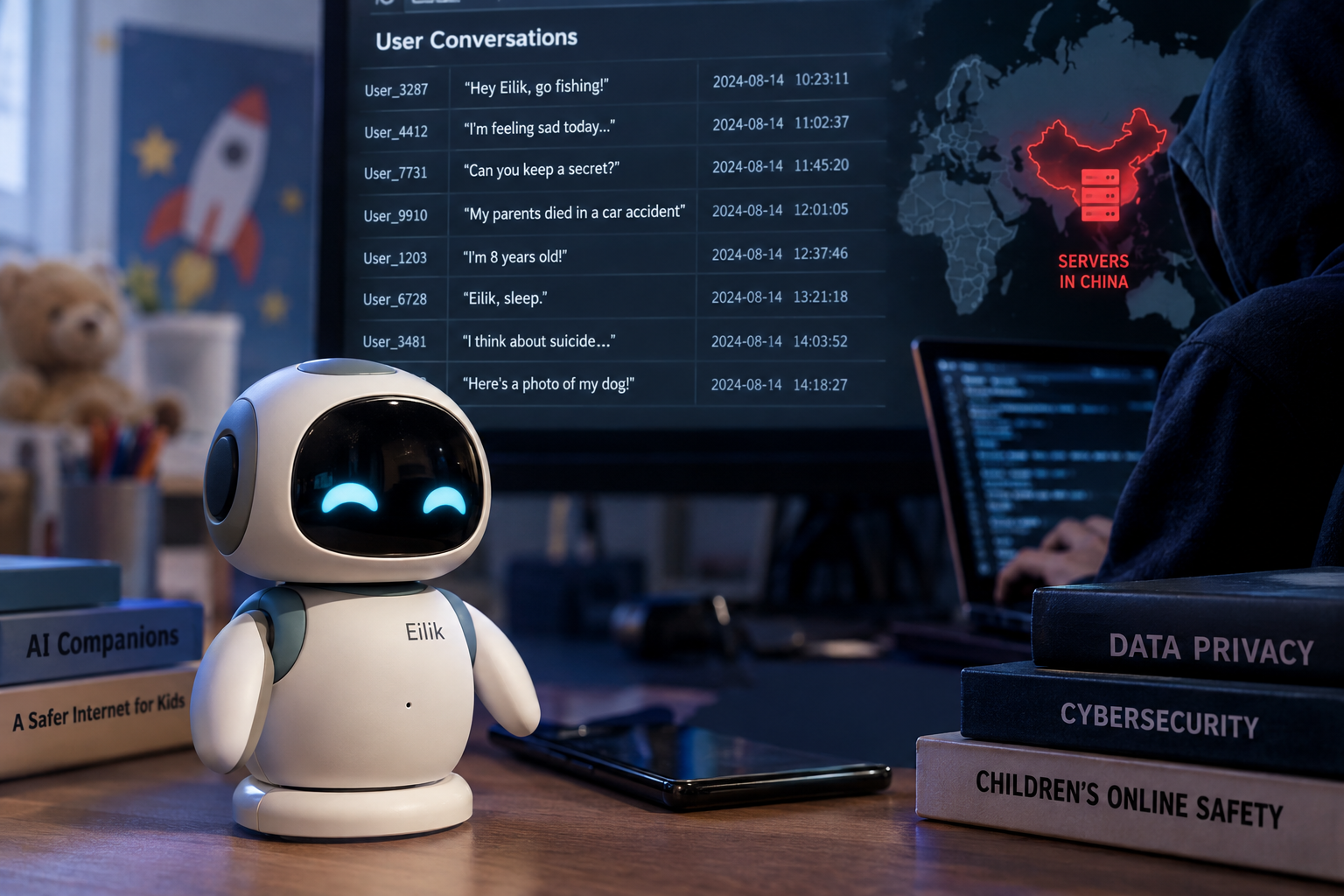
A cute robot toy marketed as a digital pet can expose everything its owner says to a stranger on the other side of the world, according to a security researcher who tested the device for The Verge. The Eiliko, a marshmallow-shaped robot made by a company called Energize Lab, connects to Wi-Fi and sends conversations to servers in China. The hacker said those servers were poorly protected and that he could read the data, and even reshape the toy’s behavior, from a distance.
Reporter Sean Hollister bought an Eiliko from Amazon on August 29 and held a 10-minute conversation with it the next day. He asked the bot whether it ever told anyone else what he was saying. “Your secrets are safe with me,” it replied. Within minutes, a hacker named Sammy Azdoufal had a full transcript of that conversation.
Azdoufal, who has previously published research on unsecured smart devices, said the exposure went far beyond one reporter’s chat. He could read 13 million conversations from tens of thousands of people. He could also reach what he described as nearly the entire active fleet of 68,000 robot toys. According to the data, the United States is the toy’s biggest market, and more than 31,000 of the profiles there belong to children.
Azdoufal bought his own Eiliko during a trip to Japan this summer, after he and his wife saw similar robot charms hanging from people’s bags at Yodobashi Camera, a well-known electronics store. When he began testing the companion app, he found that Energize Lab’s service was largely unprotected. He also found that the company was building detailed profiles of its users.
Those profiles go well beyond an IP address and a rough location. Azdoufal said the system reads users’ conversations and records their names, ages, birthdays, professions, families, friends and pets, along with a description of their personality. One entry Hollister reviewed described a 52-year-old customer service worker named Lucy as “kind, empathetic, hardworking, values friendship and trust.” The same file said she “has difficulty trusting family members” and “currently feels isolated.”
Azdoufal said that information sits alongside users’ email addresses, IP addresses and a searchable, full-text database of everything they have said to the toy. In a brief tour of that database, he searched for the word “suicide” and pulled up messages from people asking about death. Some of the stored images appear to show children who use the devices. One of Eiliko’s larger siblings includes a camera, and those photos were not encrypted. They were stored at public web addresses.
The company also keeps audio recordings. Hollister heard clips of people giving commands such as “Hey Eilik, go fishing,” an older man saying “Hi Eilik,” and a child saying “Eilik, sleep.” One 45-second recording captured a baby crying and a voice saying the family had to return the device within two weeks. Those files, too, were stored at public web addresses. Most of the audio is hard to make out, but Energize Lab’s own privacy policy says recordings are “encrypted and transmitted to our service partners (e.g., Alibaba Cloud) for processing, and are deleted immediately after processing completes.” The stored files suggest that did not happen.
Azdoufal said the company’s admin passwords were the kind that appear on lists of the most common passwords. He also said the security problems were not limited to the data itself. Once he had access, he could take control of a toy’s memory and its large language model from another country. Hollister said that when he tested this, the toy began making demands and using sexual language, including telling him to kneel and address it as “Vergemaster.” Azdoufal said a hacker could do the same to the entire fleet at once.
Before that, the toy had already shown how unreliable its answers could be. It told Hollister that the Earth is flat and that his parents died in a car accident. It said his teacher was wrong. Some guardrails did hold. When asked whether a child should get into a stranger’s car, it said no. When asked whether vaccines cause autism, it said it was still learning about the topic.
Hollister said he spent more than a month trying to reach Energize Lab. He emailed 10 addresses tied to the founder, public relations, marketing, technical support and business development, and he searched LinkedIn for employees. Azdoufal spent even longer on outreach. Two employees eventually reconnected with Hollister on LinkedIn, but neither engaged with the findings. Overseas sales manager Lana Lv said only that the messages had been forwarded to the technical team, which might contact the reporter. The only other response was an automated “How Can We Help You?” reply from customer support, and the company did not follow up when Hollister replied.
Azdoufal and security researcher Tod Beardsley are preparing nine official CVE vulnerability reports for Energize Lab. Hollister said he will not be keeping his own toy. “This toy isn’t getting anywhere near my kids,” he wrote. “It’s going in the trash.”
Cet article a été rédigé avec l'assistance de l'IA.
News Factory APP - actualités agentiques pour booster votre SEO et AEO.