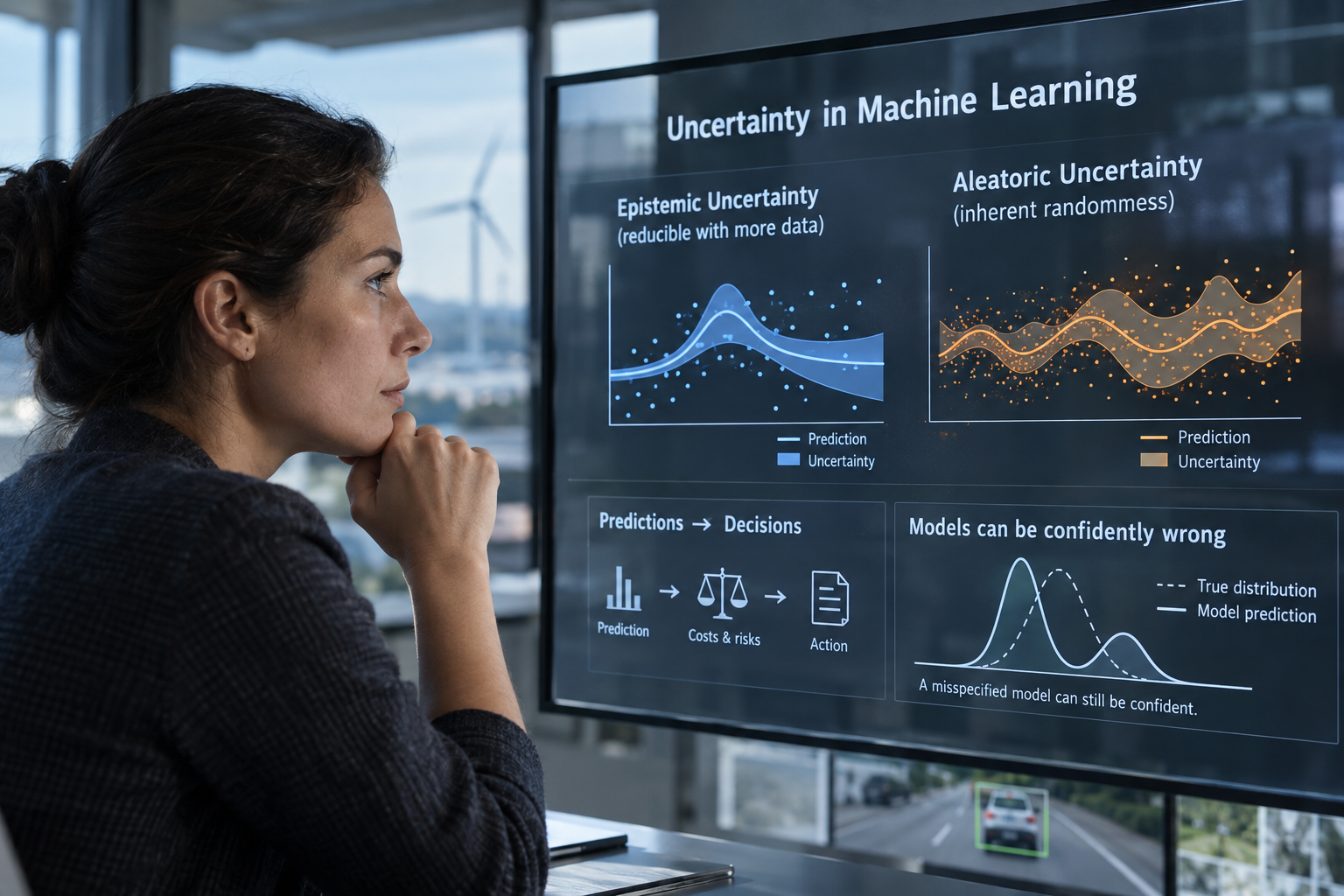
Every machine learning model makes an assumption about uncertainty, even when its builders never say so. That is the central argument of an introductory essay by a machine learning researcher, who writes that the choice matters most in exactly the places where data runs thin, because there the assumption ends up deciding the answer.
The essay is based on a talk the author gave at the University of Alicante. It is not meant as a complete treatment of the field. Its goal is to give readers an intuitive model they can use to pick assumptions that make uncertainty estimates useful for decisions, even though, as the statistician George E. P. Box put it, every model is wrong in some way.
What is the difference between epistemic and aleatoric uncertainty?
The author starts with a basic distinction. Uncertainty is incomplete knowledge, and probability is the tool for describing it. The essay splits that uncertainty into two kinds. Epistemic uncertainty comes from what a model has not learned yet, such as the true relationship between inputs and outputs. More data can shrink it. Aleatoric uncertainty comes from what cannot be observed. If the inputs do not fully determine the outcome, more data of the same kind will not remove it.
The line between the two depends on what gets measured. A coin flip is a good example. If nobody records how the coin is thrown, the best available answer is 50/50, and that uncertainty is aleatoric. If the throw is measured, physics predicts how the coin will land, and the uncertainty becomes epistemic, since the model now has to learn the physics from data. Weather is harder still. Small differences in the atmosphere can grow into very different conditions weeks later, and because no one can observe every such difference, part of any forecast stays aleatoric.
Why doesn't a prediction alone tell you what to do?
The essay also makes a point about the gap between a prediction and a decision. A prediction alone does not say what to do. People weigh possible outcomes by how likely they are and by what they would cost, including rare outcomes that could do serious damage. A single number hides that picture. It also cannot indicate when a case should go to a human or when more data should be gathered first.
To show how this plays out, the author uses a self-driving example: a car approaching a lane split. In the left and right lanes, human drivers mostly steer in one direction. In the middle lane, which points straight at a divider, about half go left and half go right. A model that predicts a single Gaussian peak will average those two choices and steer straight into the divider. No setting of its parameters avoids that outcome, because every hypothesis in the model has a single peak. A richer model, such as a mixture of two Gaussians, can represent both lanes. The essay notes that such a model needs more data to find the right answer, which is the familiar tradeoff between bias and variance.
Why can a machine learning model be confidently wrong?
The essay then turns to Bayesian inference, which the author describes as a principled way to capture epistemic uncertainty, though not the only one. Instead of settling on one hypothesis, a Bayesian model keeps every hypothesis in its space, weighted by how well each explains the data. With enough data, the weight concentrates on the hypothesis closest to the truth within the model. If the model cannot represent the truth at all, the result is only the best option it has to offer. A misspecified model can still produce a confident prediction, the author warns, because it is confident about the least wrong hypothesis it contains.
Some situations call for a formal guarantee instead. Conformal prediction offers one. It wraps any trained model and returns a prediction set that contains the true output a set share of the time, such as 90 percent. The catch is that the guarantee holds on average over inputs, not for any particular case, such as a car at the lane split. The guarantee also says nothing about whether the sets are useful. A poor model produces wider sets with the same coverage, and a poorly chosen score can still produce a set that includes the divider.
The essay's most practical section concerns decisions. The author uses decision theory to explain that a model's belief should be judged against the loss an action would cause. Two examples show how the required faithfulness changes. In visual quality inspection, a camera scores each part for the probability of a defect. The cost of a missed defect is hard to pin down. It can mean a recall, a lost customer or, in the worst case, risk to people. Inspectors also disagree on borderline parts. The author argues that a calibrated probability is less important here than a score whose order reflects the severity of a flaw, so that an operator can set the threshold by hand.
Wind power reserves present the opposite case. A grid operator must hold backup power to cover a shortfall, and the best reserve level is a quantile of the predicted shortfall. That quantile depends on the relative costs of a shortage and of idle reserve, and those costs change by the hour. Because shortages are expensive, the reserve sits far out in the tail of the predicted distribution. A Gaussian model can perform well at a 1-in-10 shortage rate and still fail badly at 1 in 100, since shortages can come more than twice as often as planned. In a year of daily data, the rarest events may never appear at all, so the assumptions built into the model decide the outcome.
The author concludes that faithful uncertainty takes real work, including a likelihood that can represent the truth, enough data to find it, and inductive biases that hold up where data runs out. That effort is not always needed. The essay suggests that people should ask what faithful uncertainty would add before investing in it, while still understanding what faithful would mean, so they can judge whether their model's errors matter for the decision at hand.
Cet article a été rédigé avec l'assistance de l'IA.
News Factory APP - actualités agentiques pour booster votre SEO et AEO.