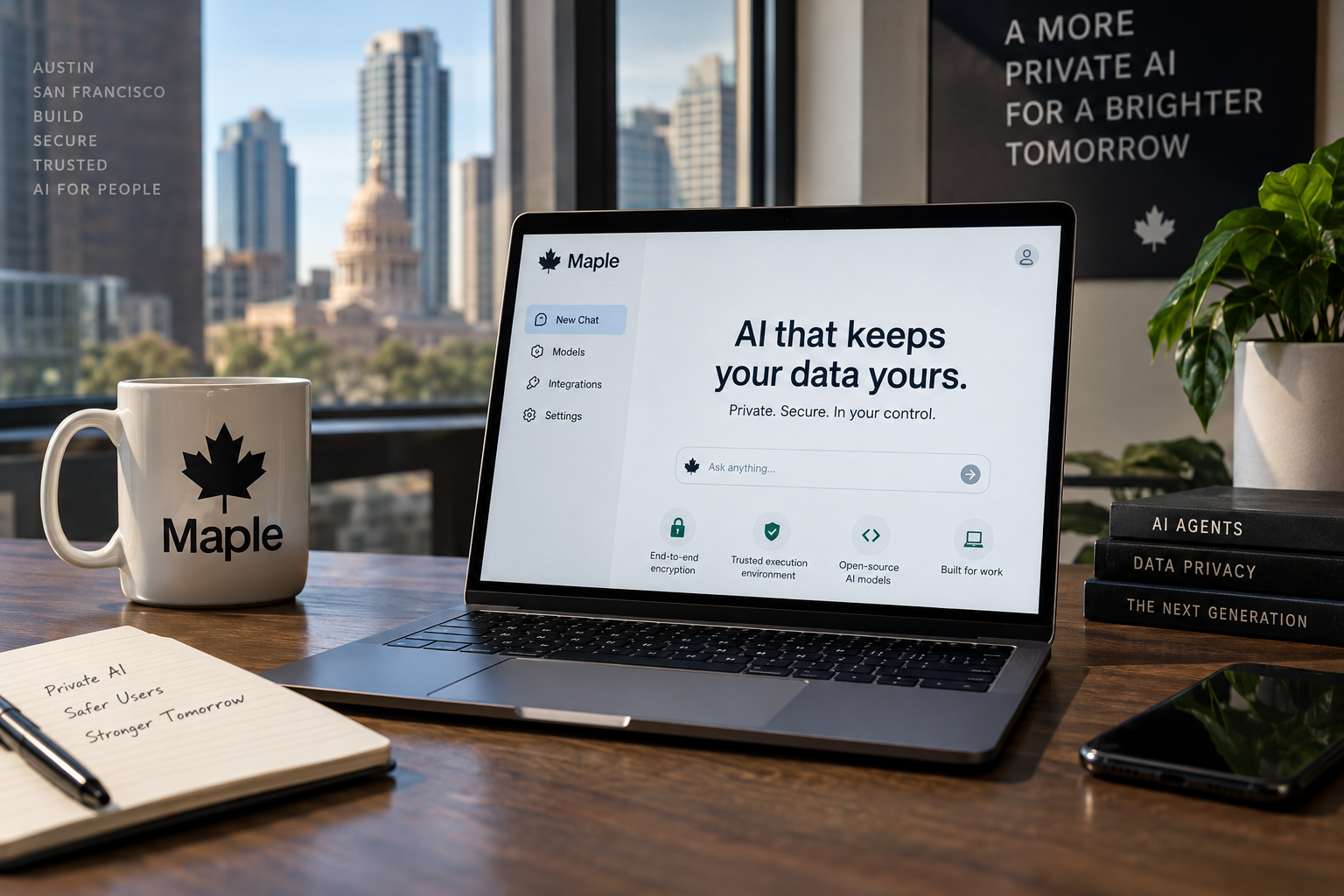
A small startup is betting that people will pay for AI assistants they don’t have to trust. Maple, based in Austin and San Francisco, has closed a $5.3 million seed round to build AI products designed so that user data stays private, even from the company that runs them.
How much did Maple raise and who led the round?
The round was oversubscribed and led by Epic Ventures, with participation from Draper Associates, Planetary VC and Epoch VC. It follows a pre-seed angel round of under $1 million. Maple plans to raise a Series A in the first half of 2027, according to the company.
The pitch centers on a simple problem. AI assistants are gaining access to people’s files, emails, calendars and browsers, and users are being asked to hand over more trust along the way. Many competing products come with broad privacy policies and data collection practices, and some train on users’ personal data. Maple says it is taking the opposite route. Rather than asking users to trust that the company won’t misuse their data, it is trying to build a business that never has access to that data in the first place.
“We wanted to build something that was not only encrypted but also could be proven, and that people could go look at the open-source code,” said Mark Suman, Maple’s co-founder and CEO. He said users can examine the code running on Maple’s servers through what the company calls trusted execution environments. “They can audit everything themselves and know how their data is being handled.”
Suman spent six years at Apple, where he worked on AI and machine learning with a focus on computer vision. He said the central challenge at Apple, which emphasizes consumer privacy, was building products that protected people’s identity while still benefiting from those techniques. His co-founder, Anthony Ronning, serves as CTO and has a background in defense technology, security and networking.
The company’s roots go back further than the AI product. Ronning started the business in 2023 as a privacy-focused fintech. After Suman teamed up with him in August 2024, the idea for Maple’s AI product took shape. The app became publicly available the following January as a mobile app.
The chat app looks familiar to anyone who has used an AI chatbot. Underneath, it runs a range of open models, including versions of DeepSeek, Kimi, GLM, Inkling from Thinking Machines, Google’s Gemma and OpenAI’s GPT OSS. Users can select the models they want, or they can keep things simple and switch between a quick model and a more powerful one.
The models run inside a trusted execution environment, which Suman described as a server with hardware encryption, located in a U.S.-based data center. Maple also offers support for European customers through a partner that runs servers in Europe.
How does Maple keep user data private?
Suman explained how the process works. Data is encrypted on the user’s device using a password only the user knows, then sent into the secure environment, where it is decrypted and processed by the AI. The result is re-encrypted with the user’s password before being sent back. “We actually don’t have access to the raw data as it’s in flight or even when it’s at rest,” he said.
That design, Suman said, means Maple can’t hand over readable customer data even under pressure. A hacker who breached the system would find only encrypted files, and the same would be true if the government served a subpoena. “We just simply don’t want access to it,” he said. “That’s not part of our business model. And we also don’t want it to be part of our threat model.”
The newest product, Maple Work, is a desktop app aimed at giving the AI more control over a computer, including files, apps and browser tasks. It also includes an integration store where users can connect services such as Gmail or their calendar. The app can launch a subagent that works inside other AI tools on the desktop, including Claude, Codex and others that support the Agent Client Protocol. Suman’s pitch is that users can hand a specific task to their preferred AI without giving it access to everything.
Maple is also preparing a cloud-based agent that can keep working when a user’s computer is off. The company says that addition would make it more competitive with consumer AI services such as Meta’s Muse and Instinct, along with other agents that operate through chat.
Maple plans to move into the enterprise market next year with pilot programs, offering its own version of zero data retention. The company said it doesn’t retain most customer data, and when it must keep some, that data is encrypted. It is currently completing SOC 2 compliance and security audits to prepare for the expansion.
The company declined to disclose its number of registered customers. It did say usage has grown 60 times over the past three months, as people look for ways to improve their security when using AI.
How much does Maple's Pro plan cost?
Maple makes money through subscriptions that the company says are comparable to those of other AI model providers. The Pro plan costs $20 per month. Maple also offers two higher tiers, Max at $100 per month and Max Plus at $200 per month.
The startup has four employees and is actively hiring.
Cet article a été rédigé avec l'assistance de l'IA.
News Factory APP - actualités agentiques pour booster votre SEO et AEO.