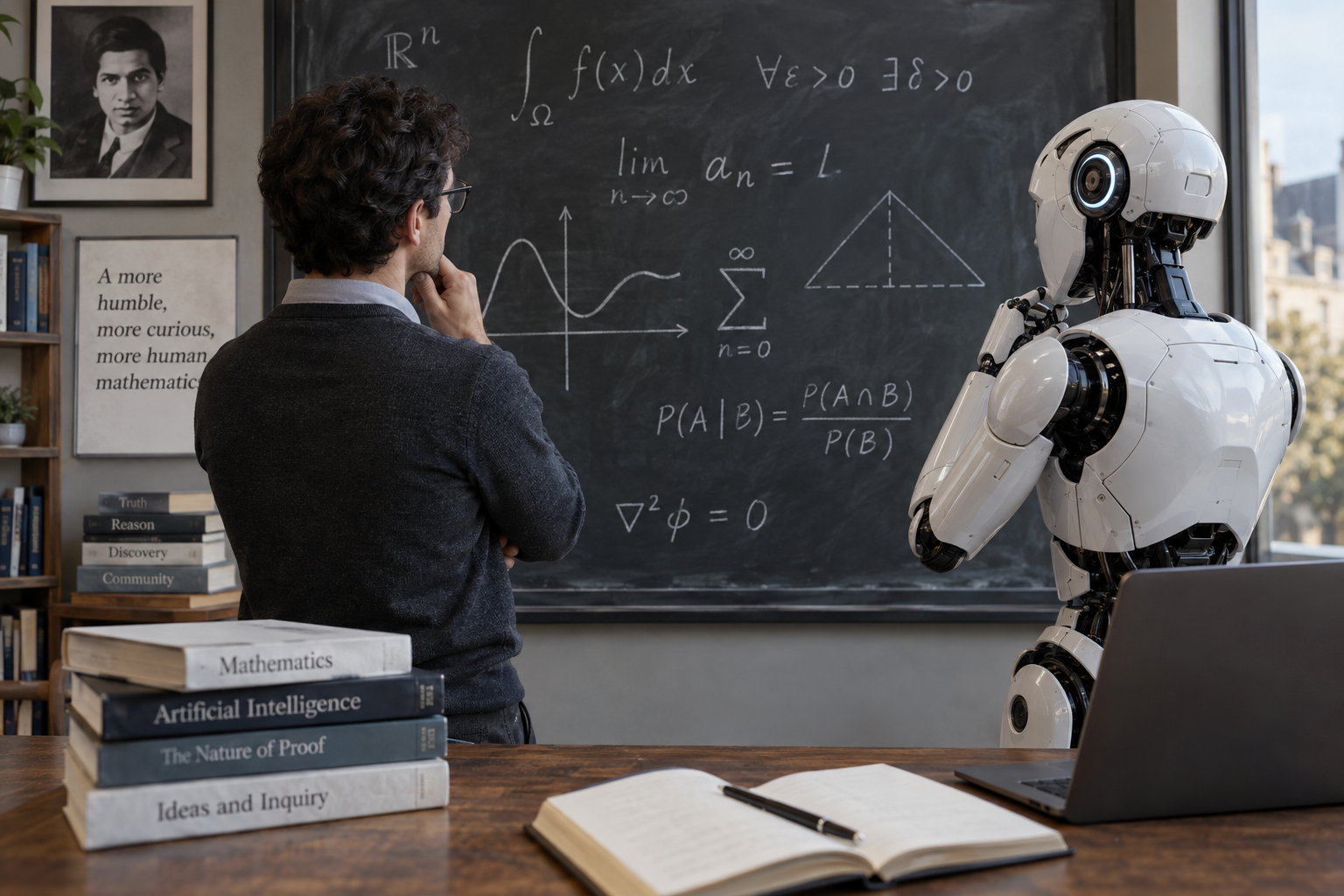
Three mathematicians are asking their field to reconsider why it does what it does. In a guest post on a mathematics blog, Karthik C. S., Amit Sahai and Jie Xue argue that the spread of artificial intelligence forces mathematicians to ask a more basic question than which tasks machines will take over. That question, in their view, is what mathematical work actually is and where its worth comes from.
Have mathematicians tied their worth too closely to output?
The authors say the field has tied its sense of value too tightly to output. Publications, citations, awards and other measures of performance have become the yardsticks, and mathematicians have come to see themselves as collections of productive abilities. Seen that way, anxiety about being replaced by an AI system is natural, since a machine that performs those tasks better appears to threaten the mathematician's worth. But the authors argue the problem started before AI arrived. "AI merely exposes the consequences of this view," they write.
Is mathematics invented or discovered?
To explain what they mean, the authors return to an old dispute. One camp holds that mathematicians invent their subject by choosing axioms and introducing concepts. The other holds that mathematics exists independently and must be discovered. The authors do not claim that one side wins outright. They point out that mathematicians plainly build formal systems and arguments. The harder question is whether the truths people come to understand depend on those acts, or whether the constructions simply help people recognize something that was already there.
They illustrate the point with a paleontologist. A fossil hunter has to choose where to dig, invent techniques and recognize what a fragment means, yet the fossils were there long before the search began. Mathematical discovery can work the same way, the authors say. A result may require inventing an entire language before a previously unnoticed relationship becomes clear. The creativity involved is real, but it does not make the truth a personal creation.
Surprise is the clearest evidence, according to the authors. A definition introduced for one purpose can reveal an unexpected link elsewhere. A conjecture that fit every example can fall to a single counterexample. Researchers can revise their definitions or abandon a conjecture, but they cannot make a flawed argument valid by wishing it so. The Platonic view, in which there were infinitely many primes before anyone proved it, offers a natural explanation for that independence. In that account, the mathematician's intelligence is the means by which an order that does not depend on us gets understood.
The authors also separate a correct derivation from an understanding of why it matters. An axiomatic system allows endless deductions, but producing them does not by itself point toward a worthwhile question. Some statements are formally correct and still tell us little. Why does one theorem expose something fundamental while another adds only to the pile? The authors argue that mathematical taste matters here, as long as it is understood as more than personal preference. A theory earns its place when it reveals unity among things previously considered separate, or explains why a phenomenon occurs.
Should mathematicians compete with AI on human strengths?
Their central proposal follows from that reasoning. The authors reject the idea that the answer to AI is to lean on distinctly human strengths. If creativity, intuition and taste are valued mainly because they give people an edge over machines, the authors write, the same flawed measure of worth remains in place. "Why should the value of our pursuit depend on being better at it than someone or something else?" they ask.
Instead, they call for humility about the place from which mathematicians pursue knowledge. That humility goes beyond modesty about accomplishments or generosity in sharing credit. It asks whether the search for truth is being bent to protect the researcher's standing. From this perspective, the possibility that AI might produce mathematical discoveries need not be a cause for sadness. A truth that becomes accessible loses none of its worth because the researcher did not author it. The authors add that the demand for every advance to vindicate the person who pursues it has long weighed on the field, whether the competing claim came from another mathematician or from a machine.
The authors also tie this outlook to the joy of mathematics. Solving a hard problem or winning a prize can be fleeting when it depends on one's standing relative to others, they write. The joy of understanding is different. It does not shrink when someone else gets there first, and it can be shared without taking anything from anyone else.
The post also takes up the split within the mathematical community over AI. Some researchers are enthusiastic about using the technology and want clear principles for doing so. Others prefer not to use it at all. The authors say both positions have merit and that both can reflect the same commitment to mathematical truth. They say their aim is not to settle policy questions but to offer a broader perspective that can guide those debates.
The authors are candid about their own distance from the ideal they describe. "We, the authors of this essay, are still far from having attained such egolessness," they write. "Nevertheless, we recognize it as an ideal toward which we wish to strive." They close with a thought experiment built on a remark attributed to Srinivasa Ramanujan: "An equation has no meaning for me unless it expresses a thought of God." The authors ask whether Ramanujan, witnessing AI's advances in mathematics today, would be troubled by what they might mean for his purpose as a mathematician.
Cet article a été rédigé avec l'assistance de l'IA.
News Factory APP - actualités agentiques pour booster votre SEO et AEO.