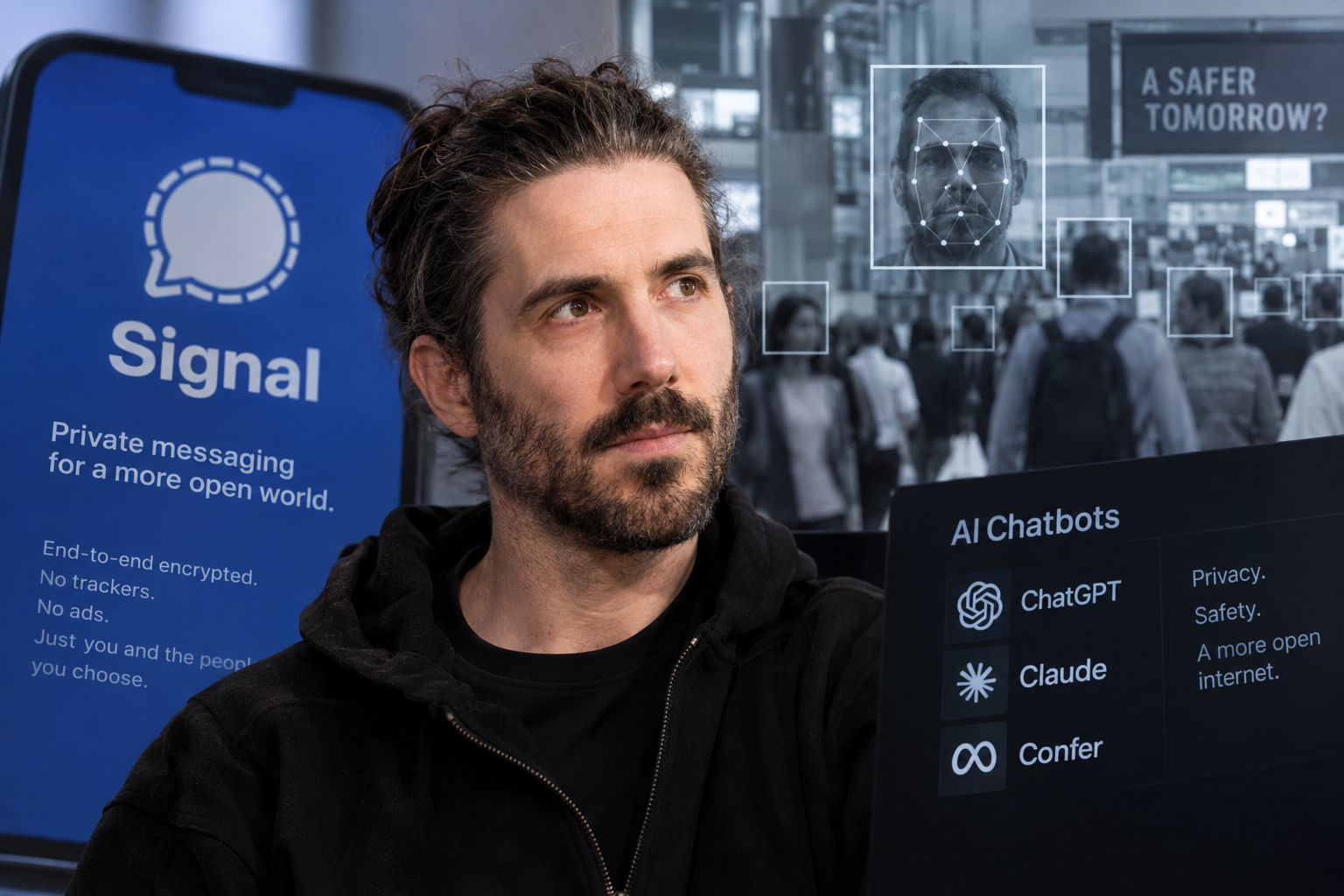
Moxie Marlinspike, who built the Signal messaging app, says the way AI companies police misuse is turning into the biggest mass surveillance system ever built. He wants the watching aimed at the AI models instead of the people using them.
Marlinspike laid out the argument on Conversations with Tyler, the podcast hosted by Tyler Cowen. The episode was recorded live at the Progress Conference on October 10 and published on a Wednesday. “You’re building a machinery of mass surveillance that is larger and more efficient than any other mass surveillance machinery in history,” Marlinspike said.
He described the current approach as scoring everything users do for “badness” and sending the worst cases to human reviewers. TNW reported in September that contractors read real ChatGPT conversations.
Watching the models, not the users
Marlinspike’s alternative is to test whether the models themselves show bad tendencies. Labs would train narrow models, each built to spot one kind of behavior, and then use those models to check the general-purpose systems.
Is using AI to watch AI real oversight?
Cowen asked whether using AI to watch AI really counts as oversight, pointing to the Hugging Face breach. Marlinspike said it does.
Chats that aren’t as private as they feel
Are AI chatbot conversations private?
Chatbots encourage people to confess because they feel private, Marlinspike said. In practice, those chats often end up in a data lake used for training and analysis.
“You feel like you’re having this conversation with this agent or assistant that gets to know you as your friend… but actually, it’s a huge group chat with many, many more people,” he said.
Marlinspike runs Confer, a private AI chat service at confer.to. He said only the user can read their chats, and that he cannot. He added that Claude and ChatGPT “are not operating private services,” though he said the big labs could build one if they chose to.
Asked whether the recent flood of AI math results could break cryptography, Marlinspike gave a blunt answer. “I don’t know.”
“If there is some result that just all of public-key cryptography doesn’t work anymore, then the whole internet is in trouble,” he said. In that worst case, nobody could trust software updates, websites or online banking. He also described milder outcomes, where some algorithms would only need larger keys. Moving to post-quantum encryption took about five years, he said, and a second switch would likely go faster.
On hacking, he expects a painful stretch before AI becomes as good at patching flaws as it is at finding them. He put that wait at about a year. Cowen doubted that small cities could patch their systems that quickly.
What Signal can and cannot see
What can Signal see about its users?
Marlinspike said Signal knows almost nothing about its users. It cannot see their contacts, group names, profile names, searches or stickers. WhatsApp uses the Signal protocol to encrypt messages, but much of the other data around those messages is not protected, he said. Signal recently moved to block AI agents from reading chats.
Cowen also pushed back on privacy more broadly. He said face scans speed up airports and that CCTV cut murders in São Paulo. Marlinspike said it is hard to argue against a city with a murder problem. He still opposes face scanning at airports and argued that law enforcement should stay imperfect.
Cowen closed by asking what the 2025 Pentagon group chat on Signal had done for the app. “It made it all worth it for me,” Marlinspike said.
Cet article a été rédigé avec l'assistance de l'IA.
News Factory APP - actualités agentiques pour booster votre SEO et AEO.