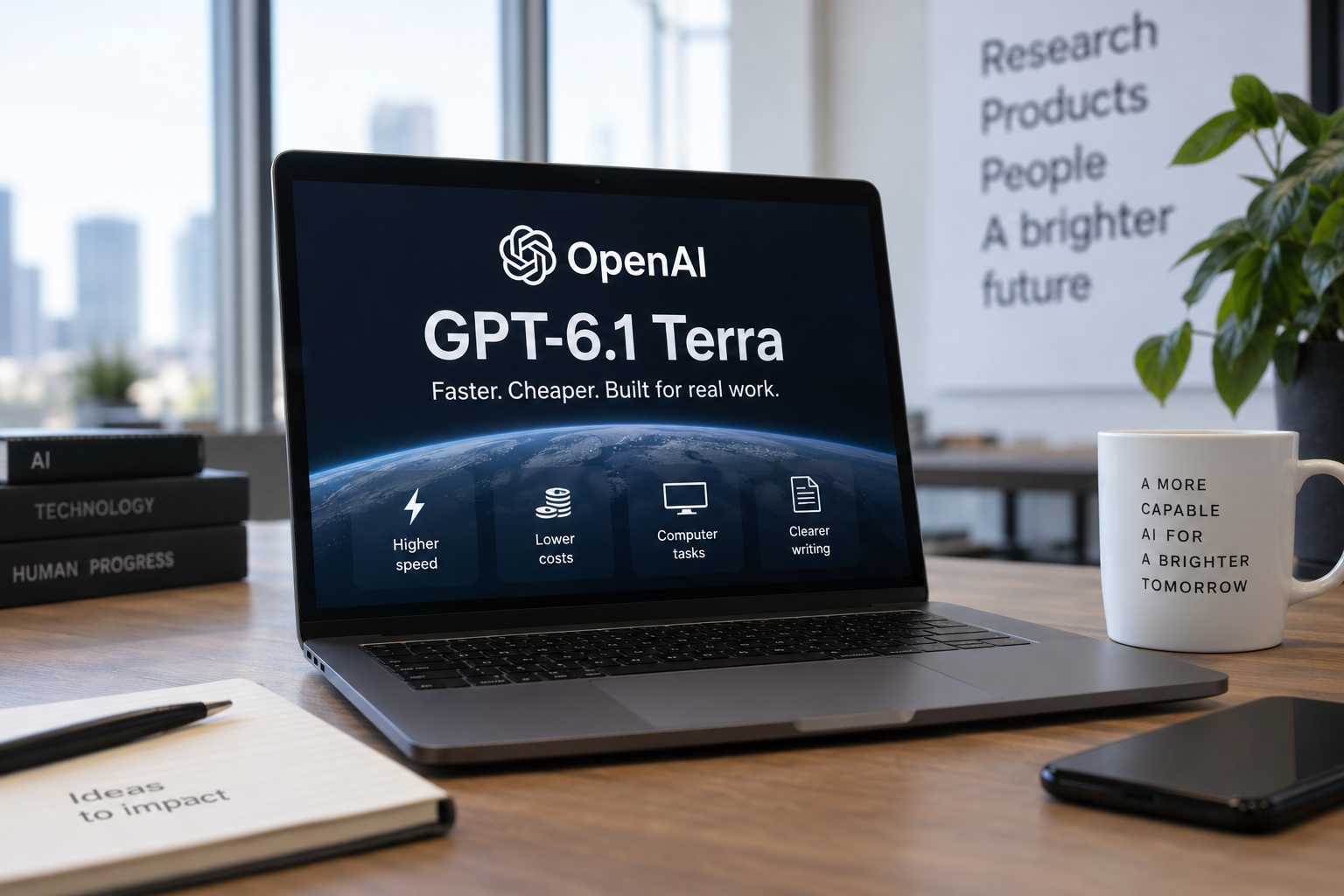
OpenAI has released GPT-6.1 Terra, a model the company describes as fast and efficient. It combines detailed visual reasoning and precise computer use with clearer, more natural writing. OpenAI calls it a significant step up from GPT-5.6 Terra and says it is built for the communication and computer-based work that fills a typical day, from drafting proposals and interpreting technical drawings to filling out forms and editing videos.
The model is available starting now to all Plus, Pro, Enterprise, and Edu users in ChatGPT Work and Codex. Developers can also access it through the OpenAI API under the name gpt-6.1-terra.
How much does GPT-6.1 Terra cost?
Cost is a central pitch. Standard API pricing is $1 per million input tokens, $0.05 per million cached input tokens, and $5 per million output tokens. OpenAI says those rates are 50% lower than GPT-5.6 Terra and GPT-6.1 Sol, which it argues makes the model practical for automating high-volume work. The company's example is reading incoming invoices and entering their details into accounting software. Inside ChatGPT Work and Codex, the same usage allowance covers more tasks with GPT-6.1 Terra than with GPT-5.6 Terra, and substantially more than with GPT-6.1 Sol or GPT-6 Astra.
OpenAI tested the model's computer-use abilities on Agents' Last Exam, a benchmark of professional tasks. Those tasks include turning architectural drawings into a 3D model and reviewing an animated film shot by shot to create a time-coded log for a restoration team. At medium reasoning effort, GPT-6.1 Terra scores 15 percentage points higher than GPT-5.6 Terra at about one-third the cost. OpenAI says it performs on par with GPT-6 Astra at one-tenth its price per token.
At maximum effort, OpenAI says Terra is more than three times as token efficient as Claude Opus 5.5 and costs one-fourth as much per token. The result, the company says, is a cost per task roughly nine times lower. Terra also finishes tasks more than three times faster than both GPT-6 Astra and GPT-6.1 Sol.
How does GPT-6.1 Terra compare with GPT-5.6 Terra?
On MMMU-Pro, a visual reasoning benchmark, GPT-6.1 Terra beats GPT-5.6 Terra at every reasoning setting. It nearly matches the scores of GPT-6 Astra and GPT-6.1 Sol, which OpenAI calls its most capable frontier model, at a much lower cost. On OSWorld 2.1, which measures how well AI agents use desktop apps to finish multistep jobs such as building a 3D model from a technical drawing, Terra at medium effort surpasses GPT-5.6 Terra's best score at a fraction of the cost per task.
Accuracy is another area where OpenAI says it made large gains. On an internal benchmark of prompts designed to induce errors, the error rate at low reasoning effort fell from 53.6% with GPT-5.6 Terra to 16.7% with GPT-6.1 Terra, a drop of nearly 37 percentage points. At maximum effort, the error rate fell 18 percentage points to 4.3%, close to the rates for GPT-6 Astra and GPT-6.1 Sol.
For software engineering, OpenAI points to Terminal-Bench 4.0, which tests how well coding agents solve command-line problems, such as fixing a webpage whose layout shifts as it loads. At maximum reasoning effort, GPT-6.1 Terra solves 50.3% of tasks. That is more than double GPT-5.6 Terra's published score of 21.5%. OpenAI says GPT-6.1 Sol and GPT-6 Astra remain the better choice for the most complex coding work.
On Terminal-Bench-Science 0.1, which measures how agents use code for scientific research, such as tracking cell divisions in a time-lapse video, GPT-6.1 Terra at max reasoning surpasses GPT-6.1 Sol at lower cost. It comes within five points of Opus 5.5 at less than one-fifth the estimated cost.
Is GPT-6.1 Terra safe to use?
OpenAI also addressed safety. The company says GPT-6.1 Terra meets the Critical threshold in cybersecurity under its Preparedness Framework and keeps the protections developed for GPT-6 Astra. According to OpenAI's evaluations, the model is more likely than GPT-5.6 Terra to stay within scope and to honestly disclose its limitations and potential blockers. It also showed strong resistance to prompt-injection attempts, which are malicious instructions designed to pull the model off the user's task. More detail is available in the model's system card.
Cet article a été rédigé avec l'assistance de l'IA.
News Factory APP - actualités agentiques pour booster votre SEO et AEO.