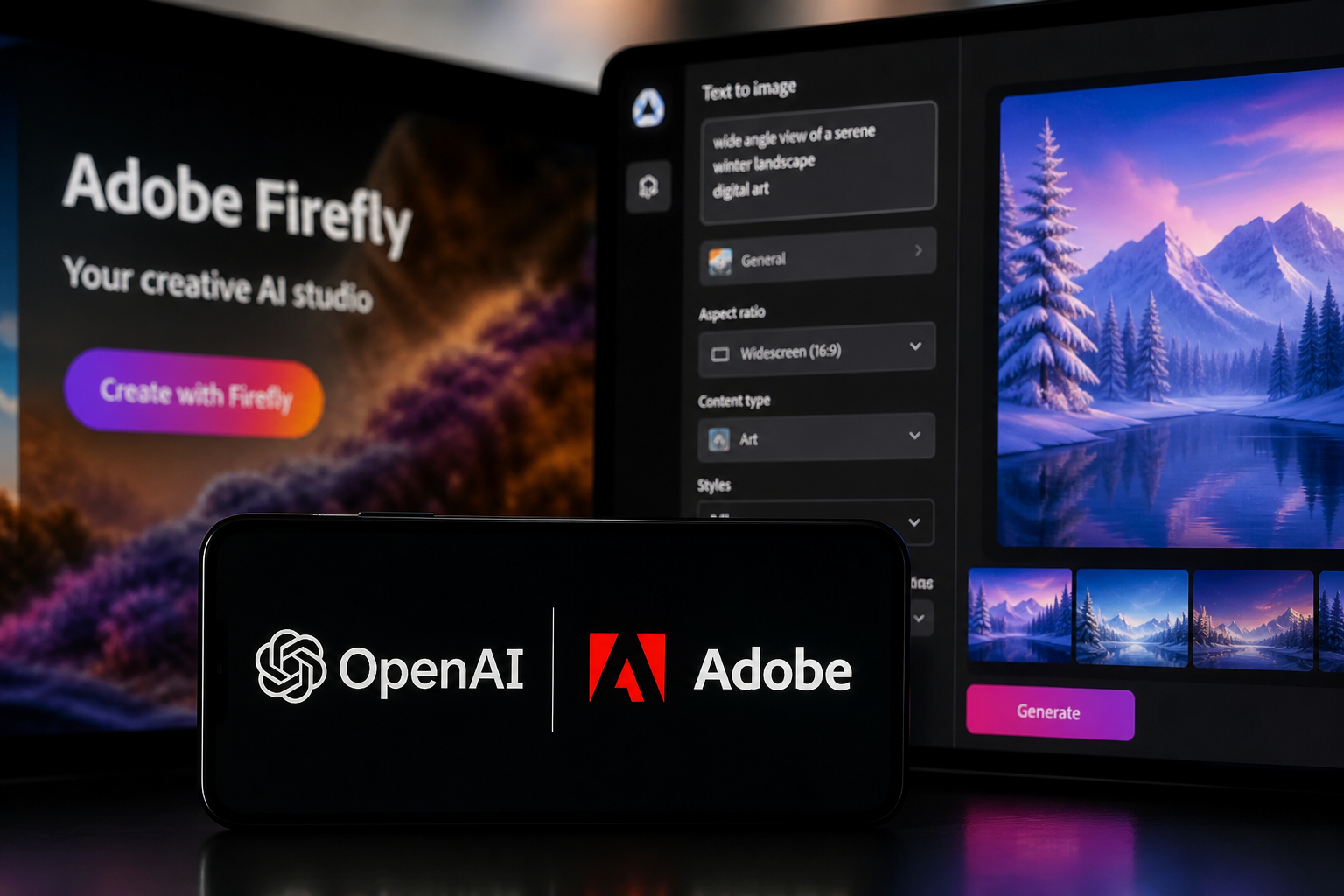
OpenAI's latest release, ChatGPT Images 2.5, brings significant improvements to its image generation capabilities. The new models, GPT-Image-2.5 Flare and Sunburst, offer sharper detail, more precise editing, and up to 50% lower latency than their predecessors. But what's notable about this release isn't just the technical advancements - it's the strategic partnerships that are shaping the future of creative software.
Adobe, a launch customer for ChatGPT Images 2.5, has already integrated the models into its Firefly creative AI studio. This move is part of Adobe's deliberate strategy to position itself as the interface, rather than just the model, in the world of creative AI. By bringing leading AI models together with its own tools in one place, Adobe is creating a conversational layer over its entire toolset, and model choice is a key part of that pitch.
The relationship between OpenAI and Adobe is a two-way street. Not only is Adobe using OpenAI's models in Firefly, but OpenAI is also incorporating Adobe's tools into its own platform. With over 70 Adobe tools available in ChatGPT, the traffic runs both ways, and neither company can be confident that it owns the starting point of a creative task. This ambiguity is at the heart of the competitive question in creative software right now - whoever owns the starting point captures the workflow.
OpenAI is addressing this question with a new social feature that allows users to share images and attach the prompts that made them. This feature, which includes the ability to share prompts alongside images, makes it easier for users to collaborate and build on each other's work. But it also raises questions about provenance and ownership in the world of synthetic imagery. With over 3 billion images created weekly across ChatGPT Images and the GPT-Image models in the API, the scale of synthetic imagery entering circulation is vast.
As regulators struggle to define what constitutes a deepfake, and how to mark and track synthetic images, OpenAI is applying C2PA metadata and invisible watermarking to its images. But whether these measures will be sufficient to establish provenance and ownership remains to be seen. The prompt-sharing feature, while convenient for users, also makes it easier for distinctive looks to be reproduced by many people from the same recipe, potentially undermining efforts to establish provenance.
The competitive landscape of creative software is complex and rapidly evolving. While OpenAI and Adobe are positioning themselves as leaders in the field, other companies, such as Higgsfield and Manus, are building on OpenAI's API, and Freepik is rebranding as Magnific, a profitable AI creative platform. As the market continues to shift, it's clear that the battle for dominance will be fought over who owns the starting point of a creative task, and who can provide the most seamless and integrated workflow for users.
Cet article a été rédigé avec l'assistance de l'IA.
News Factory APP - actualités agentiques pour booster votre SEO et AEO.