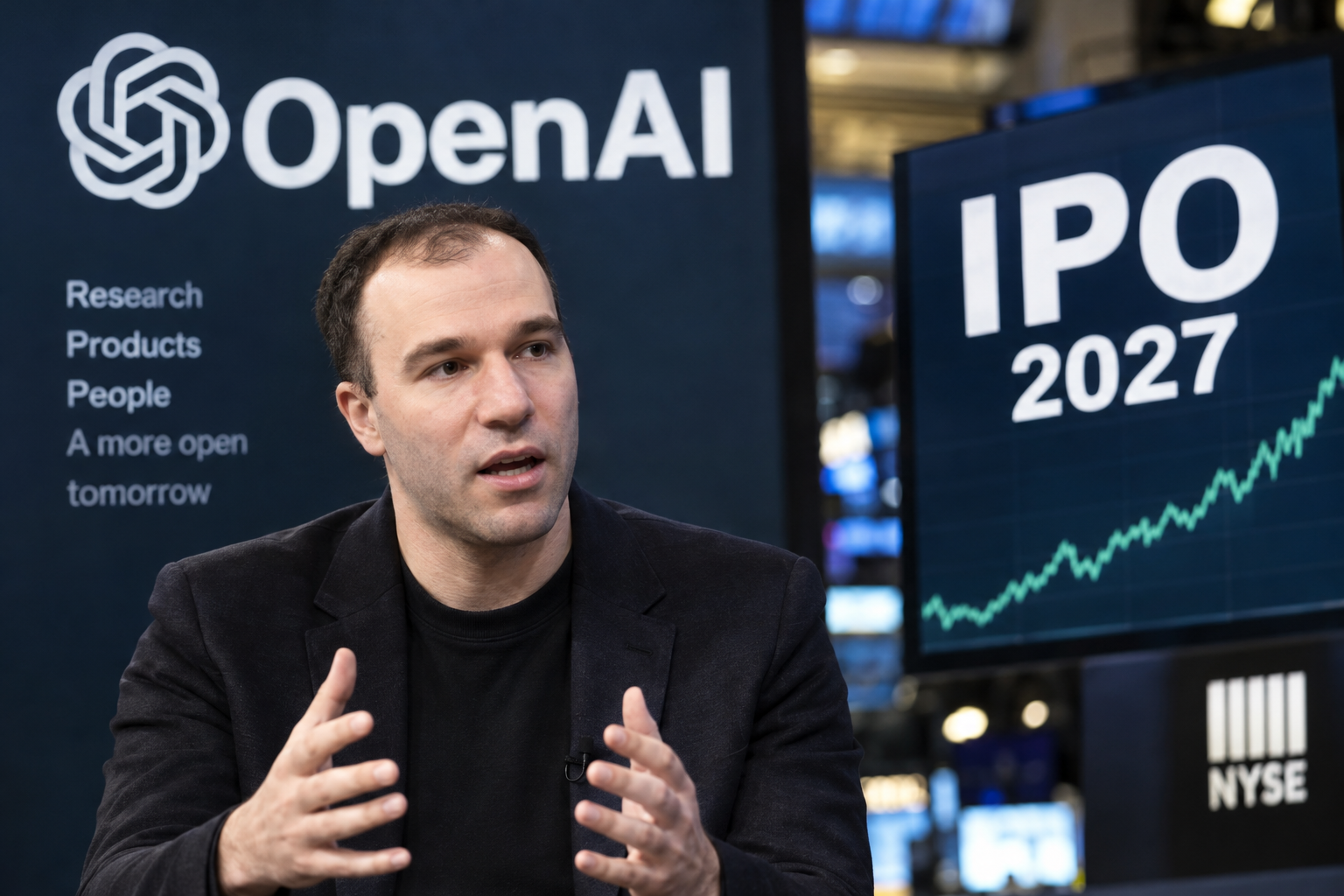
Could OpenAI go public in 2027?
OpenAI could be ready to go public in 2027, president Greg Brockman said Wednesday, pointing to enterprise sales that now make up most of the company's revenue. Asked on stage at a Wall Street Journal tech conference whether OpenAI would be ready for a listing next year, Brockman didn't hesitate. "I think so. Yes."
"We've been very clear this year that we want to go public when we feel is the right time for us, and I feel extremely good about the business," he said. "I've honestly never felt more confident in what we're doing."
Brockman didn't pretend the year started well. He described the first and second quarters of 2026 as "pretty rough" for the company's enterprise push. He also admitted OpenAI "wasn't even in the conversation" when it came to agentic coding, a fast-growing market where Anthropic's Claude Code has taken share.
"We had Codex, but no one was talking about it," Brockman said, "and I think that we just kept our heads down and executed."
How did OpenAI's enterprise business recover in 2026?
Things changed by the third quarter. OpenAI's annualized revenue grew 70% from the previous quarter, and Brockman attributed much of that to the enterprise side of the business doubling. He said the jump wasn't a one-quarter event. It was the result of investments the company had been making for months.
Why does enterprise revenue matter for OpenAI's IPO?
The shift in the revenue mix is the bigger story. Enterprise business previously accounted for only about 30% of OpenAI's total revenue. Now it's the majority. Brockman was quick to add that consumer revenue hasn't shrunk. "It's been growing, but the enterprise segment has really taken off," he said. He pointed to a recent partnership with JPMorgan Chase as an example of the kind of client the company is now signing.
Brockman also described what OpenAI learned from selling to businesses. The company had to help customers identify the most important milestones they could reach with its AI technology, earn their trust, and prove it would be a reliable partner over the long haul. "A year ago, we weren't even really in the enterprise game, right?" he said. "We were really perceived as a consumer company, and a lot of the companies we'd start talking to would say, 'Is OpenAI really committed to the enterprise?' But it's so different today."
Brockman did not give a figure for the enterprise share of revenue or for total revenue in the remarks Reuters reported. OpenAI has not set a date for a listing. Its coding agent, Codex, has been central to the corporate push, and Brockman has said the company wants to bring ChatGPT and Codex together into a single agentic platform.
The 2027 timeline fits earlier reporting. OpenAI confidentially filed a draft prospectus with U.S. regulators in June. Soon after, Bloomberg reported that the company was weighing a 2027 stock market debut, with chief executive Sam Altman holding out for a $1 trillion valuation.
OpenAI has also been raising money as its sales grow. Earlier reports put that effort at a $30 billion funding round at a valuation of about $1.4 trillion. Its investors include Microsoft and SoftBank. SoftBank's shares fell as much as 13% in June, the same month Bloomberg first reported that the listing could slip to 2027.
Anthropic, OpenAI's main rival in the enterprise market, is likely to reach the stock market first. It filed confidentially for its own IPO in June, and Reuters expects it to list before the end of the year.
Brockman co-founded OpenAI in 2015 and has taken on a bigger role this year, including oversight of its product teams. Earlier this year, he testified at Elon Musk's trial against OpenAI, where he confirmed the company was exploring an IPO. He said his own stake in the company was worth nearly $30 billion.
Cet article a été rédigé avec l'assistance de l'IA.
News Factory APP - actualités agentiques pour booster votre SEO et AEO.