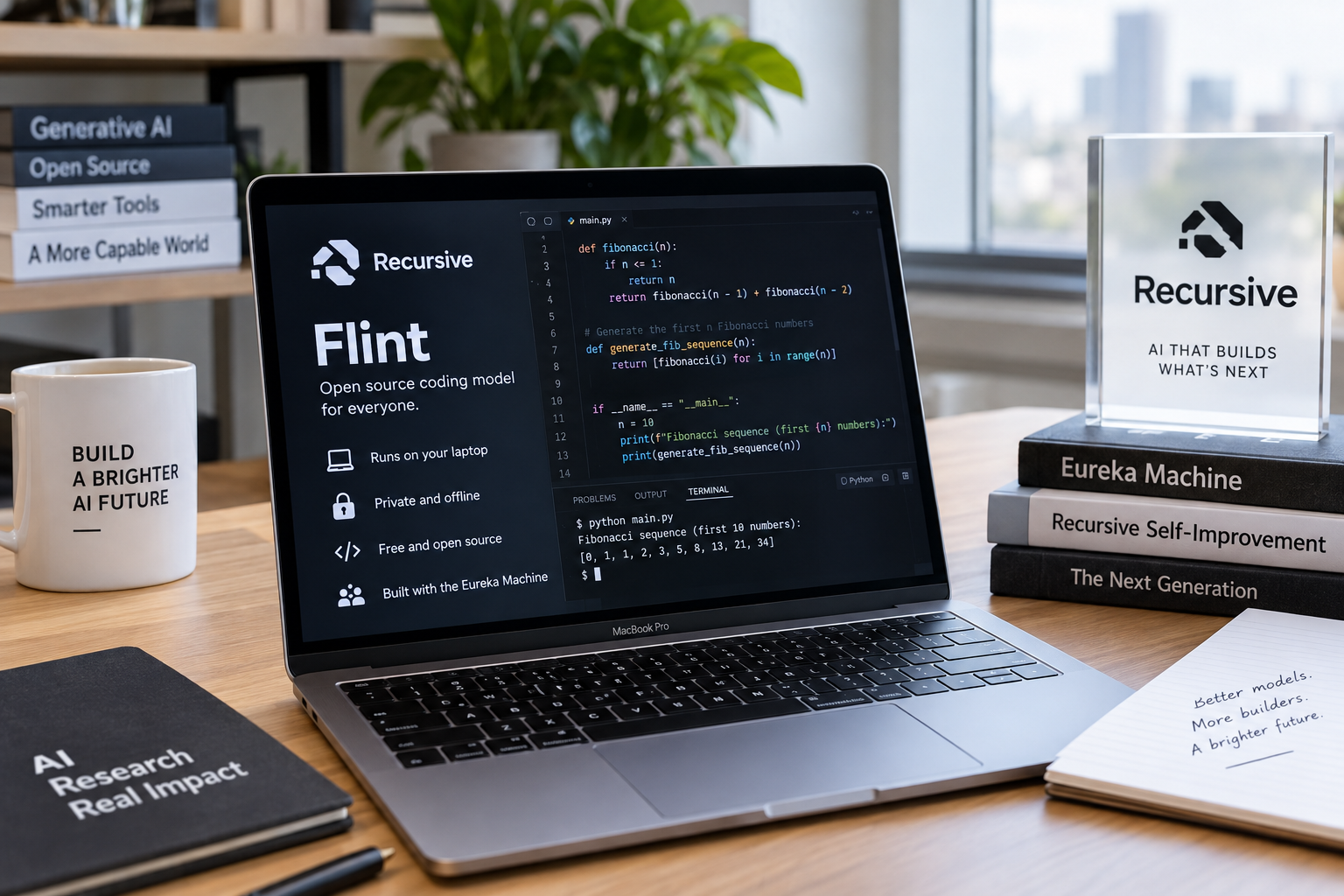
Recursive has released Flint, a free coding model from an AI startup founded last year. It runs on an ordinary laptop, and the company says its automated research system, the Eureka Machine, helped with nearly every step of building it, taking under four months with a small team.
What is Recursive's Flint coding model?
Recursive, an AI startup founded last year, released its first model, Flint, on Wednesday. It is a free coding model that runs on an ordinary laptop, and the company says AI did much of the work of building it.
Recursive’s automated research system, which it calls the Eureka Machine, helped with nearly every step of Flint’s development, according to the company. That allowed a small team to build the model from scratch in under four months.
The launch is an early public test of recursive self-improvement, the idea that AI can build better AI, which in turn builds even better AI. The concept is also one of the most debated in the industry. Some researchers fear that AI improving itself could slip out of human control. Recursive’s version is more limited for now: an AI research assistant overseen by people, producing a model small enough to run on a laptop.
The company emerged from stealth in May with $650 million in funding at a $4.65 billion valuation. Backers include GV, Nvidia and AMD Ventures. Recursive is led by CEO Richard Socher, Salesforce’s former chief scientist.
Because Flint runs on a user’s own computer rather than a company’s cloud servers, developers can use it offline and keep their code private. They also avoid the usage fees that cloud AI services charge based on how much text a model processes. Flint is free to download on Hugging Face, the popular site for sharing AI models, under the Apache 2.0 license, which allows free use and modification.
How can Flint run on an ordinary laptop?
Flint uses a mixture-of-experts design, meaning it activates only a small portion of itself for any given task. It uses just 2.5 billion of its 40 billion settings, known as parameters, at a time. That keeps it light enough for a standard laptop. By comparison, Meta’s Muse Spark Open, an open model built for Macs that was released last week, uses 816 billion parameters and needs at least a terabyte of memory.
How fast is Flint compared with other coding models?
Speed is another selling point. In Recursive’s tests, Flint generated about 131 tokens, or chunks of text, per second on a MacBook Pro with Apple’s M4 Pro chip. Similar models managed 58 to 69 tokens per second on the same machine, including Google’s Gemma 4 and Nvidia’s Nemotron 3.5 Lightning. On Nvidia’s RTX Spark, Flint topped 150 tokens per second.
On SWE-Bench Verified, a benchmark that measures how well AI can fix real-world software bugs, Flint outperformed other models with under 50 billion parameters. On Recursive’s own average across six tests, only one model, Alibaba’s Qwen3.8 27B, scored higher.
The company concedes that Flint needs more direction than the big paid coding assistants. It recommends breaking large tasks into smaller steps. Early reviews have still been encouraging. Wired’s Will Knight used Flint on a Mac with 48GB of memory to build several small programs, including a to-do list app and a tool that searches the web for research. He said smaller coding models often ran into errors or were slow compared with Claude or Codex, but Flint handled his coding requests every time.
The Eureka Machine generates ideas, runs experiments and uses the results to decide what to try next. According to the company’s launch video, it contributed to nearly every part of building Flint, from pretraining to post-training and inference. Recursive said those contributions included a sparser model shape, low-bit training that shrank Flint by 71 percent with almost no loss in quality, and custom kernels, which are specialized programs that speed up underlying computations.
Recursive did not say how much time the Eureka Machine saved its researchers. The company is not alone in leaning on AI for research. OpenAI said last month that by mid-August, its AI agents were logging 3.1 workdays for every one worked by a human researcher.
Recursive has framed its strategy around scale of computing rather than staffing. The company previously told TechCrunch that its $410 million compute deal with Amazon Web Services in June was “less about headcount and more about agent count.”
The long-term goal, Socher told Wired, is for the Eureka Machine to achieve full recursive self-improvement, with humans overseeing the process and able to stop it if something goes wrong. Recursive says each new model should make the Eureka Machine a better researcher, helping it build the next one faster.
Cet article a été rédigé avec l'assistance de l'IA.
News Factory APP - actualités agentiques pour booster votre SEO et AEO.