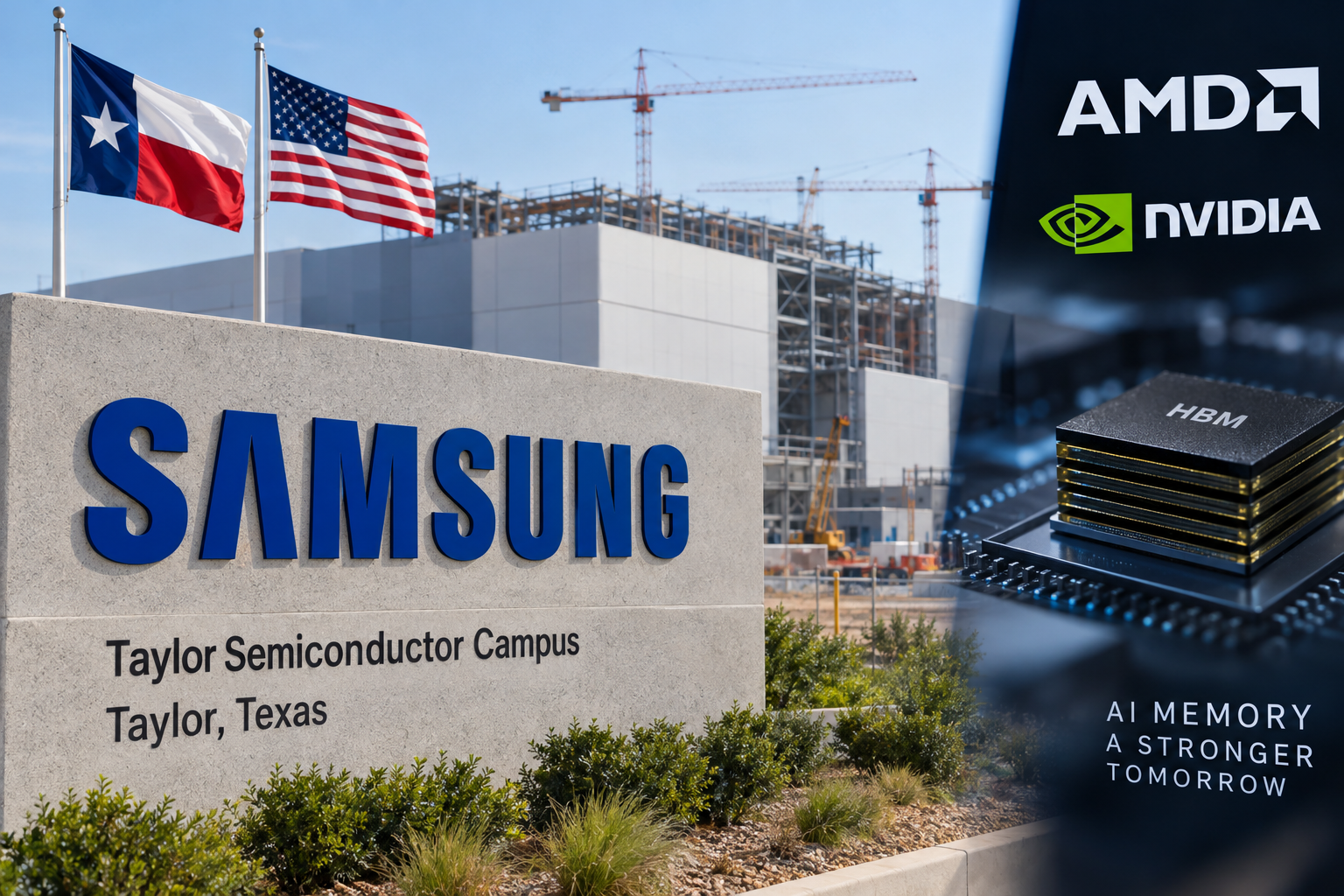
Samsung plans to use its second chip plant in Taylor, Texas, to make parts for AI memory chips sold to AMD and Nvidia, South Korea's Maeil Business Newspaper reported Tuesday, citing industry sources. The paper says the plant has already filled its entire output with orders, and that most of the booked volume belongs to AMD.
Where Will Samsung Make AI Memory Parts for AMD and Nvidia?
The facility will produce base dies for high-bandwidth memory. That is the logic layer at the bottom of the stacked memory chips that feed AI processors. The second Taylor fab will run on Samsung's advanced 2-nanometer process and cover about 2.7 million square feet, roughly 1.5 times the size of the first plant, according to the report.
Has Samsung Confirmed the Taylor Plant Report?
Samsung declined to comment. Reuters said it could not confirm the report, and the news outlet TNW said it had not independently verified it either.
When Will Samsung's Second Taylor Plant Start Production?
Timing is still months and years away. Formal construction is due to begin this month, according to the report. Equipment should arrive starting in February 2029, with mass production expected in 2030.
The first Taylor plant has a longer track record. The project grew from an initial $17 billion to a total investment of $37 billion, and it is due to begin mass production in 2027. Tesla is its anchor customer, having signed a $16.5 billion contract for its AI5 and AI6 chips. The 1,268-acre site has room for up to 10 fabs. The first plant's budget includes a $4.75 billion subsidy under the US CHIPS Act.
Activity around the second fab has been visible for months. Taylor's city council approved engineering support for the second fab's permits in March, and Samsung has been hiring for the campus.
The stakes for Samsung's chip foundry arm are high. The unit has lost money for years, and a second fab filled before ground is broken would be a sharp reversal. Kiwoom Securities expects the unit to return to profit starting in the fourth quarter. Samsung has projected that orders for its 2-nanometer chips will grow more than 130% this year, helped by AI demand and strained capacity at rival TSMC.
The move would also deepen the US supply chain for AI memory, where demand has outpaced supply. Memory makers are racing to catch up, including SK Hynix and China's CXMT. AMD, meanwhile, has been locking in capacity across the board as its AI chip business grows.
Cet article a été rédigé avec l'assistance de l'IA.
News Factory APP - actualités agentiques pour booster votre SEO et AEO.