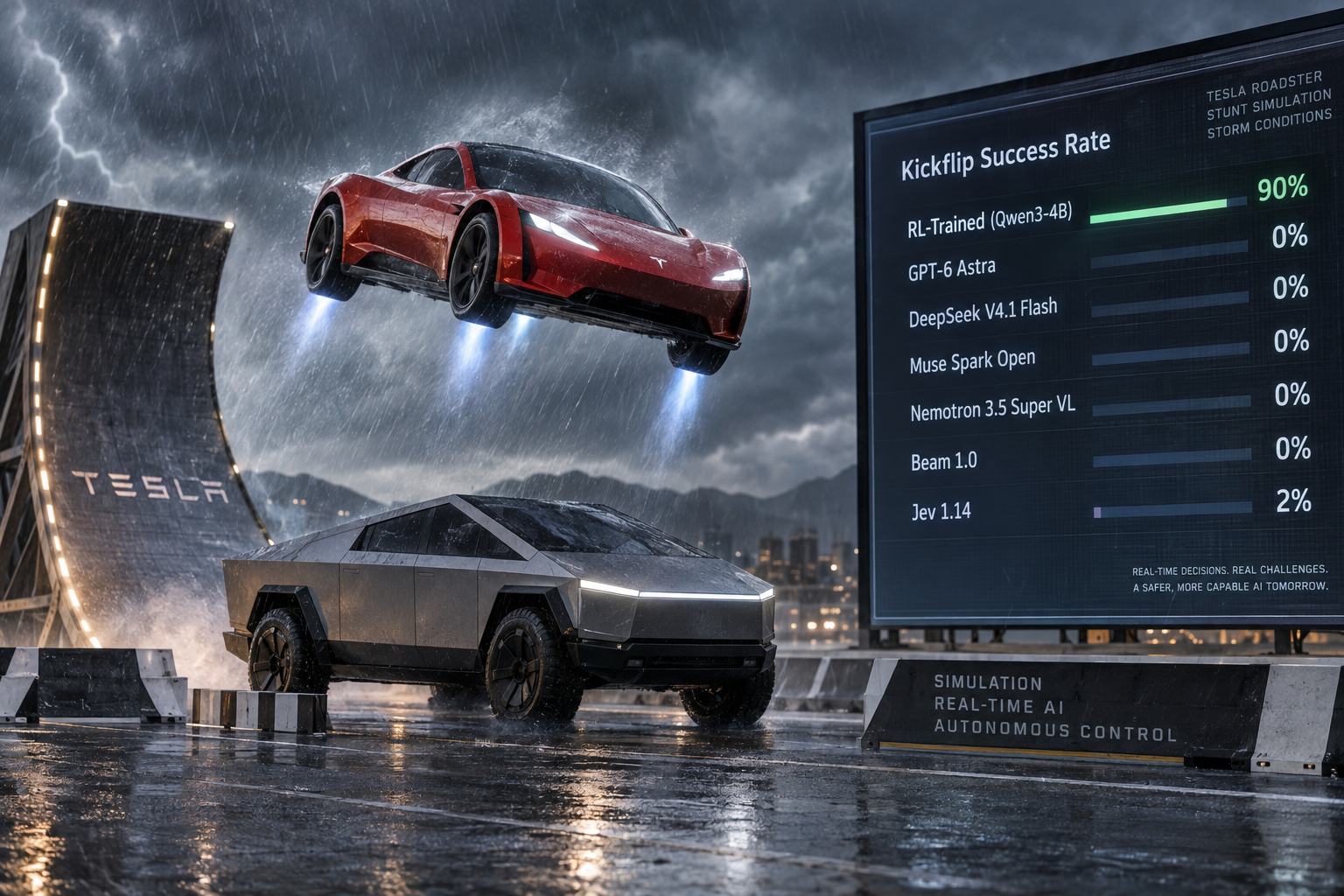
A 4-billion-parameter language model trained with reinforcement learning landed 90 percent of simulated kickflips in a storm with the clock running, while OpenAI's GPT-6 Astra landed none in real time. Researchers tested the stunts in a physics simulator of a flying Tesla Roadster, and the study covers only two stunts in one setup.
A small language model trained with reinforcement learning flew a simulated Tesla Roadster through two stunts from the car's October 15 reveal more reliably than OpenAI's GPT-6 Astra and several leading open models, researchers say. The 4-billion-parameter model landed 90 percent of kickflips in a simulated storm while the clock was running. Astra landed 74 percent in the same conditions when it was allowed unlimited time to think, and in real time it landed none.
The stunts were the ones Tesla showed at the reveal: a ramp that curls the car upside down and a kickflip over a parked Cybertruck. At the event, the car drove off the ramp, rolled upright in the air and landed, then used thrusters to hop over the truck. Elon Musk said on X that the demo had already been pushed back two weeks because of high winds. That raised a question the researchers wanted to test: how would a language model handle the controls in that wind?
To find out, they built a reinforcement learning environment around a physics simulator of a flying roadster. The car is a rigid body, 4.5 meters long and 2,000 kilograms dry, with four cold-gas thrusters at the corners of its floor. Each flight was assigned a wind band: light, gale or storm, with storm winds reaching 33 meters per second. Gusts came on top of the average wind, and a car that fell flat caught far more of it.
The language models were not given the controls in the usual way. They had to send one command every 0.2 seconds of simulated time while the car kept moving. The commands included coast, climb, hold, rotate and land, and a flight computer turned each one into thrust for the four thrusters. A flight counted as a success only if the car ended up on all four wheels on the 14-meter road, within about 20 degrees of level, and without crashing.
Does the clock running change the results?
The results depended heavily on whether the clock kept running. The researchers tested the open models DeepSeek V4.1 Flash, Meta's Muse Spark Open, Reflection's Beam 1.0 and NVIDIA's Nemotron 3.5 Super VL. When the simulator waited for each reply, DeepSeek landed 98 percent of kickflips in light wind and 87 percent in a storm. Muse, Nemotron and Beam landed between 58 and 82 percent, depending on the wind. Once the clock ran, all four landed 0 percent of kickflips. Their median decision time was between one and six seconds, so by the time a reply arrived, the car had already moved on.
The researchers also flew GPT-6 Astra and TypeSafe's Jev 1.14, a model built for fast decisions that picks from a menu of commands. Astra took about two seconds per decision and landed none of its 768 storm flights in real time. Jev answers in about 0.17 seconds, fast enough for the clock, but it landed only 2 percent of storm kickflips live.
The team's own model started from Qwen3-4B-Instruct-2507, using a small set of add-on weights that train while the base model stays frozen. Training had two stages. First came supervised fine-tuning on flights that had landed, copied from a hand-written rule-based pilot in light wind and from DeepSeek's successful gale and storm flights. Then came reinforcement learning, in which the model practiced 60 steps of flights across all three wind levels, with storm flights counted twice. The final model took about four GPU-hours, or roughly $13 at the researchers' rate.
Did the small model beat GPT-6 Astra in the simulation?
The trained model answers in 0.09 seconds, which keeps it inside the 0.2-second interval. It landed 96 percent of kickflips in light wind, 96 percent in a gale and 90 percent in a storm, with the simulator running in real time. Against DeepSeek with unlimited time, the difference was not large enough to call significant in storms, though the researchers said the 4B model was ahead. Against Astra with unlimited time on the same 384 storm kickflips, the 4B landed 347 flights to Astra's 286, a gap the researchers said was statistically significant.
What are the limits of this study?
The researchers were careful about what the results mean. The environment, the vehicle parameters and the stunts are their own assumptions, and the study covers two stunts in one simulated setup. The 4B model's storm training also included flights learned from DeepSeek, so the comparison is not entirely between strangers. The rule-based pilot still decides instantly, and the researchers noted that a real car would likely use a conventional controller rather than a language model. They said they had not tested a classic controller policy on the simulator and would expect one to land nearly every flight.
The team has released the environment, prompts and setup files in an open-source repository, along with the tools needed to run other models against the benchmark. The researchers said they built the training pipeline on SkyPilot, an open-source tool for running jobs across cloud and Kubernetes GPUs.
Cet article a été rédigé avec l'assistance de l'IA.
News Factory APP - actualités agentiques pour booster votre SEO et AEO.