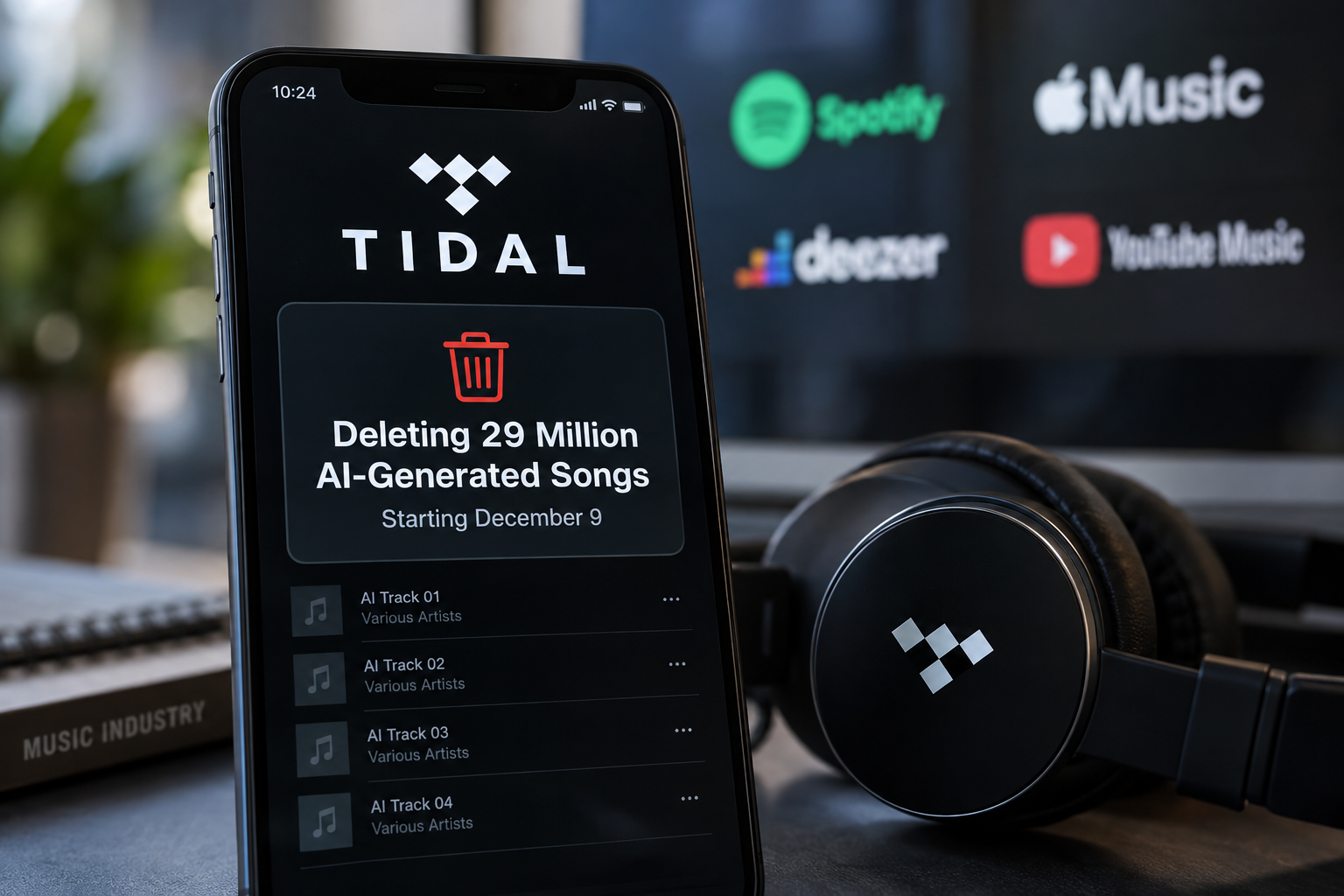
TIDAL will start deleting every wholly AI-generated track from its catalog on December 9, removing about 29 million songs. The company said it also expects to turn away 80,000 to 85,000 AI-made tracks a day after the purge begins.
Robert Andersen, who leads TIDAL at parent company Block, announced the plan on X. TIDAL’s own account confirmed the date. Andersen said the songs should be gone by the start of 2027, and he described the move as the first of its kind among streaming services. He urged rivals to follow.
The decision marks a sharp turn for a company that had already taken a softer approach. In July, TIDAL began labeling AI tracks and cutting off their royalties. Andersen said that wasn’t enough. “43% of tracks distributed to us in the last 90 days have been detected as AI-generated. Something more drastic needs to be done,” he wrote.
Much of that music finds no listeners. Andersen said 96% of AI-generated songs on TIDAL received zero plays. The company has argued that removing them will have essentially no effect on how people use the service.
Why is TIDAL deleting AI-generated songs?
Harm to human artists is the core of TIDAL’s argument. The company says AI models can churn out material faster than people can make work of real value, which can mislead listeners and divert royalty payments away from creators. TIDAL also said it has already removed about 66,000 tracks for impersonating artists. That practice violated its AI policy even before this update.
The policy applies only to music made wholly by AI. Artists can still use AI tools as long as the final product contains human elements, according to the company’s announcement.
How TIDAL plans to find AI tracks
How does TIDAL detect AI-generated music?
TIDAL relies on detection tools to identify AI music. Its terms of service warn that those tools can wrongly tag tracks, and users can ask support to fix a label. The company has not said exactly how its detection works. Industry observers have suggested the company will likely rely on watermarks, since Suno, which accounts for 94% of AI songs on TIDAL, added watermarking earlier this year. TIDAL also cites Google Lyria as a source of AI tunes, and those files carry SynthID labels embedded in the waveform. Deezer has said it offers a licensable AI music detector with a false-positive rate of less than 0.01%, but it is unclear whether TIDAL uses that tool or something similar.
Watermarks will not catch everything. Open models for music generation can run locally on a graphics processing unit, and some cloud providers do not watermark their outputs. Detection systems can also be evaded as new models appear.
Will other streaming services delete AI-generated music too?
The problem is not unique to TIDAL. Rivals face the same flood of uploads. More than half the music uploaded to Deezer in June was made by AI. Other services have taken different paths. Spotify has pulled 50 million spam tracks from its recommendations but left them on the service. Apple Music has made AI tags mandatory for record companies. Spotify, YouTube Music, Deezer and Apple Music all still allow AI music on their platforms with labeling.
For now, TIDAL’s policy will remove a large share of the AI-generated material on its platform. Whether other services follow Andersen’s call is the open question.
Cet article a été rédigé avec l'assistance de l'IA.
News Factory APP - actualités agentiques pour booster votre SEO et AEO.