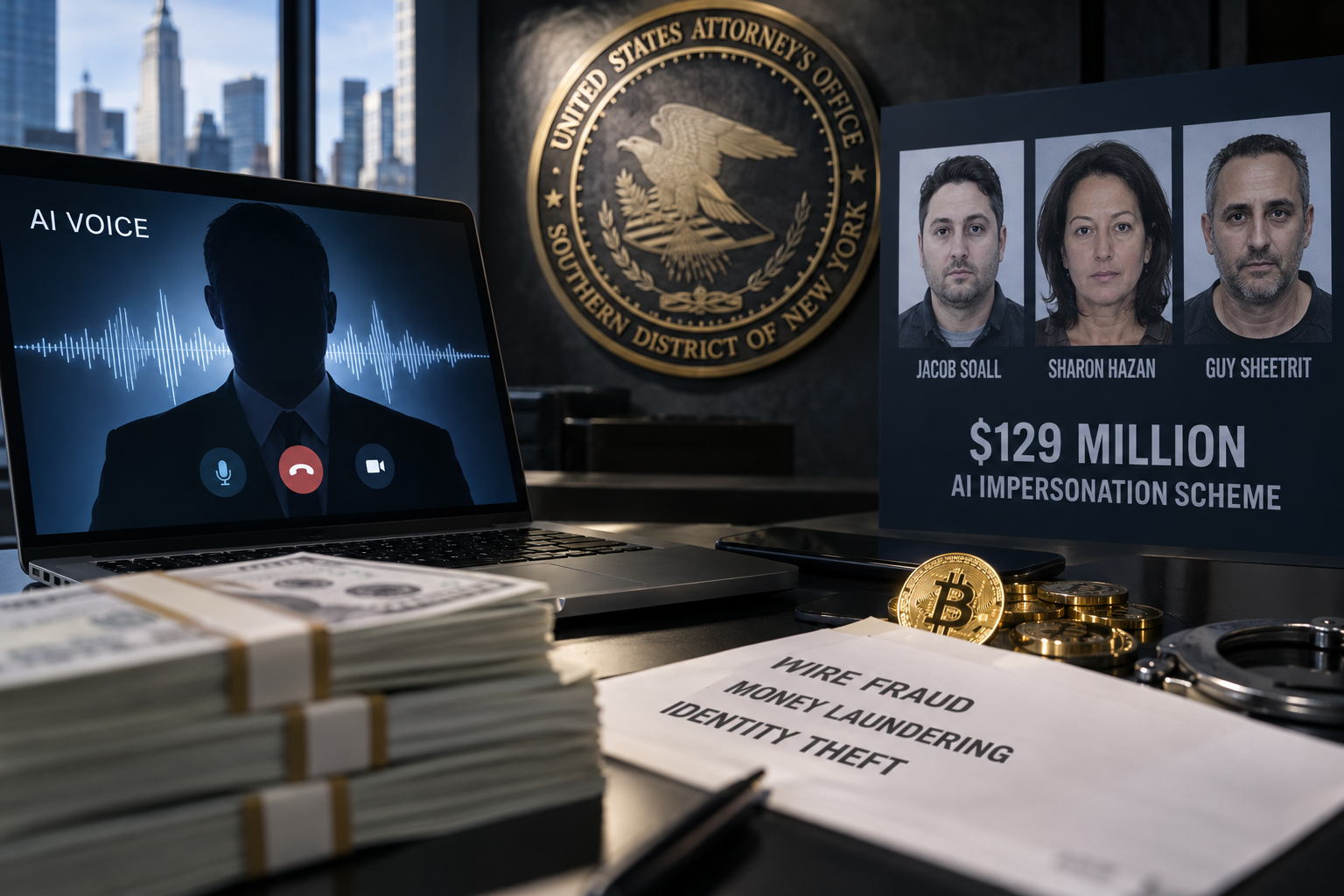
Three men, Jacob Soall, Sharon Hazan and Guy Sheetrit, face U.S. charges for allegedly using artificial intelligence to impersonate company executives and lawyers. Prosecutors say the group tricked employees into sending about $129 million to accounts they controlled between 2024 and 2026. The charges are allegations, and the men are presumed innocent.
Three men face U.S. charges for allegedly using artificial intelligence to impersonate company executives and lawyers, tricking employees into sending about $129 million to accounts controlled by the group, prosecutors said.
Who Is Charged in the $129 Million AI Impersonation Case?
The indictment was unsealed Thursday by the U.S. Attorney's Office in Manhattan. It names Jacob Soall, 41, Sharon Hazan, 54, and Guy Sheetrit, 42. Spanish police arrested Soall and Hazan in June and August, and U.K. police arrested Sheetrit in September. The U.S. has asked that all three be extradited.
How Did the AI Impersonation Scheme Work?
According to the indictment, the scheme ran from 2024 to 2026. The group would call an employee while posing as the company's chief executive. Using AI to mimic the boss's voice or image, they asked the employee for help with a secret deal.
The fake executive then directed the employee to contact a lawyer at a large international law firm. A second member of the group posed as that lawyer and supplied the bank details for a large transfer. The employee, believing the request came from senior leadership and outside counsel, would then move the money.
The victims included a Missouri hospital system, which lost about $4.8 million, and a U.K. financial technology company, which lost about $11.6 million. A Rhode Island bank, a California hospital system, a Massachusetts mutual fund and a Florida pet food company were also targeted.
The money moved through accounts in Spain, Greece, the United Arab Emirates, Singapore and China. Prosecutors said the funds were then converted into cryptocurrency to hide where they came from.
Soall mainly posed as lawyers in the United Kingdom, according to the indictment, and kept a handwritten script he called "Lawyer Call." Prosecutors accuse Hazan and Sheetrit of laundering the money. Hazan was previously convicted of conspiracy to commit bank fraud in the same court in 2008.
What Charges Do the Three Men Face?
All three face charges including wire fraud, money laundering and aggravated identity theft. The most serious counts carry sentences of up to 20 years in prison. The charges are allegations, and the men are presumed innocent until proven guilty.
The case is a much larger version of a 2019 voice-cloning fraud, in which criminals faked a chief executive's voice to steal $243,000. Impersonation scams using AI have grown quickly since then, and this indictment shows how far the schemes have expanded in scale.
Cet article a été rédigé avec l'assistance de l'IA.
News Factory APP - actualités agentiques pour booster votre SEO et AEO.