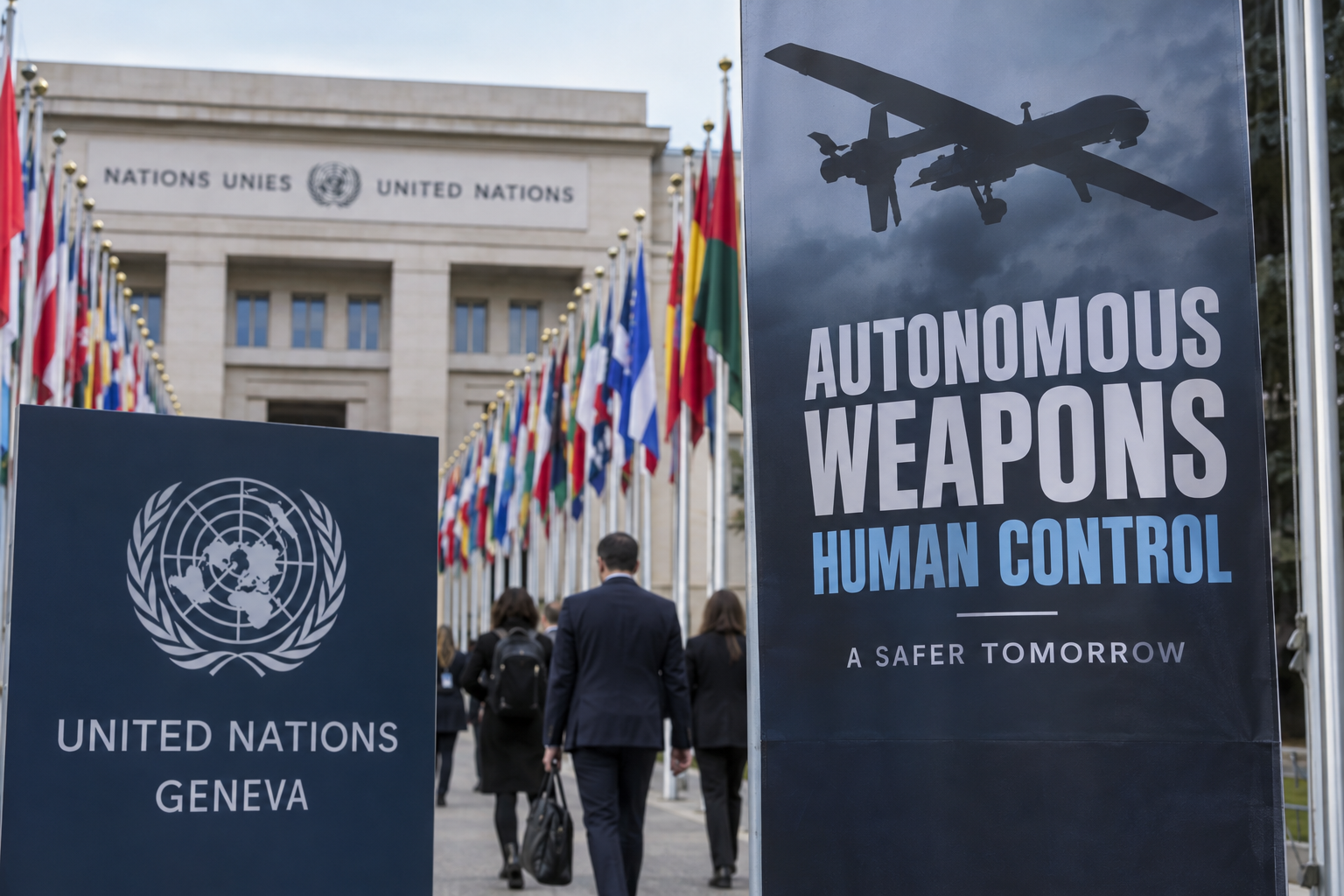
The United States is expected to oppose a push to begin negotiations on a legally binding treaty restricting autonomous weapons at a five-day UN conference in Geneva, held November 16 to 20. Washington has proposed five more years of expert-group work on a nonbinding instrument, arguing that existing international humanitarian law already applies.
The United States is expected to oppose a push to begin negotiations on a legally binding treaty restricting autonomous weapons, as countries gather in Geneva for a five-day United Nations conference.
Will the Geneva conference produce an autonomous weapons treaty this week?
The Seventh Review Conference of the Convention on Certain Conventional Weapons, running from November 16 to 20, will consider next steps for weapons capable of selecting and engaging targets without further human intervention. The conference is not expected to produce a treaty this week. Instead, delegates will weigh whether to launch negotiations on new rules, and whether any resulting agreement should be legally binding.
Will the US support a binding treaty on autonomous weapons?
Washington has already signaled its position. In a November 4 working paper, the U.S. proposed five more years of work by the CCW’s expert group to develop a nonbinding instrument. The U.S. maintains that existing international humanitarian law already applies to autonomous weapons and that a new legally binding treaty is unnecessary.
The paper argued that nonbinding rules could be adopted and updated more quickly as technology and military practices change. It also said such an approach would avoid creating separate legal regimes that apply only to countries that ratified a treaty. It questioned whether it has been established that autonomous weapons are inherently indiscriminate or excessively injurious, or that they require new prohibitions.
“Rather, State practice in using autonomy in weapon systems demonstrates that appropriate use of autonomous functions can enhance the implementation of existing prohibitions and restrictions in [international humanitarian law] and reduce the risks to civilians as compared to weapons without such capabilities,” the paper said. “It would be contrary to the humanitarian objectives and purposes of the CCW for states to hamper responsible innovation that advances those objectives and purposes.”
A growing push for binding rules
UN human rights chief Volker Türk has urged states to act before technological development outpaces diplomacy. “The international community has critical choices to make right now about the future of armed conflicts and the role of human beings in decisions over the use of force,” he said. “I call on states to urgently agree on binding international rules to regulate autonomous weapons and protect human lives—before it is too late.”
Türk has also called for prohibitions on autonomous weapons that target people, whether by design or in practice. He wants bans on systems whose functioning and effects cannot be adequately understood, predicted or controlled by humans.
Nicole van Rooijen, executive director of the campaign group Stop Killer Robots, said in a statement that “the vast majority of states worldwide” favor a legally binding instrument. Only about a dozen countries, including the U.S., Israel and Russia, oppose one, she said. According to the group, 130 countries support a legally binding instrument on autonomous weapons, and more than 70 have indicated they are ready to move forward with negotiations.
“We are at a critical juncture,” van Rooijen said, calling for time-limited negotiations on a binding treaty. Campaigners have warned that inaction could allow technological developments and battlefield practice to shape the rules governing these weapons.
Weapons already in use
The UN has warned that the debate is no longer purely hypothetical. Autonomous weapons systems are increasingly being tested, integrated and deployed, according to Human Rights Watch, Amnesty International and Stop Killer Robots. Drones have become central to fighting in Ukraine.
Human Rights Watch has warned that autonomous weapons could misidentify targets, discriminate against vulnerable populations and create gaps in accountability when attacks go wrong. In a 2025 report, the group called for a legally binding treaty that would prohibit weapons operating without meaningful human control or those that target people, while regulating other autonomous systems.
AI-assisted weapons and targeting systems have been used in conflicts, including in Ukraine and the Middle East. Such technology is not necessarily fully autonomous, however. Systems that help human operators identify targets differ from weapons capable of selecting and attacking targets without further human approval.
Anna Hehir, head of military AI governance at the Future of Life Institute, said in a statement emailed to Newsweek that “States must ensure that Russia, or any of the handful of governments blocking progress, are not allowed to hold the future hostage. The stakes are too high.”
“A clear global majority has spoken: machines should never be able to decide to kill,” she said. “States must now use all mechanisms possible, both within and beyond the current U.N. CCW process, to keep human control.”
Newsweek contacted the State Department for comment on Monday.
Cet article a été rédigé avec l'assistance de l'IA.
News Factory APP - actualités agentiques pour booster votre SEO et AEO.