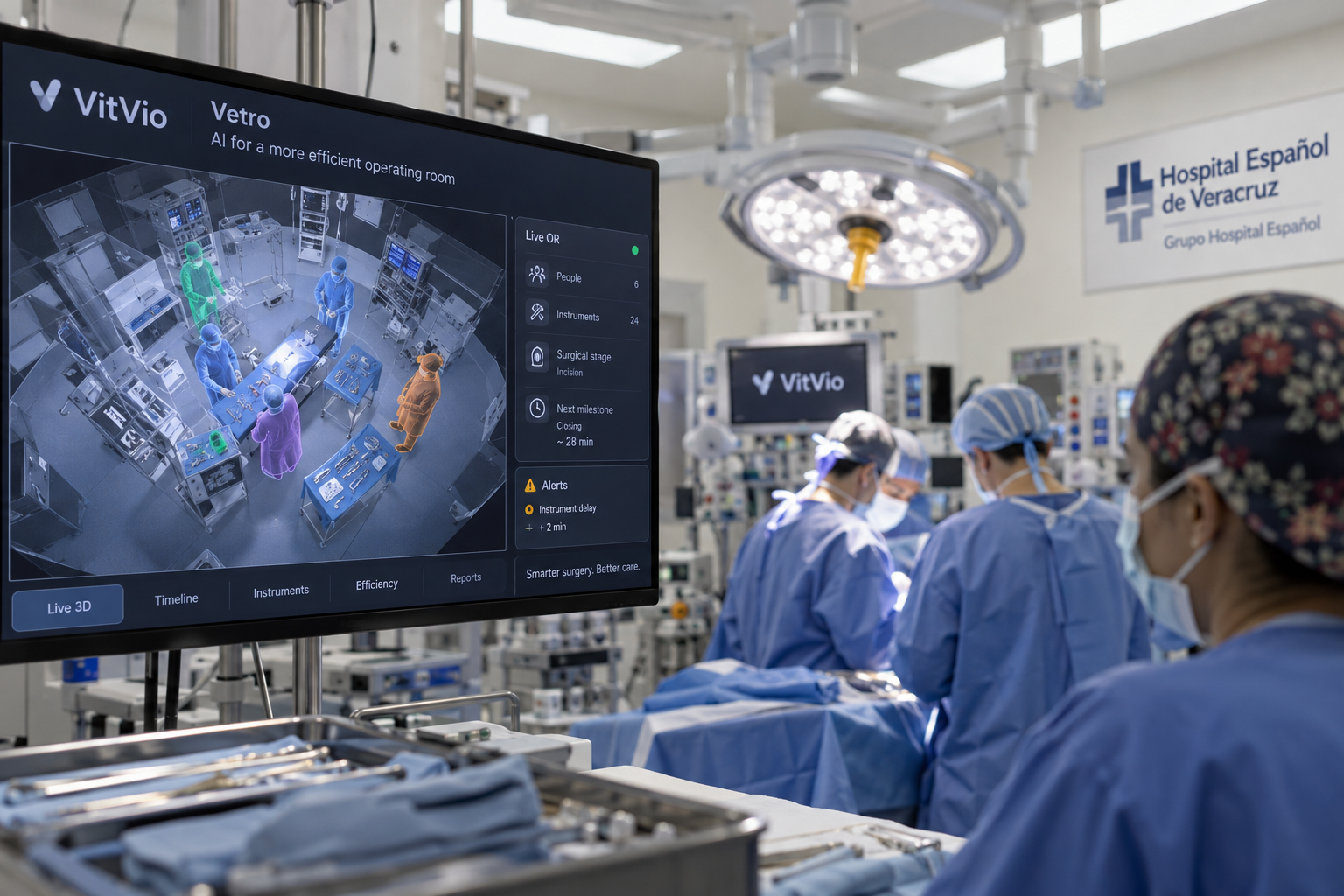
London-based startup VitVio is bringing its Vetro AI system to every operating room at Hospital Español de Veracruz, a private hospital on Mexico's Gulf coast. It is the company's first deal in Latin America and could extend to as many as 60 operating rooms across seven Grupo Hospital Español facilities.
London-based startup VitVio is bringing its artificial intelligence system to every operating room at Hospital Español de Veracruz, a private hospital on Mexico’s Gulf coast. It is the company’s first deal in Latin America.
How does VitVio's Vetro system work?
The system, called Vetro, uses cameras and sensors to create a live 3D model of an operating room. That model shows the people, equipment and activity inside. AI agents use the information to help manage the work that happens around surgery, from tracking instruments to spotting delays.
Vetro can flag bottlenecks, help coordinate staff across patients and monitor which tools are being used. The goal, according to the company, is to cut waste and make operating rooms run more efficiently. The system can also generate operative notes while a procedure is underway.
VitVio sees the tool as a way to free doctors and nurses from some of the administrative work that surrounds surgery. That would give clinicians more time with patients and help hospitals fit more procedures into their schedules.
The company says Vetro tracks cases, surgical stages and equipment rather than individual people. It is designed to strip personal details from the data.
“Mexico is modernizing its hospitals with AI, and we want to lead that,” said Antonio Ramos De-la Medina, chief executive of Hospital Español de Veracruz.
The hospital is part of Grupo Hospital Español. VitVio said the agreement could eventually bring Vetro to as many as 60 operating rooms across seven of the group’s hospitals. Hospital Español de Veracruz ranked among Mexico’s top five small and medium-sized private hospitals in the 2025 Funsalud ranking, according to Mundo Ejecutivo.
VitVio was founded in 2024 by chief executive Thomas Knox, chief technology officer Peter Rennert, chief operating officer Maks Kozarzewski and chief product officer Aleks Pajewski. The company has raised $10 million to date, including an $8 million seed round led by Bek Ventures in October 2025.
Where is VitVio expanding beyond Mexico?
Mexico is the latest step in the company’s international push. Earlier this month, VitVio began installing Vetro at a hospital in Gdańsk, its first deployment in Poland. The company also works with specialist hospitals in New York and with NHS hospitals in England, including the Royal Orthopaedic Hospital in Birmingham.
Does Vetro raise privacy concerns for staff and patients?
Putting cameras inside operating rooms, however, raises obvious questions about staff surveillance and how hospitals handle the data those cameras collect. VitVio has not disclosed how long it keeps that data or where it is stored. Its assurances about removing personal details do not, on their own, answer those questions.
AI is finding uses across healthcare well beyond the operating room, from hospital administration to the management of drug trials. For VitVio, the test is whether monitoring the activity around surgery can make hospitals more efficient without creating new privacy concerns.
Knox credited the hospital’s team for moving quickly. “Their conviction took us from that conversation to go-live in under three months,” he said.
Cet article a été rédigé avec l'assistance de l'IA.
News Factory APP - actualités agentiques pour booster votre SEO et AEO.