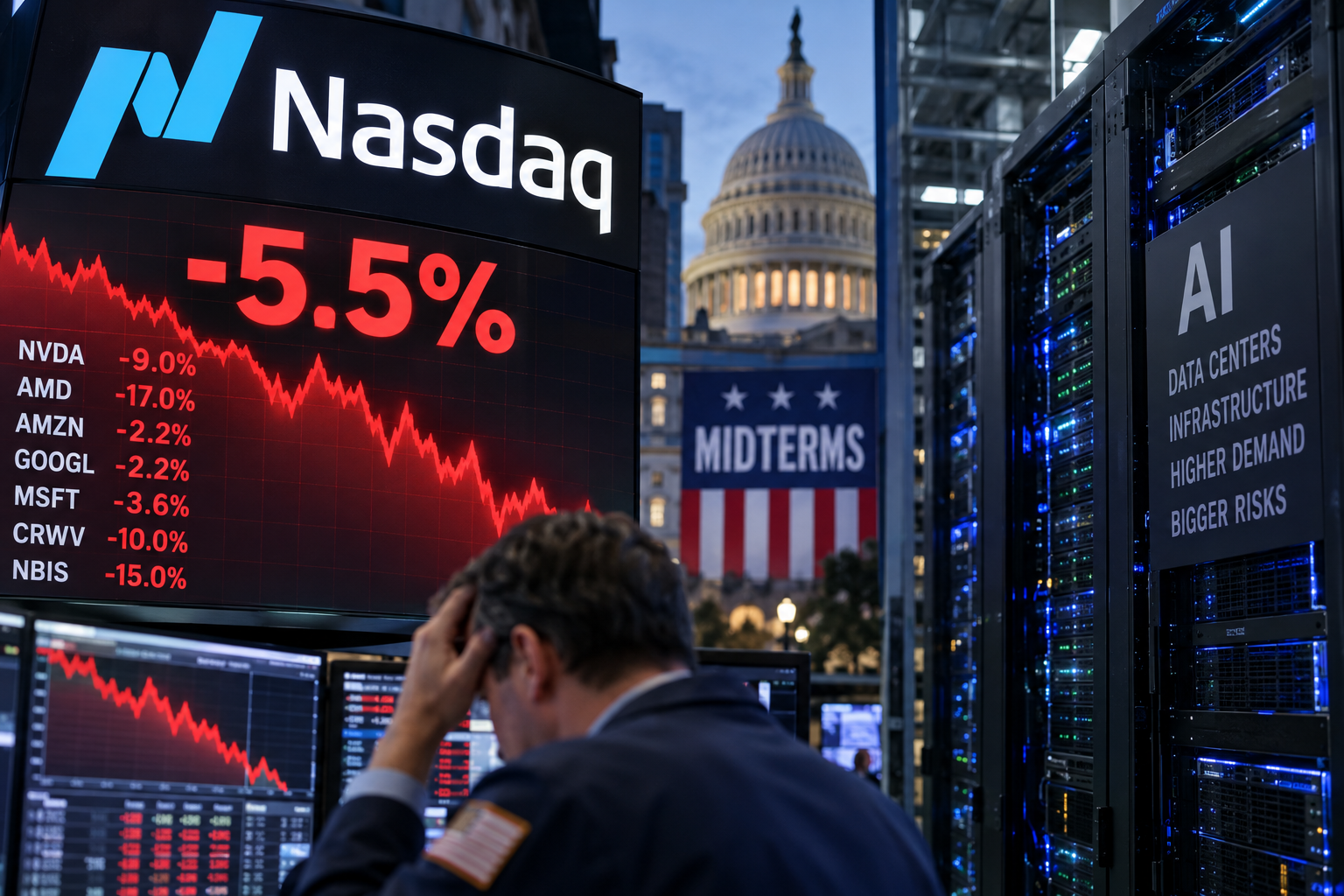
Why did the Nasdaq fall 5.5% on Thursday?
The Nasdaq Composite fell 5.5% on Thursday, its deepest one-day drop since the 'Liberation Day' selloff in April 2025, as investors dumped technology shares on fears that the Democrats' sweeping midterm victory would slow the buildout of artificial intelligence infrastructure.
The tech-heavy index is now in correction territory, down nearly 12% from its record close on October 6. A correction is generally defined as a 10% drop from a recent peak. The Nasdaq 100, which tracks the largest names in the broader index, fell 6.4%, erasing $2.5 trillion in market value.
It was the second straight day of selling in AI stocks and the fifth time since mid-October that the Nasdaq Composite dropped more than 500 points. The AI trade, which had been buoyant for months, has come under growing scrutiny over the past several weeks.
Michael O'Rourke, chief market strategist at JonesTrading in Stamford, Connecticut, said the election results pointed to a clear risk. "The big election outcome was, especially with the Democrats winning a lot of the governorships, that the slowdown of the data center buildout is the real key theme that's going to stick," he said.
How do midterm results affect data center buildout?
Investors are also weighing the local resistance that data centers have faced. Some analysts said markets have not fully priced in the costs these facilities impose on communities. Bruce Zaro, managing director at Granite Wealth Management in Plymouth, Massachusetts, said he expects significant pushback. "There's going to be a lot of pushback about those data centers being geographically located in someone's backyard, straining the power grid, straining the water systems," he said. "Although there are a number of data centers already approved, there are still a lot to be permitted."
UBS analysts estimated that around 30% of expected U.S. data center capacity additions in 2028 could be at risk from potential construction pauses. That is a serious concern for an industry whose growth depends on building new facilities quickly.
Which AI and chip stocks fell the most?
The chip sector took the hardest hit. The Philadelphia SE Semiconductor index fell 12% to its lowest level in more than six months. Nvidia dropped 9%, and Advanced Micro Devices slumped 17%. Wall Street's fear gauge, the VIX index of expected price swings, posted its largest increase since December 2024.
Hyperscalers, the large cloud operators that had held up during Wednesday's AI selloff, did not escape Thursday. Amazon.com and Alphabet each slid 2.2%. Microsoft declined 3.6%, and the company is tightening oversight of some data center projects from Nebius, IREN and Nscale, Bloomberg News reported.
The so-called neocloud firms, which rent computing capacity for AI work, were among the worst performers. CoreWeave, which has become a barometer of investor anxiety over heavy AI spending and borrowing, slumped 10%. Its five-year credit default swap spreads, which measure the market's expectation of a potential default, widened to a record 1,267.9 basis points, according to S&P Global Market Intelligence data. Nebius dropped 15%. Shares of both companies have fallen by half or more since the Nasdaq Composite hit its record on October 6.
Data center operators Applied Digital, Cipher Digital and IREN each tumbled more than 14%. The weakness spread to utilities and equipment suppliers tied to the buildout. GE Vernova fell 7.4%, and Constellation Energy slipped 2.5%.
Ted Parkhill, founder and chief executive of Incline Investment Management, said the market has shifted its focus. "The market's moving from the promise of AI to the price of AI," he said. He added that AI would be transformative over the long run but that not every AI-related stock is priced correctly right now. "There's going to be a lot of turmoil."
Some analysts wondered whether the scale of the sell-off could affect the timing of Anthropic's highly anticipated initial public offering, which is expected this fall. A delay could amplify negative sentiment, they said.
Asian markets are likely to feel the pressure next. Many analysts expected further selling to start with Friday's sessions in Asia. Japan's Nikkei and South Korea's Kospi have risen more than 20% this year, but both fell sharply after Wednesday's rout in data center shares.
Questo articolo è stato scritto con l'assistenza dell'IA.
News Factory APP - notizie agentiche per potenziare il tuo SEO e AEO.