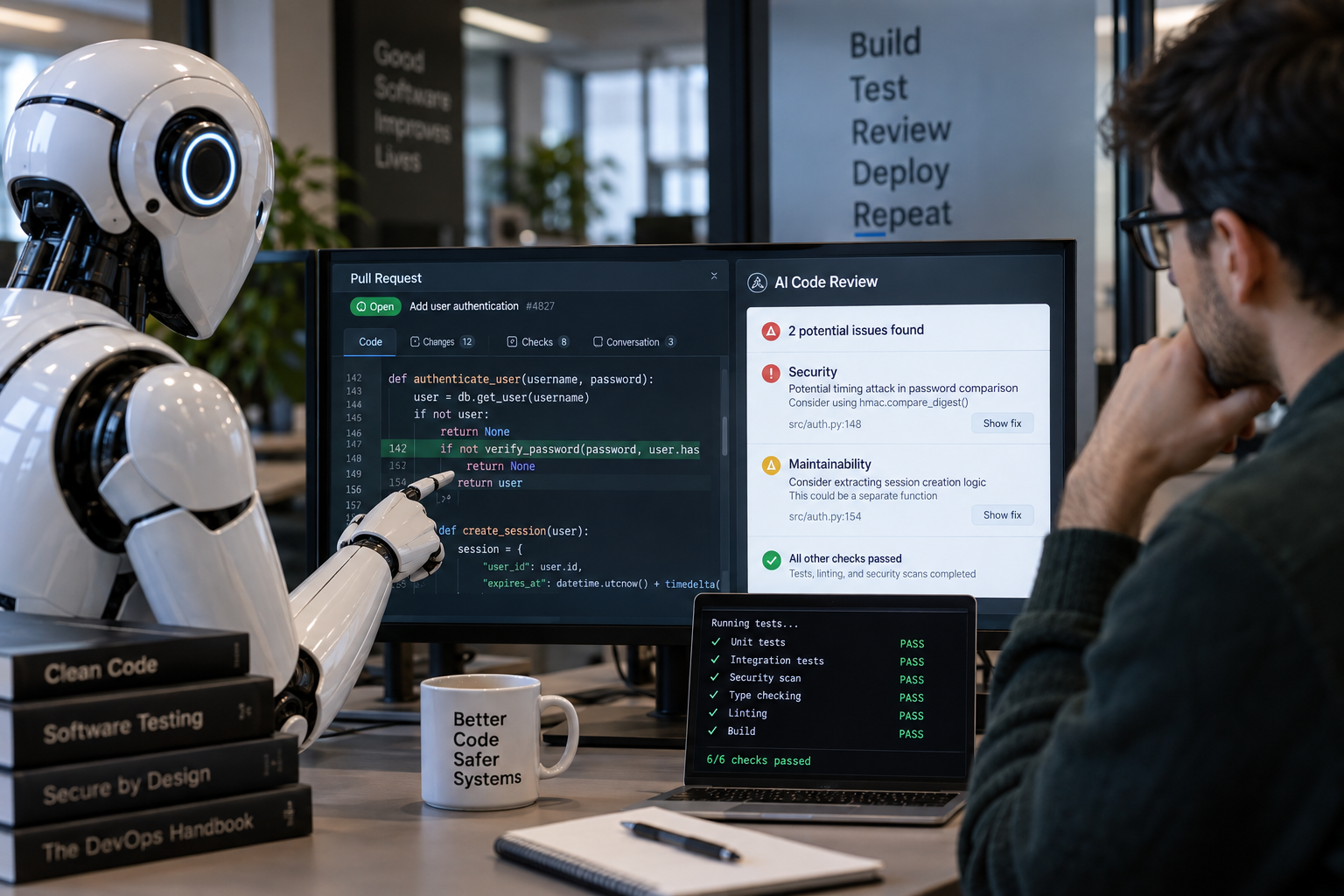
Engineering teams are shipping more code than ever, and much of it is written by AI agents. A 2026 study by Faros, which analyzed two years of telemetry from 22,000 developers across 4,000 teams, found that throughput is rising in organizations with high AI adoption. Bugs, rework, review load and production incidents are rising even faster.
The numbers are stark. Faros reported 54% more bugs per developer, a roughly fivefold increase in median pull request review time, and more than three times as many incidents per pull request when comparing periods of lower and higher AI adoption. The researchers are careful about what those figures mean. They are correlations, not proof that AI caused every outcome. A later Q3 report found some of the early effects were easing, but verification, remediation and operational costs kept piling up downstream.
The question, then, is how teams keep the speed without giving up quality. The answer many engineers are reaching for is automated verification, meaning tools and checks that catch problems before they reach users. Nobody is promising bug-free software. The goal is more ways to catch mistakes.
The review tools on the market
Several projects now aim to put a second set of eyes on AI-written code. Superpowers, an agentic development methodology and collection of skills, pushes coding agents to behave more like disciplined engineers. It emphasizes planning, test-driven development, debugging and reviews, including separate agents reviewing the work. Depending on the task, though, following the full methodology can slow development down.
RoboRev, created by Wes McKinney, the developer behind the pandas library, takes a different approach. It brings continuous AI code review into the local development loop. A developer commits code, and a local daemon reviews the commit with a configured coding agent. The findings can be fed back into the same coding session while the context is still fresh.
The major platforms have their own offerings. Anthropic's hosted Code Review sends multiple specialized agents to examine a GitHub pull request in parallel, looking for logic errors, security vulnerabilities, regressions and missed edge cases. The deeper review may take longer and cost more than a quick local pass. As of October 2026, Anthropic lists it as a research preview for Team and Enterprise plans, with separate usage-based billing. OpenAI's Codex can review pull requests against a repository's context and instructions, and it can prepare a fix when it finds a problem.
GitHub's Copilot Code Review is the most hands-off option. It can review pull requests automatically, follow repository instructions and suggest fixes. Cursor's Bugbot reviews GitHub pull requests for logic bugs and can propose fixes through cloud agents, which is most convenient for teams already using Cursor. The tradeoff is less control. Developers can customize Copilot's instructions, but they lack the per-run model configuration they would get by invoking their own agent. Much of Cursor's model selection is handled by the company.
Using one AI to check another has limits. Two models can agree on the same wrong answer, miss the same requirement or flag a bug that does not exist. Experts recommend pairing AI review with checks that do not depend on a model's judgment, and keeping a human accountable for final decisions on high-risk changes.
Stacking checks across the pipeline
Most of the underlying practices are decades old. Teams typically run linters, formatters, type checkers and build steps first, followed by unit, integration and end-to-end tests. Security checks include static analysis, secret scanning and dependency vulnerability scanning. Agentic reviews can look for bugs, security risks and whether a change matches the spec. Infrastructure scans and database migration checks round out the list, along with maintainability reviews that flag overengineering.
Those checks are spread across stages. Cheap ones run before code is committed. Broader tests and security scans run after a push. Pull requests get the heavier reviews, and pre-production adds integration tests, infrastructure scanning and deployment smoke tests. Production monitoring covers health checks, error and security monitoring, and automated rollback when it is safe. GitHub Actions, GitLab CI/CD and Jenkins are the common ways to orchestrate these steps.
Running every AI review on every pull request can get expensive, especially for teams that merge many times a day. The author recommends running cheap checks early and saving heavier reviews for later stages or riskier changes.
Large companies have been building this kind of setup for years. Adam Faik's guide to how Uber, Shopify, DoorDash, Spotify and Stripe run coding agents at scale describes a common pattern. Requests enter through a gateway, pass permission and governance checks, and move through an automated pipeline that writes the code, tests it and produces proof, such as diffs, screenshots and test results. Developers then review the output before anything is merged or pushed to production.
The overall message is that writing code is getting cheap. Checking it is not. As one essay put it, verification has to become a first-class part of how software gets built.
This article was written with the assistance of AI.
News Factory APP - agentic news to boost your SEO & AEO.