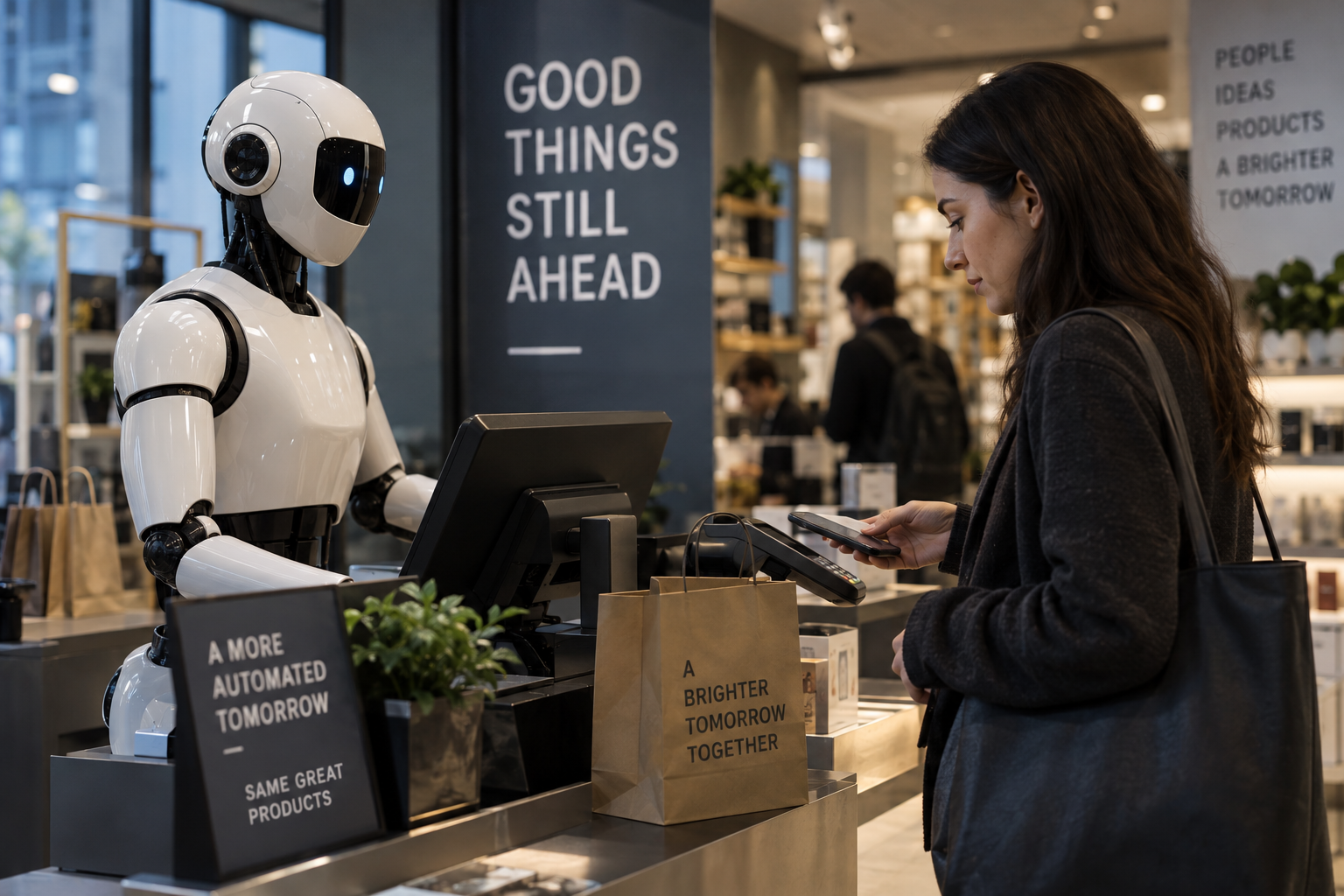
Writer Cory Althoff argues that if AI replaces most jobs, consumer spending would shrink gradually as fewer people earn paychecks, not collapse overnight. He says the slow erosion is harder to act on than a sudden shock, and that universal basic income remains unlikely soon.
The big technology executives keep saying artificial intelligence will replace 100 percent of jobs. Writer Cory Almost-certainly-not-a-prediction, Althoff, has a follow-up question that those executives rarely answer: if AI does every job, who is left to buy things?
In an essay, Althoff says the answer is worse than most people expect, though not in the dramatic way many imagine. He does not expect the economy to seize up overnight. Instead, he expects spending to thin out gradually as fewer people draw paychecks.
Would universal basic income fix AI job losses?
Supporters of rapid AI development often point to universal basic income, or UBI, as the fix. Under that idea, the government would give everyone enough money each month to cover basic living expenses. Althoff is skeptical. He says U.S. politicians are not taking the idea seriously or working toward it in any meaningful way, and he is not optimistic it will arrive soon.
Without a policy response, he expects AI to improve productivity, leave fewer companies hiring and push more people out of the job market altogether. Those who fall through the cracks, he writes, would be forced to get by however they can.
Althoff does not buy the idea that AI will quickly reach superintelligence. He says the most bullish researchers have suggested that such systems could do every job in the world better than any human within six months. If that happened, he argues, the shock would be so sudden that governments would have to act with something like UBI or risk an economic collapse. He describes a scenario in which superintelligence arrives in 2027 and companies fire their entire staffs en masse.
He thinks that scenario is less likely. What he expects instead is a slower erosion of jobs, with people left to work out their own way through it. "Slow is worse, because nobody is forced to act," he writes.
What is a K-shaped economy?
The spending pattern he describes is already visible, he says. Althoff points to what economists have called a K-shaped economy, in which the top 20 percent of income earners drive nearly 60 percent of spending. Since the pandemic, he writes, the bottom 80 percent have barely grown their spending faster than inflation. In his view, that gap is the early shape of a future where spending concentrates in the hands of people who still have money coming in.
In that world, Althoff expects AI to handle nearly all execution, including building websites, running ads and sending cold emails. Humans would still make the judgment calls, such as which products to sell and how to position them. He sees two groups coming out ahead: founders who own companies and benefit from automation, and employees with strong judgment who use AI to get outsized results.
Are product manager jobs growing as software engineering jobs stall?
He points to the current job market as evidence. Software engineering jobs are flat, he writes, but demand for product managers is strong. Citing Lenny Rachitsky's latest job market report, Althoff says open product manager roles are up 75 percent from their 2023 low, the highest in nearly four years.
The skills employers want have also shifted. Two years ago, the most frequently mentioned skills in product manager job descriptions were SQL, Jira, AWS and Python. Today, the top skill is "LLM," with Claude ranked third. Cursor, MCP and evals all appear in the top 10. According to the report, as Althoff relays it, AI-focused product managers earn $245,000 on average, compared with $123,000 for traditional product managers.
Althoff says the pattern is clear. AI is taking over execution, such as writing code, and companies are paying a premium for people who can decide what to build and know enough about AI to direct it. He hopes universal basic income will eventually materialize, but he warns that people who are not building skills while they wait could be in serious trouble if superintelligence does not arrive quickly.
His own bet is on running his work through AI. He says he uses a second brain he built, along with a tool called Claude Duet, to manage a content system that draws ten million views a month on social media.
This article was written with the assistance of AI.
News Factory APP - agentic news to boost your SEO & AEO.