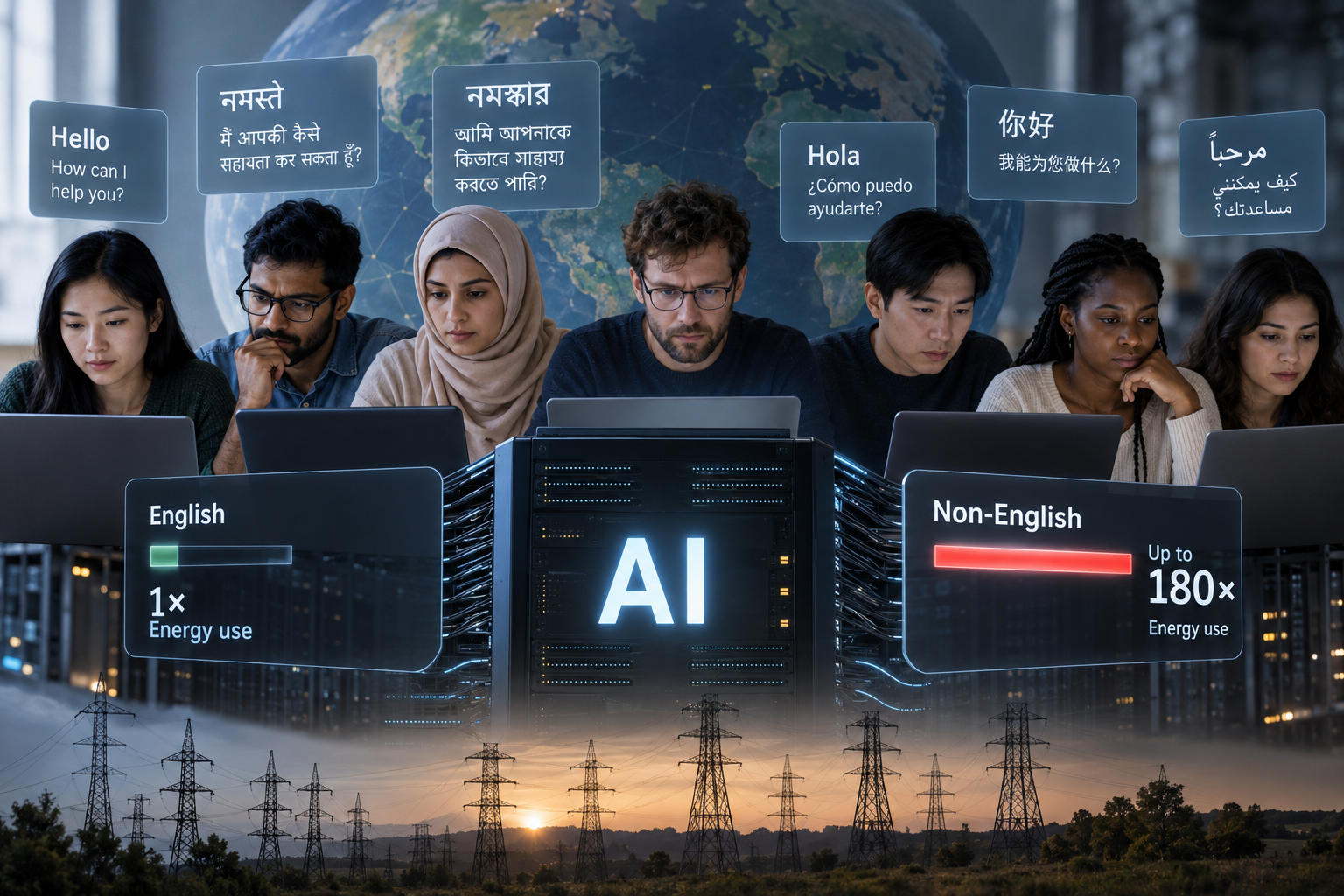
Generative AI burns more energy and sometimes gives less accurate answers when people use languages other than English, according to researchers at the University of Michigan. The energy gap ranges from 1.4 to 180 times, and the researchers warn it could deepen existing global inequalities.
How much more energy does AI use for non-English text?
The gap is widest for languages that do not use Latin script and have less digital content available for training. Most Western European languages require twice the energy or less than an equivalent English prompt. Hindi and Bengali, however, each spoken by hundreds of millions of people, require 7.9 and 15.3 times more energy, respectively.
Naihao Deng, a doctoral student in computer science and engineering and the first author of the study, said the languages that consume the most energy also tend to produce the least accurate output. The study was presented at the Empirical Methods in Natural Language Processing conference, organized by the Association for Computational Linguistics.
“Most people will want to use AI models by asking questions in their native languages, and they may feel pressured to use it as it’s incorporated into more parts of society,” Deng said. “But the double penalty makes it more likely that certain people will be priced out of AI and that companies will be more reluctant to serve models in certain languages.”
Based on the researchers’ measurements and demographic data from Ethnologue, about 5.2 billion people must use more than twice as much energy to generate text in their first language as English speakers do.
Which AI models did the study test?
To measure the gap, the team tested three open-source models: Alibaba’s Qwen 3, Google’s Gemma 3 and Meta’s Llama 3.1. They asked each model to answer multiple-choice questions from Belebele, a dataset designed to assess reading comprehension in 122 languages. The researchers measured the energy used for each answer with the ML.Energy framework, which was developed at Michigan Engineering.
The team also tested grade-school math word problems and open-ended user prompts from other benchmark datasets. Those datasets are not multilingual, so the researchers translated the English questions into seven other languages using Meta’s No Language Left Behind translation tool.
Every model used less energy for English text, on average. The disparity held at larger model sizes and across different types of computer processors.
Why more tokens mean higher costs
The extra energy comes largely from tokens, the basic units of data that AI models process. A token can be a whole phrase, a single word or a syllable or character. Models convert prompts into tokens before processing them, then convert the output tokens back into human language.
Why does non-English text use more energy in AI models?
When text is written in another language, the model often has to generate more tokens to produce the same answer. The problem grows for scripts whose characters require more code to display. The Devanagari script, used for Hindi, Nepali and Marathi, and the Bengali script both have characters that change form and combine with accents, producing a very large number of unique characters.
More tokens take up more computer memory, leaving less room for processing information. The model then handles tokens in smaller batches, which uses more energy per token. The researchers say this effect compounds the gap with English.
The extra tokens also affect what users pay. Companies often price model access by the number of tokens generated, so non-English speakers may face higher direct costs.
Narrowing the gap
The researchers recommend that companies optimize their services for more languages. One option is to route user queries to models tailored to specific languages. Another is to translate prompts into English before sending them to a general-purpose model, provided the translation is reliable.
Rada Mihalcea, the Janice M. Jenkins Collegiate Professor of Computer Science and Engineering, director of the U-M AI Lab and corresponding author of the study, said developers should invest in resources for languages with the largest gaps.
“AI developers should be creating more resources for those languages with an energy and cost disparity,” Mihalcea said. “Crowdsourcing native speakers to help translate material or create resources to get enough training data could also help improve efficiency.”
The National Science Foundation and the Defense Advanced Research Projects Agency partially funded the research. Additional support came from Ford, the Laude Institute, OpenAI and the Survival and Flourishing Fund. The study ran on the university’s Great Lakes high-performance computing cluster.
This article was written with the assistance of AI.
News Factory APP - agentic news to boost your SEO & AEO.