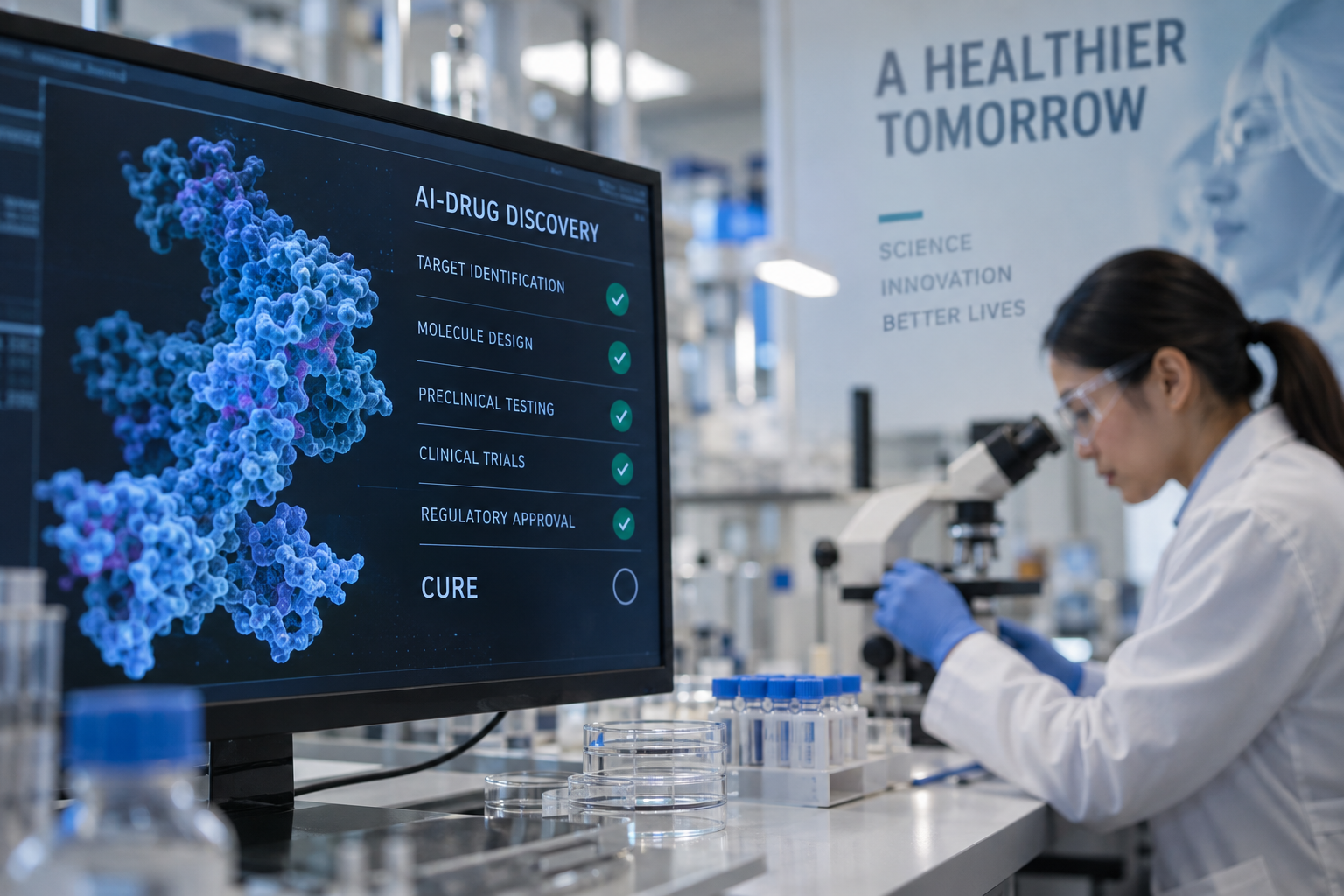
No disease has been cured by artificial intelligence, according to a public tracker that counts only diseases with regulatory approval and proof of a cure. As of Nov. 26, 2026, the count stands at zero. Its strict criteria require AI involvement in discovery, regulatory approval for the disease, and a genuine cure.
Has AI cured any disease?
No disease has been cured by artificial intelligence, according to a public tracker that counts only diseases with regulatory approval and proof of a cure. As of Nov. 26, 2026, the count stands at zero.
The tracker sets a strict bar. A drug counts only if AI chose or designed both the biological target and the molecule, the drug finished Phase III and won approval from the FDA, the European Medicines Agency or an equivalent regulator for that disease, and patients are cured, not just managed. Reading medical scans, predicting protein shapes and speeding up lab work do not qualify, the tracker says.
That distinction matters because AI is already widely used in medicine. The tracker counts 1,614 AI devices authorized by the FDA, mostly for radiology. It also puts the AI drug-discovery market at $6.93 billion in 2025. Neither number amounts to a cure.
The closest candidates
Which AI-discovered drugs are closest to approval?
Insilico Medicine’s rentosertib is the furthest along. It is the first drug where AI picked both the target, TNIK, and the molecule. A Phase IIa study published in Nature Medicine enrolled 71 patients over 12 weeks and showed a lung-function signal of 98.4 mL at the top dose. A Phase III trial began in 2026 with 320 patients over 52 weeks. The first patient was dosed on Sept. 9, 2026, and the results are still ahead. Idiopathic pulmonary fibrosis has no cure today, so even a successful trial would first yield a treatment.
Takeda and Nimbus’s zasocitinib is nearer to a regulatory decision. The FDA accepted its application under priority review, with a decision due in the first quarter of 2027. The drug beat an approved rival in Phase III. The tracker notes, however, that psoriasis is managed rather than cured, and that the drug’s roots trace to physics-based modeling from around 2016 against a target that was already known.
Isomorphic Labs, the Alphabet and DeepMind spinout, sits at the other end of the spectrum. The company raised $2.1 billion in a Series B round in May 2026, largely on the strength of AlphaFold. As of November 2026, none of its molecules had been dosed in a human, and it had not disclosed a named candidate. First-in-human dosing was targeted for the end of 2026.
What are AI leaders promising about curing disease?
Industry leaders have offered timelines of their own. Dario Amodei, CEO of Anthropic, said in an IPO roadshow video on Nov. 10, 2026: “If today we look at things like cancer, Alzheimer’s, heart disease, mental illness, these will be relics of the past in, I think, less than a decade.” Sam Altman, CEO of OpenAI, said at the Stargate announcement at the White House on Jan. 21, 2025: “We will see diseases get cured at an unprecedented rate. We will be amazed at how quickly we’re curing this cancer and that one, and heart disease.”
Demis Hassabis, CEO of Google DeepMind, told CBS’s “60 Minutes” in April 2025 that “maybe within the next decade or so” AI could cure all diseases. Bill Gates, co-founder of Microsoft and chair of the Gates Foundation, wrote on X on Nov. 20, 2026, that “AI has the potential to cure diseases, improve education, and give people more time to spend on the things that matter most.”
The tracker’s zero is the score so far. It will move only when a drug clears all three requirements: AI involvement in the discovery, regulatory approval for the disease and a cure.
This article was written with the assistance of AI.
News Factory APP - agentic news to boost your SEO & AEO.