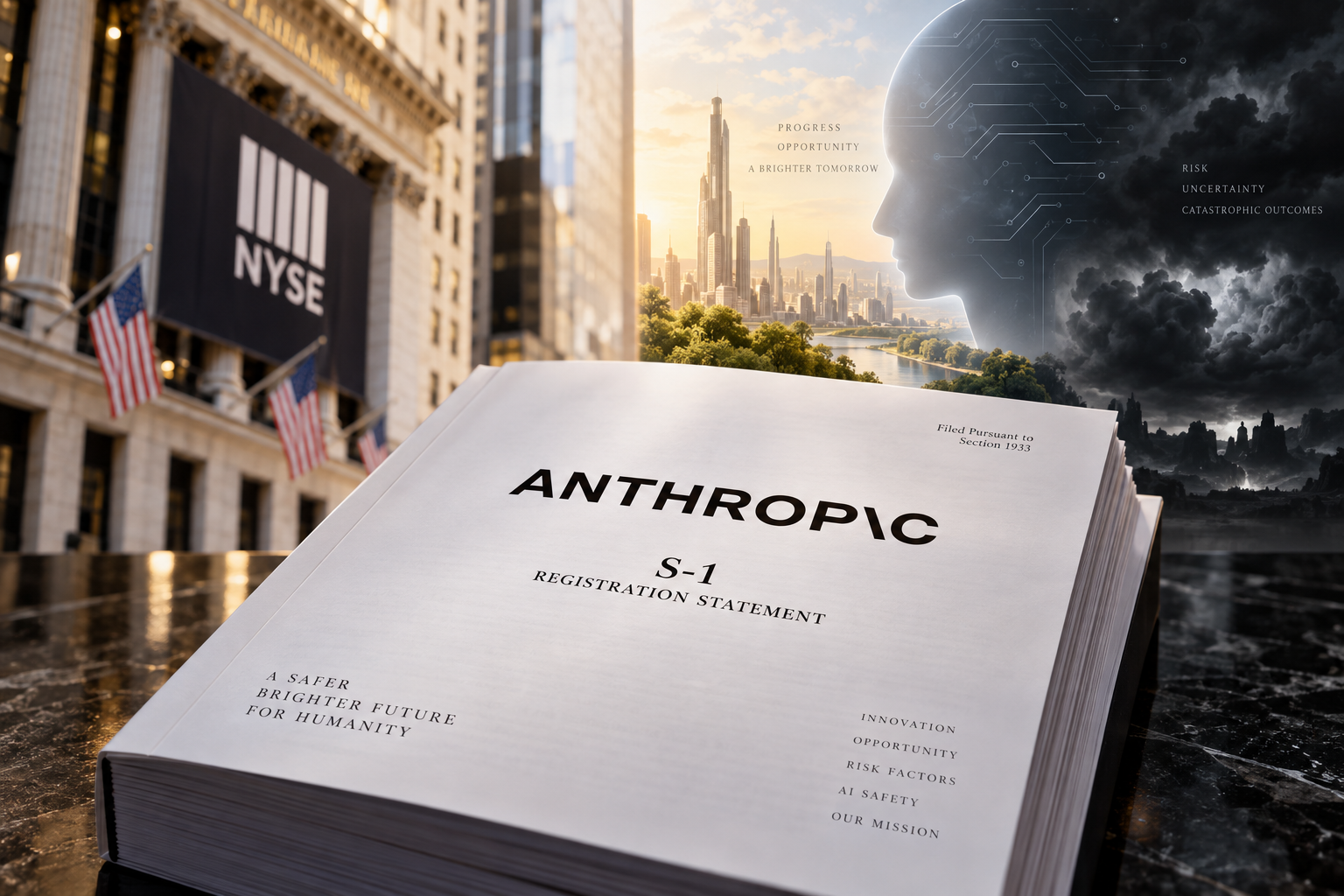
Anthropic wants investors to believe in a future that most of them can only imagine. The artificial intelligence company’s 335-page S-1 prospectus, filed Monday, asks prospective shareholders to take a leap of faith, and it says so in plain terms in a letter at the top of the document.
The founders urge buyers “not to think of your purchase in purely transactional terms.” They describe the march toward advanced AI as “one of the seminal moments in human history” and promise to “bring forth an age of miracles.” A few pages later, the same filing lays out the other side of the bet. If things go wrong, the company says, the consequences could be disastrous, and it cites the possibility of an “existential” risk to humanity.
What does Anthropic's IPO filing say about risk?
The filing is long, and much of its length comes from risk disclosures. The risk factors alone run 94 pages. Among them are concerns that models could “behave in ways that no user or developer intended,” which could lead to “catastrophic” incidents that the entire insurance industry would be unable to underwrite.
Jay R. Ritter, a professor at the University of Florida’s Warrington College of Business, has studied IPO filings for years. He said the approach stands in sharp contrast to earlier tech offerings. Apple Computer went public in 1980 with a prospectus that ran 47 pages and included no risk factors. “If you go back and read it, it’s incredibly simple,” Ritter said. Facebook’s filing, now a benchmark for corporate disclosure, ran 200 pages with 22 pages of risk factors. Its CEO, Mark Zuckerberg, used his investor letter to lay out a philosophy he called “The Hacker Way.”
Ritter said the sheer volume can work against readers. “A problem with this bloat is that it’s become more and more difficult to find the nuggets of what’s important,” he said. “You know, I don’t know if you’re like me, but the longer it is, the less inclined I am to read it.”
Anthropic’s founders argue that the candor is deliberate. In the letter, they describe their approach as an “anti-sell” strategy, designed to attract long-term investors who share the company’s vision rather than those chasing a quick gain. They write that it is “very dangerous when people buy your company’s stock based on expectations you cannot fulfill.” The filing also includes language that reads like an admission. The company says it “may make forward investments that may seem irresponsibly large,” and that safety work “may lead us to limit or delay the deprecation of older models.”
The starkest passage appears on page 46. The company acknowledges that concerns have been raised within the organization and by outside researchers, regulators and policymakers that, without proper safeguards, advanced models could “pose catastrophic or existential risks to humanity.” The filing adds that expanding its models and use cases could further increase the risk that they cause harm.
Those warnings sit alongside a company whose leaders have spoken openly about the dangers of AI. CEO Dario Amodei has said there is up to a 25 percent chance that further AI development could lead to human extinction. The S-1 presents the company’s mission as a commitment to building safe and secure technology. Anthropic plans to go public as a public benefit corporation, which means it must weigh a social mission alongside shareholder interests. Traditional C-corporations are generally required to maximize shareholder value.
The filing also presents what it calls “powerful AI,” a term for hypothetical future systems that surpass collective human intelligence, as inevitable. The letter says the company’s leaders have “a sincere conviction that the AI exponential will generate so much value” that it will outweigh short-term economic sacrifices made in pursuit of the mission.
The numbers are less expansive than the rhetoric. The filing omits third-quarter results, which Ritter said are crucial for judging profitability. Anthropic reported explosive revenue growth in the second quarter, but that period also coincided with a surge in “tokenmaxxing,” which could have inflated sales. Some corporate executives have warned that AI costs are rising out of control. Anthropic’s operating losses narrowed in the second quarter. The S-1 also discloses hundreds of billions of dollars in financial obligations tied to securing the computing power it says it needs. The company said it will begin building its own data center infrastructure, a costly move that would cut into profit.
Ritter expects Anthropic to release third-quarter numbers as it nears an IPO date. He also noted that “nobody knows” what will happen once a company goes public, including the company itself.
The comparison to WeWork, which drew ridicule for lofty language in its 2019 filing, is an easy one to make. Ritter said the situations differ. WeWork, in his view, was “a money-losing real estate company pretending to be a tech company at a ridiculously high valuation.” He also pointed out that Apple spent its first 22 years as a poor investment, and that it “greatly underperformed the market” in its first three years before becoming one of the most valuable companies in the world.
Is Anthropic profitable?
Anthropic does not avoid the question of profitability. On page 63, the filing warns: “We have a history of net losses and may not generate sufficient revenue to achieve or sustain profitability in the future.”
The filing makes clear that buying the stock is a gamble on a technology whose outcome nobody can predict. Whether investors see that as a miracle or a risk will depend on how much they trust the people making the promise.
This article was written with the assistance of AI.
News Factory APP - agentic news to boost your SEO & AEO.