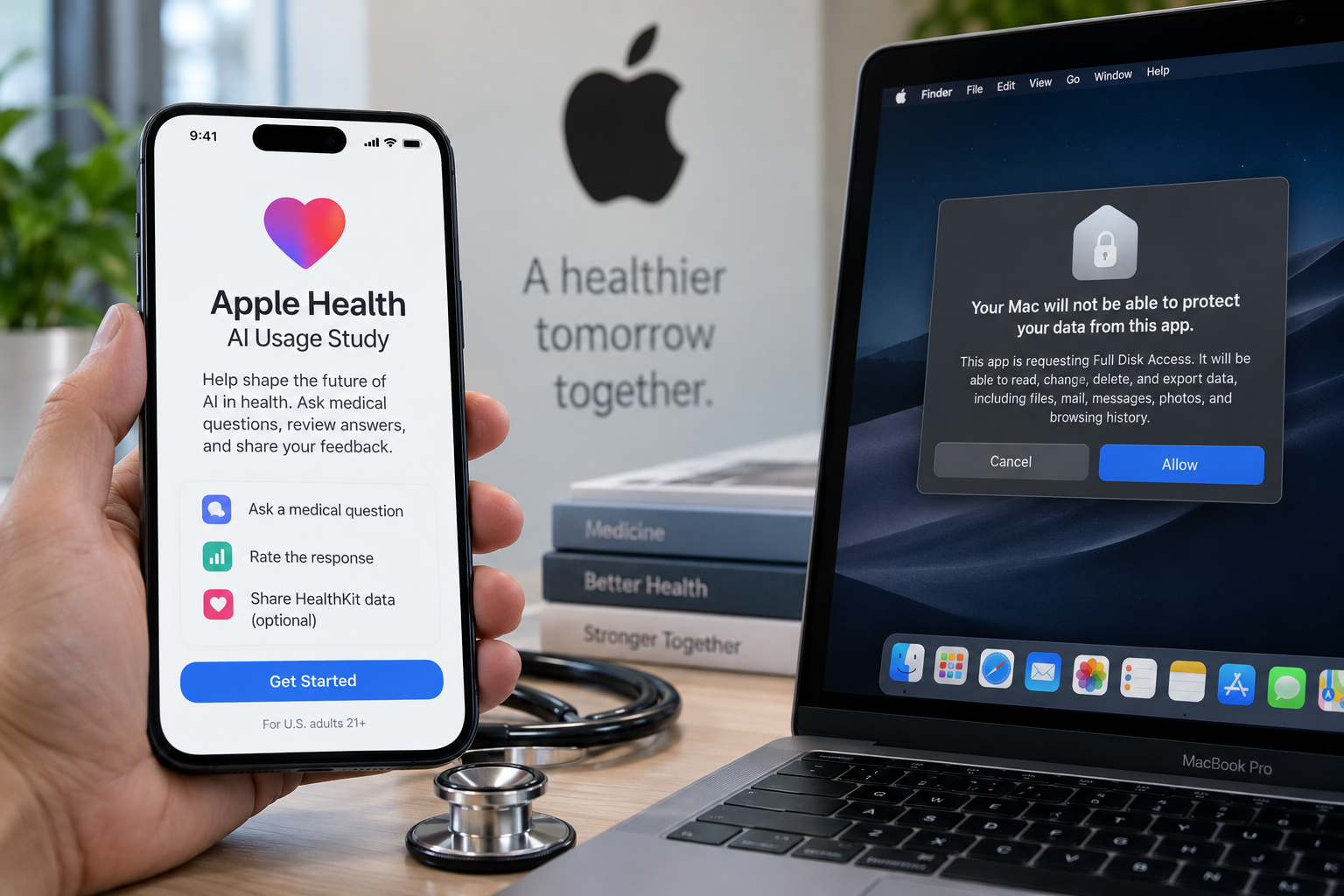
Apple is recruiting up to 200,000 U.S. adults aged 21 and older for the Apple Health AI Usage Study, which uses OpenEvidence to answer medical questions in a new iOS app. Participants rate the answers on accuracy, detail and relevance. Separately, Apple is tightening Mac Full Disk Access so AI apps need explicit approval.
Apple wants to know whether AI health tools actually help people, and it is asking up to 200,000 adults to help find out. The company announced the Apple Health AI Usage Study on Thursday, along with a new iOS app that participants will use to ask medical questions and then grade the answers. In the same week, Apple also said it is tightening how Mac apps can reach a user’s files, after complaints that AI software was getting more access than people realized.
A study of AI health answers
The study is being run with OpenEvidence, a clinical AI platform used by health care professionals. The platform generates answers drawn from medical sources such as The New England Journal of Medicine. Participants will type questions into the app and rate the responses on accuracy, detail and relevance.
Who can join Apple's Health AI Usage Study?
Enrollment starts now. Participants must be 21 or older and live in the United States. The app does not use Apple Intelligence, but it does require an iPhone 15 Pro running iOS 26 or later. Questions are entered as text, and while users can dictate with the iOS keyboard, the app is not integrated with Siri or Apple Intelligence.
Responses are written to be easy to understand and include links to peer-reviewed clinical sources. Users can also choose to share Apple HealthKit data, such as activity levels, sleep and clinical lab results, so the answers can account for their personal health. Apple says that data will stay confidential and will not be used to train AI models.
Sumbul Desai, MD, Apple’s vice president of Health and Fitness, framed the study as a way to learn how people engage with health AI in daily life. “Health is deeply personal, and conducting a dedicated research study is the most thoughtful way to understand how people engage with, comprehend, and evaluate health AI in everyday life,” Desai said in the company’s announcement.
Limits on Mac disk access
Apple’s Mac move follows a September incident that drew attention to the issue. Inc. columnist Jason Aten reported that Meta’s Muse Mac app could read his messages even though he believed he had denied that permission. Meta responded that Aten must have granted access, saying the feature is entirely opt-in. The episode caught Apple’s attention, and the company has since said it was alarmed by how some developers were using Full Disk Access.
“Some developers are using Full Disk Access in ways that could put users at risk, exposing everything on their systems, including files, mail, messages, and even browsing history, without users’ full knowledge and understanding,” Apple wrote on its developer blog.
What changed in macOS for AI apps that want file access?
In the latest macOS beta, Apple has changed the process. Users now have to take what Apple calls “very explicit” actions to give AI apps this level of access. Screen grabs shared by users show a warning pop-up that says, “Your Mac will not be able to protect your data from [your desired AI app].” Users must review and approve the actions the app will be able to take, including reading, changing, deleting and exporting data, viewing hidden and recently deleted photos, and viewing browser history.
The changes will not block anyone from giving an AI agent access to their files. They are meant to make people stop and think first. A misbehaving agent could still leak or misuse private data, and the change matters most on Macs that Apple markets for running local AI models and agents. The feature is available in macOS 27.3 beta 2. Apple has not said when it will reach all users.
This article was written with the assistance of AI.
News Factory APP - agentic news to boost your SEO & AEO.