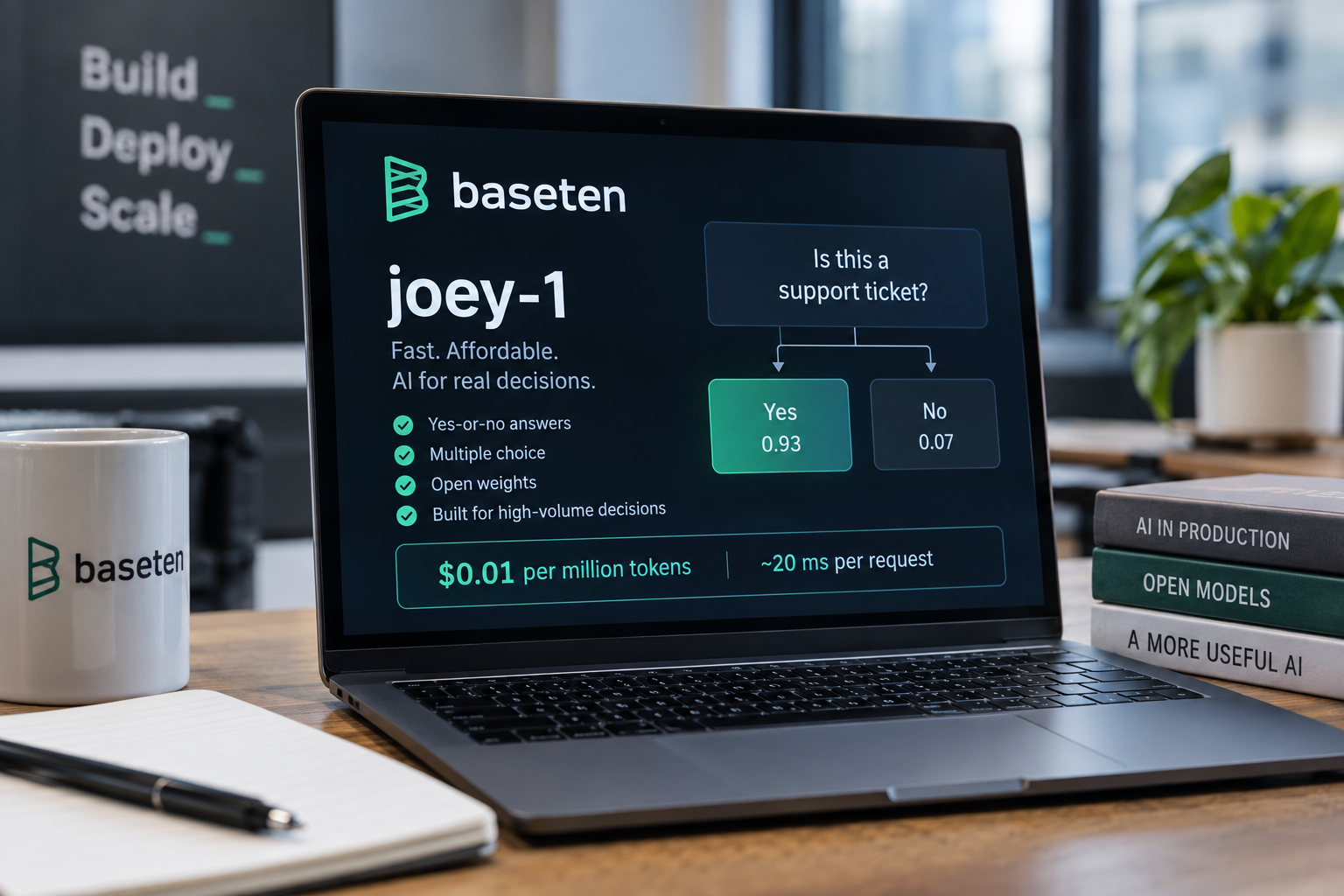
Baseten has released joey-1, a small open AI model that answers yes-or-no and multiple-choice questions rather than writing out replies, the company said Thursday. Baseten says the model costs $0.01 per million tokens, a price it puts well below what general-purpose chatbots typically charge for text generation.
What is Baseten's joey-1 model?
Joey-1 has 2 billion parameters and is open-weights, meaning its trained model files are available for others to download and run. Instead of producing a paragraph, it returns an answer along with a probability score. That design, Baseten argues, makes these so-called decision models cheaper and faster for narrow tasks like sorting customer support tickets, flagging spam or screening out harmful prompts.
How much does joey-1 cost to run?
The model joins two larger releases from Base Labs, Baseten's research arm. Mammoth-1 and elephant-1 came out last week and work the same way. According to the company, joey-1 answers a typical 2,000-token request in 20 milliseconds, about 2.5 times faster than elephant-1. Baseten also says that sorting 10 million support tickets a month would cost about $50 on joey-1, compared with $500 on mammoth-1.
How does joey-1 compare with other decision models?
Baseten calls joey-1 the strongest decision model with 3 billion or fewer parameters. The company has not yet published the tests behind that claim. Its model card ranks joey-1 37th out of 230 models on the Jev Decision Index, which Baseten describes as the top score among models under 4 billion parameters. Jev is a decision model from TypeSafe AI, launched in September, that works in a similar way.
Joey-1 is built on Qwen3.5-2B, a model from Alibaba, and was trained on 6.21 million decision examples. The approach is spreading beyond Baseten. Microsoft built its own decision model on Qwen earlier this month, priced at $0.042 per million tokens. Microsoft's model weights are free to download from Hugging Face under the MIT license.
Baseten helps companies run AI models in production. The company raised $1.5 billion at a valuation of up to $13 billion in June. In September, it acquired Blaxel, a startup that makes sandbox environments, which are isolated spaces where software can be tested or run safely.
This article was written with the assistance of AI.
News Factory APP - agentic news to boost your SEO & AEO.