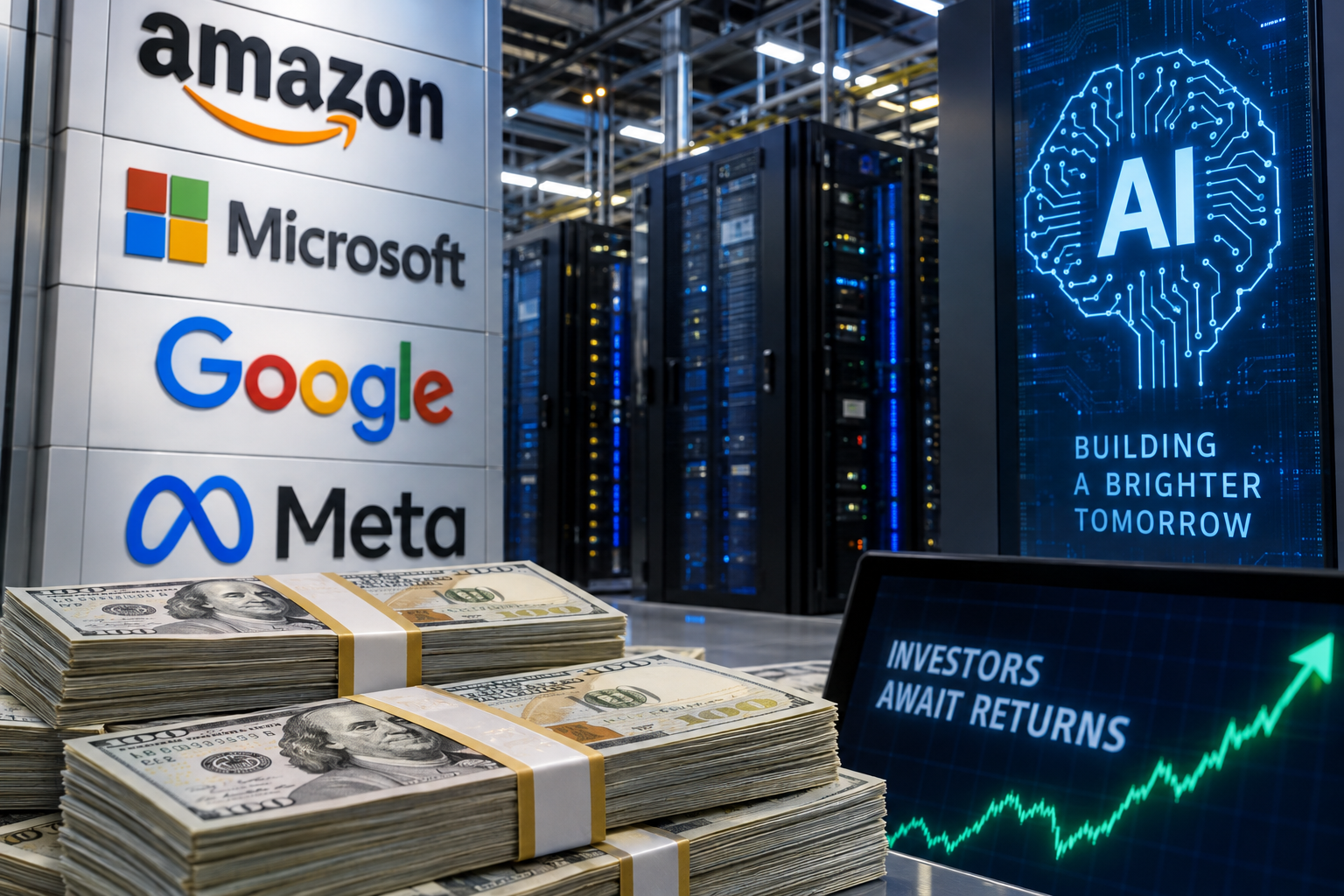
Amazon, Microsoft, Alphabet and Meta told investors they plan to spend at least $720 billion on capital expenditures this year, most of it on AI infrastructure. Investors are waiting for proof that the spending will produce profits matching its cost, and that question remains unanswered.
How much are Big Tech companies spending on AI this year?
Big Tech is not slowing its spending on artificial intelligence data centers, and investors are beginning to ask when the payoff will arrive. Amazon, Microsoft, Alphabet and Meta told investors on their quarterly earnings calls that they plan to spend at least $720 billion on capital expenditures this year alone. Most of that money will go toward AI infrastructure, on top of at least $1 trillion in spending commitments arranged for the coming years.
The spending plans spooked Wall Street and set off a sharp selloff in tech stocks last week. The decline began to ease as investors turned their attention to Tuesday's midterm elections. Voters across the country elected candidates who favor moratoriums and other restrictions on data centers, and those results could eventually reshape how much companies spend. For now, the new uncertainty has not hurt tech stocks. They began to climb again Tuesday.
Is revenue growth enough to justify AI spending?
Revenue is not the problem. Amazon reported its fastest growth in five years for the quarter. Meta's ad revenue is surging, and Google Cloud's revenue more than doubled in a year. But those gains may not be enough to justify the scale of the spending.
Alphabet offered the clearest example of the tension. Philipp Schindler, the company's senior vice president and chief business officer, acknowledged on the earnings call that Google Cloud's growth has come at the expense of the core Search business.
\u201cIt\u2019s worth noting that the strong growth in AI Mode queries had an impact because of the lower monetization we were seeing in AI Mode,\u201d Schindler said.
Revenue from Google's Search ads grew 12% in the third quarter, down from 17% growth in the same quarter a year earlier. The company's AI-enabled search engine is drawing users away from traditional search before Google has figured out how to make money from AI Mode. That is a difficult position for a company whose Search business once gave investors the confidence to back its aggressive AI spending.
\u201cTo be clear, we feel very good about our trajectory here. Our ad experiments have shown promising results,\u201d Schindler said. He did not offer any specific examples.
Why did Alphabet stock fall after its earnings call?
Wall Street reacted harshly. On Thursday, Alphabet's stock fell 13% in a single day, its worst one-day drop in history. The stock has started to recover this week, but the company has little to offer investors beyond more spending. Alphabet plans to spend between $195 billion and $205 billion on capital expenditures this year, and Chief Financial Officer Anat Ashkenazi said the company plans to increase spending \u201csignificantly\u201d in 2027.
Amazon is also signaling bigger budgets ahead. CEO Andy Jassy said on last week's call that the company intends to spend \u201cmeaningfully more\u201d in 2027 than the $220 billion it plans to spend this year. That would be the largest spending in the company's history. Jassy described the buildout as a \u201conce in a lifetime opportunity\u201d to grow Amazon into a $1 trillion company.
\u201cWould it be more convenient if this type of acceleration and opportunity happened over 25 years and you could spread the CapEx over 25 years? Yeah, it might be more convenient,\u201d Jassy said. \u201cBut that\u2019s not the world we live in, and that\u2019s not the opportunity.\u201d
Meta expects to spend between $135 billion and $145 billion this year. The company did not disclose its plans for next year, but major financial institutions expect spending to rise. Meta CEO Mark Zuckerberg, touting the rollout of Muse, the company's agentic AI program, said the program will only become profitable if Meta can bring its compute costs down. He said Meta expects compute efficiency to improve \u201ctenfold\u201d next year, a goal he said will take \u201csignificant investment.\u201d
The cash burn extends beyond the largest companies. Anthropic updated its S-1 prospectus this week with third-quarter results, showing a sharp rise in computing costs and net losses. The AI startup's revenue grew to $17 billion in the quarter, an increase of more than 1,000% from a year earlier. Its compute costs reached $17.5 billion, more than its revenue. Anthropic has committed nearly $900 billion to future compute and infrastructure costs and plans to begin building its own data centers.
Some of that $900 billion will go to Google, which is selling its TPU chips to Anthropic. Two analysts on Google's call pressed executives on the business. Google, like other hyperscalers, has said it is constrained by capacity. Why, the analysts asked, would it sell its own capacity to other AI labs? When asked whether revenue from TPU sales would help offset its own spending, Ashkenazi did not give a clear yes or no. Google is paying to build the hardware it sells, and the contracts are backed by obligations that come due once the hardware is ready. Those contracts do not yet represent cash in Google's pocket.
Microsoft was the only Big Tech company to avoid Wall Street's anger last week. It reported $45.2 billion in capital expenditures for the quarter, below the expected $50 billion. The company said the shortfall came from \u201cthird party capacity delays,\u201d not from cutting back. Microsoft had also been the only hyperscaler that had not taken on debt to fund its AI buildout. That changed quickly. On Wednesday night, Chief Financial Officer Amy Hood said the company was fortunate to have access to debt markets and had not yet tapped them. By the next morning, news of a $25 billion, 10-part bond sale had broken.
By the time of this writing, Big Tech stocks had recovered. The companies have not changed course, and the question that matters most to investors remains unanswered: when the AI spending will start to produce profits that match its cost.
This article was written with the assistance of AI.
News Factory APP - agentic news to boost your SEO & AEO.