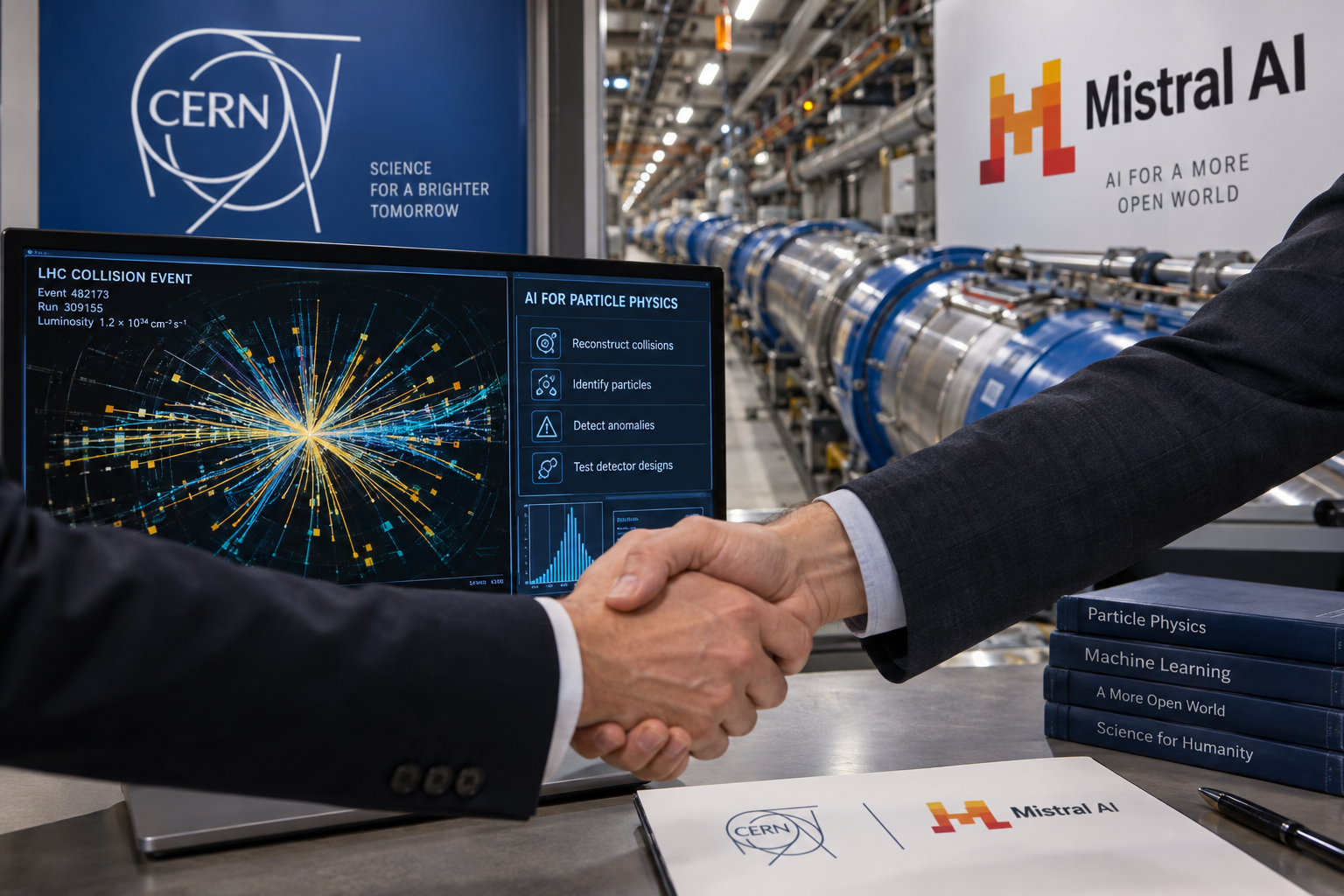
CERN and the French artificial intelligence company Mistral have signed a statement of intent to build an AI model for particle physics, the European laboratory said Thursday. The two signed the document on 15 October as the first step toward a long-term deal on AI for science.
At the center of the plan is a “Large Physics Model,” which CERN describes as the first foundation model for collider physics. A foundation model is trained once on a huge dataset and then used for many different tasks.
The model would learn from billions of simulated proton collisions in the Large Hadron Collider, the world's largest particle accelerator. CERN says it could help rebuild collisions, spot particles, flag unusual signals and test new detector designs.
Right now, CERN relies on a chain of separate tools to turn raw detector signals into data that physicists can use. A single model could learn that entire chain instead.
“High-energy physics provides a unique environment in which artificial intelligence can be developed and tested with exceptional rigour,” said Enrica Porcari, CERN's chief information officer.
The scale of the data is part of the appeal. CERN has stored about one exabyte of LHC data so far, or one million terabytes. The number of collisions will rise tenfold with an upgrade to the LHC that is due to start around 2030.
For Mistral, the agreement extends a push into science and engineering. The company bought Emmi AI, a physics-focused AI startup, earlier this year and later launched an industrial engineering product.
“Together, we have the opportunity to push the frontiers of high-energy physics,” said Johannes Brandstetter, Mistral's vice president of AI for engineering and a co-founder of Emmi AI.
The work will start with particle physics, but both sides said the models could eventually help other fields. Neither CERN nor Mistral has disclosed a budget or a timeline for the project.
This article was written with the assistance of AI.
News Factory APP - agentic news to boost your SEO & AEO.