How much funding has Circuit Mind raised?
London startup Circuit Mind has raised $25 million across a seed round and a Series A, the company said Wednesday. Norwest led the $18.5 million Series A, and Third Prime led the earlier seed round. The company is betting that AI can do for electronics design what coding tools have done for software.
Existing investors Third Prime, Differential and Blackhorn joined the Series A, along with new investor Lightscape VC. Dave Zilberman, a general partner at Norwest, is joining Circuit Mind’s board.
“Software teams are shipping 100 times faster with AI, but electronics design hasn’t changed in 40 years,” said Tomide Adesanmi, the company’s CEO. Adesanmi founded Circuit Mind with Basilio Gentile, its chief technology officer. He pointed to AI coding tools such as Cursor, Claude Code and Cognition as the model for what he wants to build.
Engineers designing a circuit board choose hundreds of components, according to Circuit Mind. They read datasheets that can run to thousands of pages. Mistakes usually surface only after the boards are made and tested.
What does Circuit Mind's ACE product do?
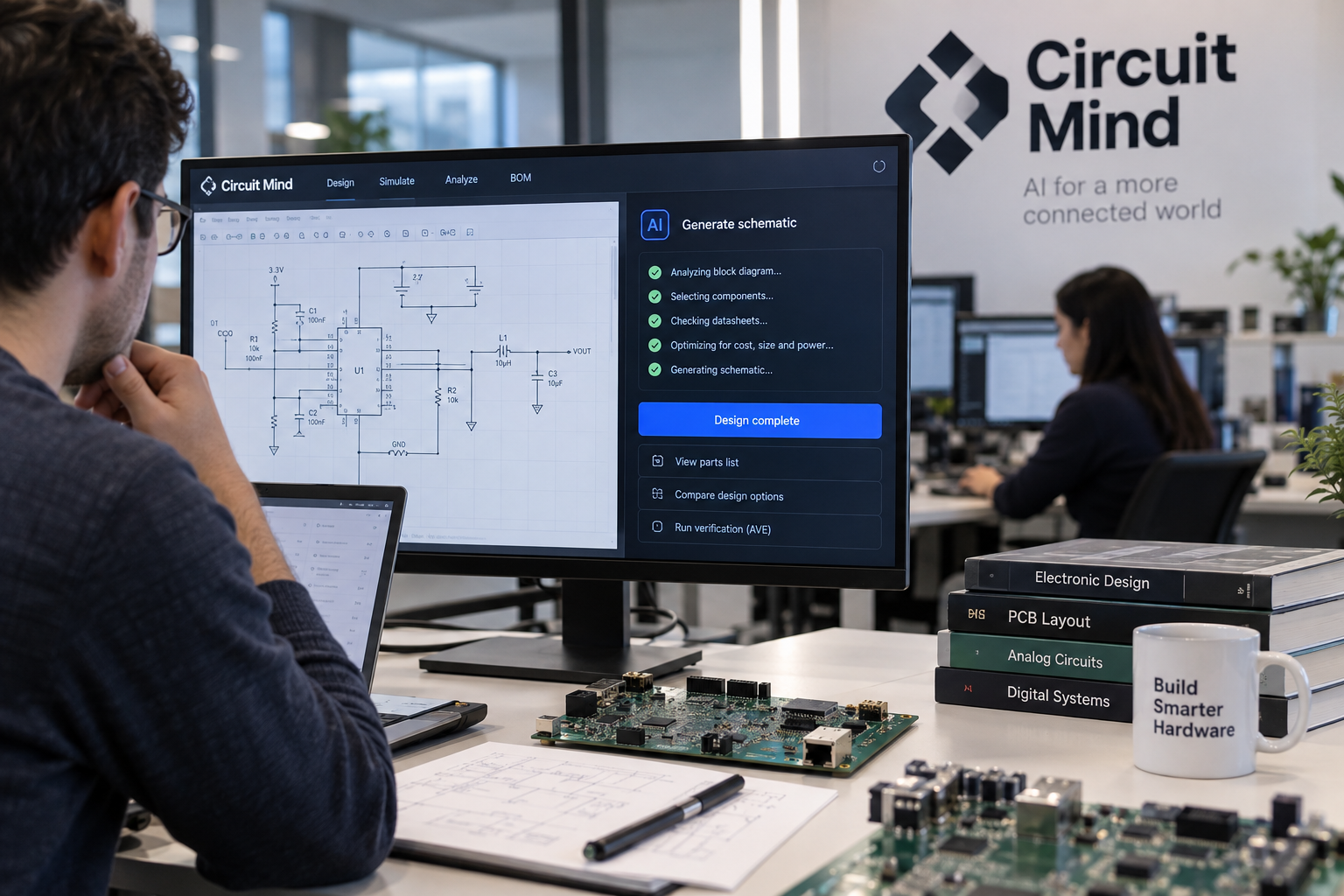
The company’s first product, ACE, turns a block diagram into a schematic and a parts list in minutes. It offers design options tuned for cost, size, power or supply chain availability.
How does Circuit Mind's AVE tool check designs?
The second product, AVE, launched the same day. A group of AI agents checks schematics against datasheets and a company’s own design rules. Before reporting back to the engineer, AVE reviews its own findings and drops the ones that do not hold up.
The platform combines those AI agents with Circuit Mind’s patented, physics-based decision engine and each customer’s engineering rules. It works inside the design software that teams already use, so engineers do not have to switch tools.
Engineering teams at Emerson, Schneider Electric and Fortune 5 companies already work with Circuit Mind, the company said. Those teams have cut design time from months to weeks, and parts costs fell by 25%, it said.
One result stands out. Engineers at Los Alamos National Laboratory finished a design in four hours instead of two weeks, according to the company. That result comes from a peer-reviewed case study.
Daniel Gheno of Schneider Electric offered an early read on the technology. “Early evaluations indicate the potential to reduce architecture exploration effort by more than 90%,” he said.
Circuit Mind will use the new money to cover more of the design process, hire across sales, engineering and customer success, and open a U.S. headquarters.
Other hardware design startups have raised money this year, including chip simulation startup Vinci and Architect Labs.
This article was written with the assistance of AI.
News Factory APP - agentic news to boost your SEO & AEO.