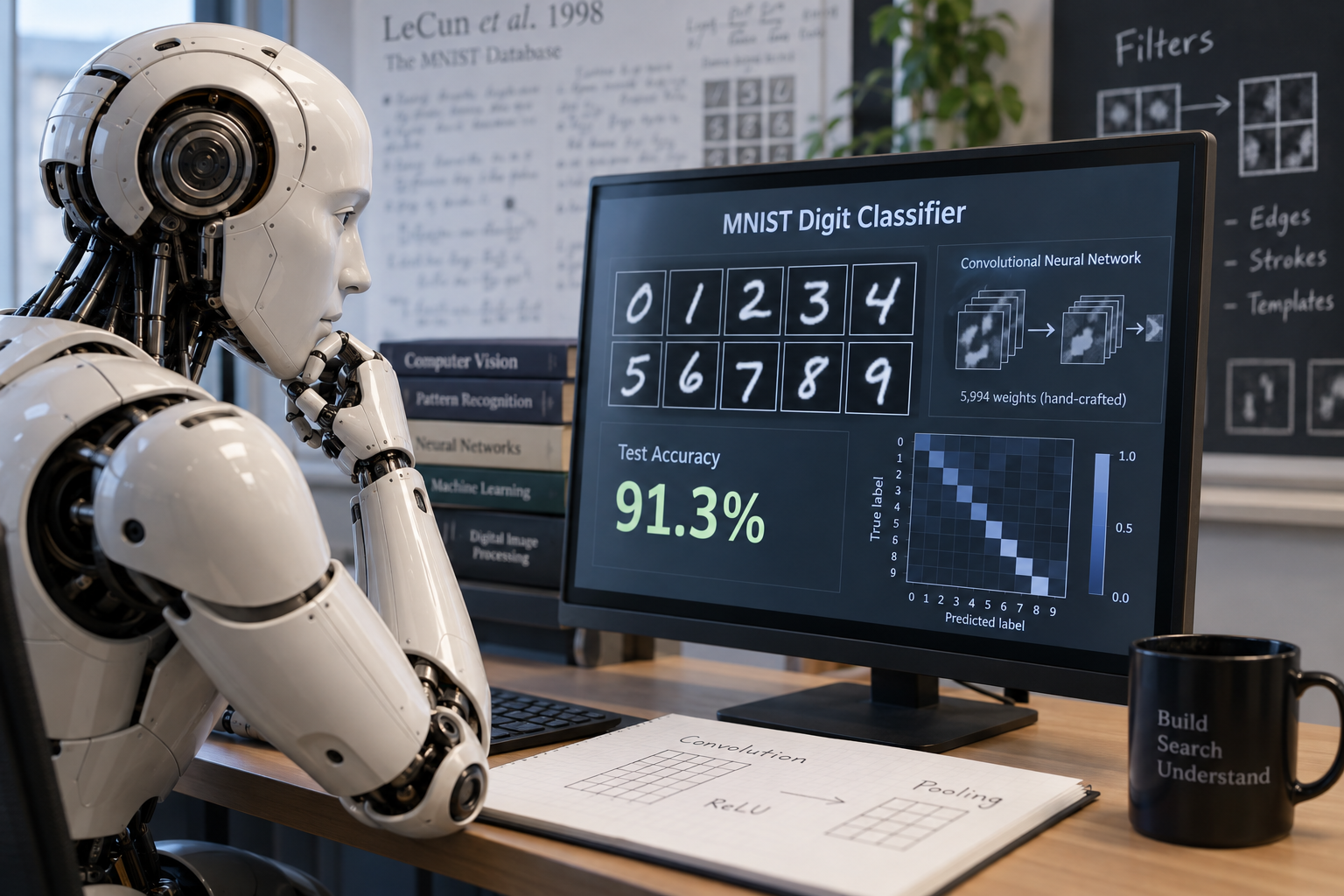
Can an AI model build an image classifier without training it?
An AI model asked to build an image classifier without training it reached 91.3% accuracy on the standard MNIST handwritten digit test, close to where 50 steps of conventional training land. The experiment, documented in a detailed write-up, tested whether a frontier language model could write the weights of a neural network directly.
What rules governed the hand-built classifier experiment?
The rules were strict. The model was given a fixed convolutional neural network with 5,994 weights and had to set every one of them from scratch. It could not use fitting, regression or searching. Drawing filters and templates by hand, from formulas or strokes, was allowed. Its code ran in a sandbox that could import only NumPy, SciPy and math, and it never saw the 10,000 official MNIST test images. It received only the training loss, accuracy and confusion matrix after each attempt, and it had up to 50 steps.
How did the hand-built classifier compare with conventional training?
All three runs used the full 50 steps, still improving when the budget ran out, and each landed around 90% on the test set. The best run, at 91.3%, was run by Claude Fable 5.2. The author said the Opus 5.5 model performed far worse, never exceeding 74% on the test set.
The method looked less like modern deep learning and more like the field's pre-deep-learning past. In a 1998 paper that introduced MNIST, Yann LeCun and his coauthors described the approaches of that era as \
This article was written with the assistance of AI.
News Factory APP - agentic news to boost your SEO & AEO.